According to Coda Labs, blockchain games do not appeal to ordinary gamers

According to Coda Labs, blockchain games do not appeal to ordinary gamers

user avatar

by dapp_writer005

4 years ago


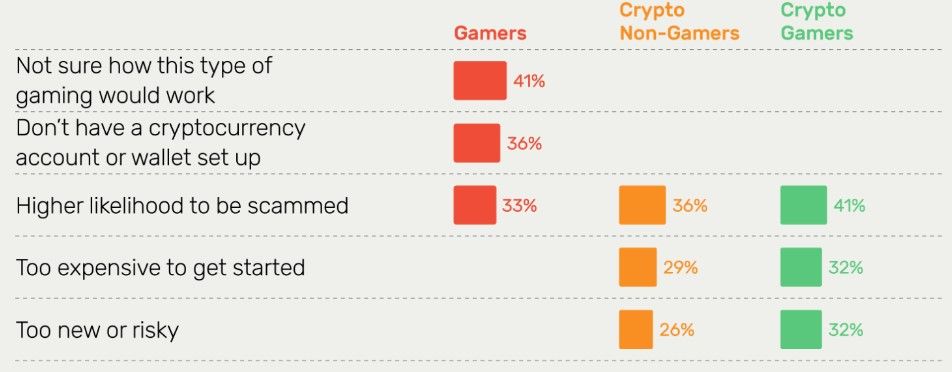
Coda Labs, a company that provides services to run blockchain games, noted that even a huge investment in the industry does not help to bring Web3 applications to the level of acceptance by ordinary players.

This opinion is based on a survey of more than 6,500 people from different countries. Regular gamers bypass blockchain games, as well as the use of NFTs. This is due, first of all, to a lack of understanding of the Web3 industry, as well as an unwillingness to store funds in cryptocurrency wallets.

12% of respondents have tried blockchain games, but do not understand their essence yet. Another 15% said they were interested in such projects and plan to join them.
According to Coda Labs, blockchain games do not appeal to ordinary gamers - news

The most recognizable term among casual gamers - the Play-to-Earn (P2E) mechanism. It is this system of earning that often attracts new users.

Despite the fact that gamers avoid blockchain applications, they appreciate such projects. People with no experience have given NFT games a score of 7.1 out of 10.

The Web3 gaming industry is evolving rapidly and offering new opportunities. For example, the blockchain company Zilliqa has announced the launch of its Web3-based console. Players will be able to play games and mine tokens at the same time.

Tier I

Sector: #18291

Sealed Hiding Place Room

Resource Cache

Resource Cache

Tier I

Requires 25% Tier Progress to Claim
Meme Cache

Meme Cache

Tier I

Requires 50% Tier Progress to Claim
Equipment Cache

Equipment Cache

Tier I

Requires 75% Tier Progress to Claim

After collecting, hiding places will be stored in your inventory and can be opened with Keys.

Other articles

Comparing Web Research Tools Fairly

A fair comparison of web research tools needs one fixed task set, a scoring sheet written before any run, and a dated record of what each tool offered.

user avatarme1afon

Keeping Time and Versions in Web Research

A web page has a date, a version and a saved copy: three different things. What to record for each, what "last updated" proves, and a six-field source note.

user avatarme1afon

What AI Page Readers Leave Behind

When an AI tool reads a complex web page, it rarely reads the page you see. Five places where content gets lost, and a receipt that shows what was read.

user avatarme1afon

Finding a Page Is Not the Same as Reading It

A search result is a pointer, not evidence. Four checks that separate a found page from a read one, with Google, Anthropic and OpenAI docs and an example.

user avatarme1afon

When a Player Question Needs an Update Instead of a New Article

A new reader question arrives and an article already exists. Publish a second page or update the first? Four questions decide it, and how to keep it honest.

user avatarme1afon

A Hundred Questions Are Not a Demand Estimate

Collecting a hundred real player questions feels like measuring demand. It is not. What a found list can honestly show, and five steps to a defensible estimate.

user avatarme1afon

Important disclaimer: The information presented on the Dapp.Expert portal is intended solely for informational purposes and does not constitute an investment recommendation or a guide to action in the field of cryptocurrencies. The Dapp.Expert team is not responsible for any potential losses or missed profits associated with the use of materials published on the site. Before making investment decisions in cryptocurrencies, we recommend consulting a qualified financial advisor.