
• Dapps:16.23K
  • Blockchains:78
  • Active users:66.47M
  • 30d volume:$303.26B
  • 30d transactions:$879.24M
The Basel Committee released initial guidelines for disclosing crypto asset data

The Basel Committee released initial guidelines for disclosing crypto asset data

user avatar

by Max Nevskyi

2 years ago


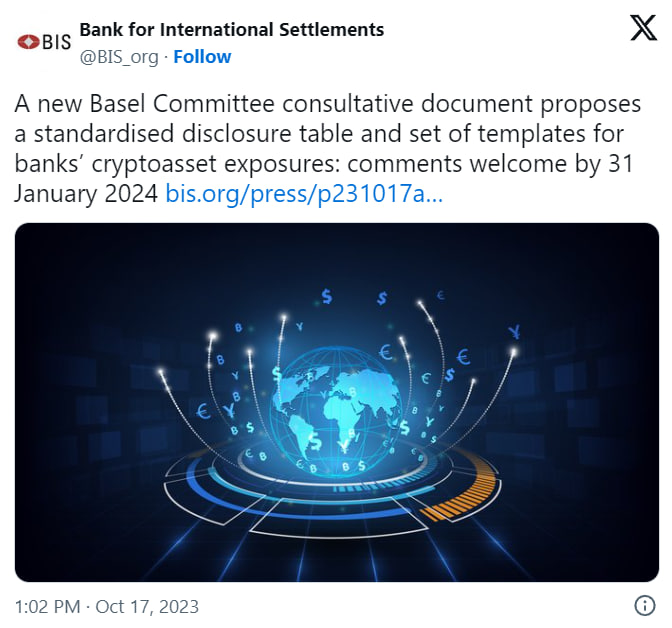
On October 18, the Basel Committee on Banking Supervision (BCBS), a global gathering of banking regulators, issued initial guidelines for integrating traditional finance and digital assets. These guidelines require major banks to disclose their cryptocurrency involvement by 2025.

The BCBS believes that standardized disclosure formats will promote consistent information sharing among banks. This will not only benefit the banks but also enhance transparency for individuals in the financial market, providing a clearer understanding of financial institutions' participation in the cryptocurrency sector.
The Basel Committee released initial guidelines for disclosing crypto asset data - news

These guidelines require banks to disclose both qualitative and quantitative information regarding their cryptocurrency activities, including exposure to digital assets and associated capital and liquidity requirements.

Additionally, the guidelines stress the importance of banks clarifying their accounting principles for crypto assets and liabilities to create consistency in a sector with varying accounting practices.

Despite being labeled as "recommendations," BCBS guidelines historically hold significant influence, often integrated into local regulatory frameworks by nations affiliated with the Bank for International Settlements.

The Basel Committee's involvement in cryptocurrency regulation is not new. In December 2022, they established rules for banks' capital reserves related to various crypto assets, recommending that banks limit their engagement with certain crypto categories to one percent and not exceed two percent.

Stakeholder feedback on this proposal is welcomed by the BCBS until January 31, 2024, with the guidelines set to potentially take effect on January 1, 2025, shaping the global financial landscape.

0

Rewards

chest
chest
chest
chest

More rewards

Discover enhanced rewards on our social media.

chest

Other news

15 Key Strategies for Effective Risk Management Using Derivatives

chest

A recent report has unveiled a Power List of 15 effective strategies for utilizing derivatives to enhance risk management.

user avatarArif Mukhtar

SOPH Trading Dynamics and Key Levels

chest

SOPH's trading dynamics reveal key support and resistance levels, with potential bullish and bearish scenarios depending on volume.

user avatarSon Min-ho

BlockDAG Faces Unique Challenges Ahead of TGE on February 11

chest

BlockDAG faces unique challenges in managing the claiming process for BDAG tokens ahead of TGE on February 11, 2026, to avoid network congestion and ensure user satisfaction.

user avatarDavid Robinson

SOPH Price Shows Recovery After Significant Volatility

chest

SOPH has shown a recovery in price after hitting a low of 000979, trading at 001257 with a 104% gain in 24 hours.

user avatarNguyen Van Long

Stay Vigilant: Security Risks During BlockDAG's TGE

chest

As BlockDAG approaches its Token Generation Event (TGE) on February 11, 2026, users are warned about potential security risks, particularly from scams during this period.

user avatarZainab Kamara

BlockDAG Set for Token Generation Event on February 11, 2026

chest

BlockDAG is preparing for its Token Generation Event (TGE) on February 11, 2026, marking a crucial transition from preparation to execution.

user avatarAyman Ben Youssef

Important disclaimer: The information presented on the Dapp.Expert portal is intended solely for informational purposes and does not constitute an investment recommendation or a guide to action in the field of cryptocurrencies. The Dapp.Expert team is not responsible for any potential losses or missed profits associated with the use of materials published on the site. Before making investment decisions in cryptocurrencies, we recommend consulting a qualified financial advisor.




