

In the era of rapid technological advancement, precise positioning plays a key role in various industries, from autonomous driving to agriculture. Traditional Global Navigation Satellite Systems (GNSS), such as GPS, have limited accuracy, creating a need for more advanced solutions. The GEODNET project offers an innovative approach to high-precision positioning by integrating blockchain technology and decentralized physical infrastructure.
Contents:
- Project History and Mission
- GEODNET Architecture and Operating Principles
- Applications and Network Benefits
- Tokenomics and Economic Model
- Future Plans and Development Prospects
- Conclusion
Project History and Mission
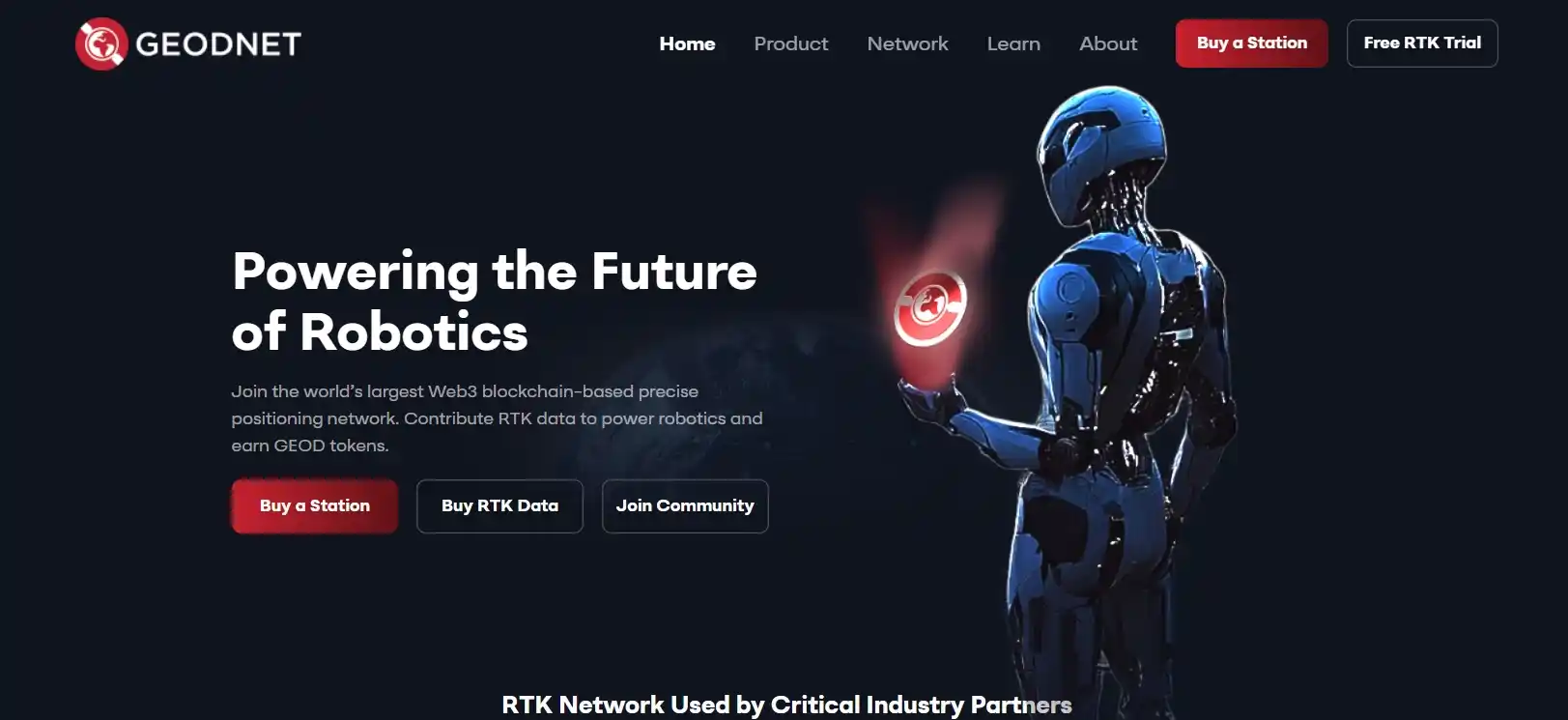
The GEODNET (Global Earth Observation Decentralized Network) project was founded in 2021 by Mike Horton, an expert with over 25 years of experience in GNSS and RTK technologies. The idea behind GEODNET arose from the need to provide global access to high-precision positioning data for various applications. Traditional centralized GNSS networks face limited coverage and high infrastructure costs, making scalability challenging. GEODNET's mission is to create a decentralized network that delivers high-precision positioning data using the principles of Decentralized Physical Infrastructure (DePIN) and blockchain technology.
GEODNET Architecture and Operating Principles
GEODNET is a decentralized network consisting of numerous base stations known as satellite miners. These stations are installed by users on rooftops and function as permanent GNSS reference stations. They receive signals from GNSS satellites and transmit real-time correction data to devices equipped with GNSS receivers, ensuring positioning accuracy of up to 1 centimeter. Network participants receive rewards in GEOD tokens for providing correction data, incentivizing network expansion and improved coverage.
Applications and Network Benefits
High-precision positioning plays a crucial role in modern technologies, ensuring accuracy and reliability across various industries. The GEODNET project provides a decentralized Real-Time Kinematics (RTK) network, delivering centimeter-level positioning accuracy for a wide range of applications.
Key application areas of GEODNET:
- Autonomous Vehicles: Ensuring safe and accurate navigation for self-driving cars.
- Agriculture: Automating processes such as machinery control and crop monitoring.
- Drones and Robotics: Precise control and navigation for unmanned aerial vehicles and robots.
- Construction and Geodesy: Providing accurate measurements and control on construction sites.
The advantages of using the GEODNET network include a decentralized structure that reduces infrastructure costs and the use of blockchain technology for transparency and data security. Additionally, the network's global coverage ensures access to high-precision positioning data in various regions, expanding the technology's application possibilities.
Tokenomics and Economic Model
The GEODNET economic model is based on the use of the GEOD token, which serves key functions in the project ecosystem. The GEOD token acts as an incentive for network participants, providing rewards for data provision and infrastructure support. This model aims for sustainable growth and network expansion while ensuring transparency and transaction security.
Key aspects of GEODNET tokenomics:
| Aspect | Description |
|---|---|
| Token Distribution | GEOD tokens are distributed among network participants, including miners, investors, and the development team, to incentivize their contributions to network growth and maintenance. |
| Reward Mechanism | Miners receive GEOD tokens for providing high-quality data and supporting the network infrastructure, promoting its stability and expansion. |
| Token Usage | GEOD tokens are used to pay for services within the network, participate in governance votes, and serve as rewards for contributions to the ecosystem's development. |
| Token Burning Mechanisms | To maintain token value and prevent inflation, a portion of tokens may be periodically burned, reducing overall supply and increasing the value of remaining tokens. |
This tokenomics structure balances supply and demand for GEOD tokens, encouraging active participation in network development. Transparency and decentralized governance foster trust in the project and its sustainable long-term growth.
Future Plans and Development Prospects
GEODNET is actively working on expanding its network to achieve global coverage and provide access to high-precision positioning data. The project's plans include increasing the number of base stations, improving services, and integrating into new fields such as robotics, drones, and mobile applications. The decentralized architecture and use of advanced technologies ensure the network's stability and scalability. This makes GEODNET a promising player in the precise positioning industry, poised to take a leading role in the coming years, pushing the boundaries of what is possible.
Conclusion
The GEODNET project represents an innovative solution in high-precision positioning by integrating blockchain technology and decentralized physical infrastructure. With a network of satellite miners providing centimeter-level GNSS data accuracy, GEODNET is finding applications in autonomous transport, agriculture, construction, and other industries. The economic model, based on the GEOD token, encourages participants to develop the network. In the future, the project aims to expand its infrastructure and introduce new services, making it a promising player in this field.











