

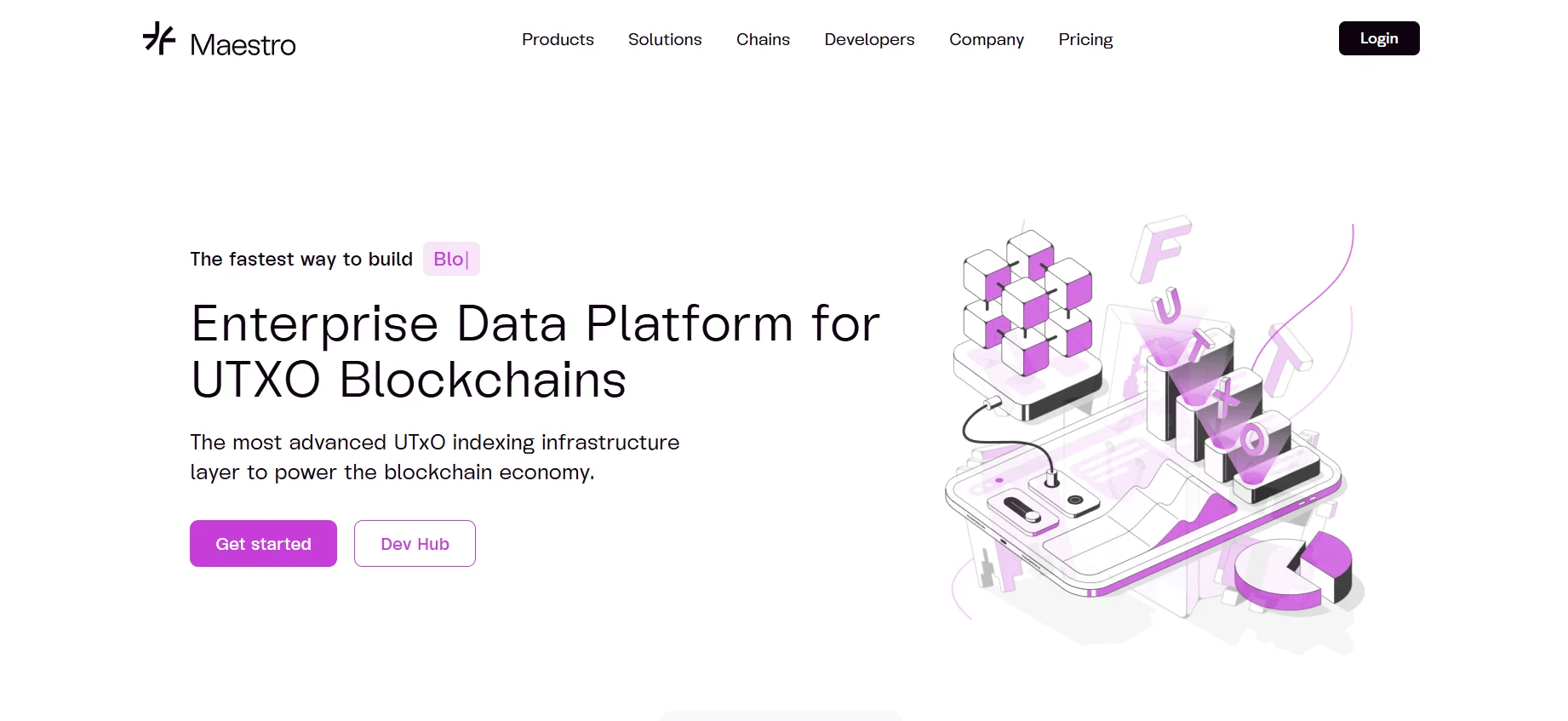
Maestro — is an innovative blockchain platform providing developers with powerful tools to build decentralized applications based on the UTxO model. Supporting networks like Bitcoin, Cardano, and Dogecoin, the project addresses key issues in interacting with UTxO blockchains: from data indexing to transaction and smart contract management. Thanks to investments, technical documentation, and partnerships, Maestro is building a strong foundation for the next generation of DeFi solutions.
Contents
- Maestro: Mission and Goals
- Technical Architecture and Supported Blockchains
- Key Products and Tools
- Ecosystem, Partnerships, and Project Growth
- Conclusion
Maestro: Mission and Goals
Maestro — is the first platform of its kind focused on providing infrastructure for DeFi applications on UTxO blockchains. Its mission is to accelerate the transition to a Bitcoin-based economy by providing developers with powerful tools and APIs for creating next-generation financial applications. The platform aims to eliminate existing barriers in UTxO blockchain development by offering solutions that simplify and speed up the process of building dApps, while ensuring high reliability and scalability.
Technical Architecture and Supported Blockchains
Maestro supports several UTxO blockchains, including Bitcoin, Cardano, Dogecoin, and Arch Network. The platform provides developers with access to high-performance APIs that allow efficient interaction with blockchain data, transaction management, and real-time event tracking. Thanks to its architecture, Maestro ensures low latency and high reliability, which is crucial for real-time financial applications.
Maestro's architecture is built on a modular approach: each platform component — whether it's the indexer, RPC interface, or event handler — can scale independently. This makes the system flexible for projects of any scale, from small dApps to large DeFi platforms. Additionally, Maestro implements an event-handling mechanism that simplifies integration with external services and gives developers more control over application logic. Support for various blockchains is facilitated through adaptable interfaces, allowing new networks to be quickly integrated without changing the core platform.
Key Products and Tools
Maestro offers a comprehensive set of tools for developers, simplifying work with UTxO blockchains. These solutions enable faster deployment of dApp projects, minimize infrastructure costs, and scale applications in real time. The products cover all key aspects of blockchain interaction — from data access to transaction and contract management.
| Product | Purpose |
|---|---|
| Blockchain Indexer | Fast access to UTxO data and blockchain history without the need for a full node |
| Node RPC | Perform network queries and send transactions via remote RPC interfaces |
| Mempool Monitoring | Monitor unconfirmed transactions for early response |
| Event Manager | Track and generate events based on network actions |
| Transaction Manager | Manage the lifecycle of transactions, including retries and confirmation |
| Market Price Feeds | Cryptocurrency price data in real-time for calculations and analytics |
| Wallet Manager | Tools for generating and managing addresses and keys |
| Managed Smart Contracts | Ready-made contract templates abstracted from low-level code |
Thanks to these products, developers can focus on application logic without spending time setting up and maintaining the underlying infrastructure. Maestro turns complex processes of interacting with UTxO blockchains into accessible services, ready for immediate use in both commercial and experimental projects.
Ecosystem, Partnerships, and Project Growth
Maestro is actively developing its ecosystem by forming strategic partnerships and attracting investments to scale its infrastructure. One of the key technological alliances is with Arch Network — a blockchain that ensures bridge-free programmability for Bitcoin. This partnership allows Maestro to implement decentralized applications directly into the Bitcoin network without the need for external bridges, significantly enhancing DeFi functionality in this ecosystem.
The platform is also actively collaborating with the Astarter project — a multi-functional DeFi hub built on Cardano, offering services such as Launchpad, Launchpool, and decentralized exchange. Supporting such projects demonstrates the flexibility and cross-network compatibility of Maestro's solutions, opening up opportunities for integration in various blockchain environments.
A significant milestone was the completion of a seed funding round in February 2025, which raised $3 million for the project. These funds are being directed towards expanding the team, developing API infrastructure, and implementing new technical solutions for developers. Among the investors are renowned venture funds specializing in blockchain innovations and infrastructure startups, further validating Maestro’s technological potential.
Conclusion
Maestro represents a powerful platform for developing and managing DeFi applications on UTxO blockchains. By providing developers with tools and services that simplify interaction with blockchains, Maestro accelerates innovation in decentralized finance. With the ongoing development of its ecosystem and the attraction of investments, the project has all the potential to become a key player in blockchain infrastructure.











