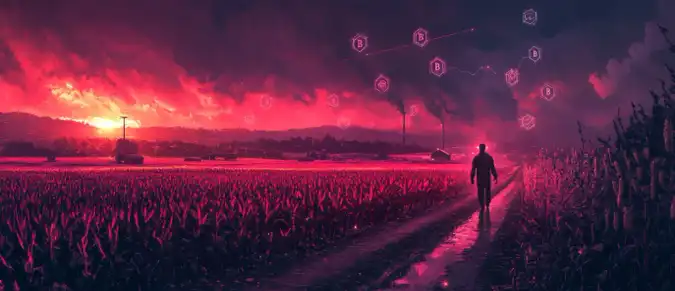

Sunflower Land — a cryptocurrency farming simulator game on the Polygon blockchain. The project combines traditional gaming mechanics with non-fungible token (NFT) technology, allowing users to grow crops, harvest resources, and own digital assets. Unlike traditional farming games, Sunflower Land offers an economy based on the real value of in-game items and tokens. Players can earn, trade, and interact with the community while developing their own farm in the metaverse. The developers actively support the project, introducing new features, quests, and integrations with other blockchains. Participation in the game process requires strategic thinking and efficient resource management.
- Overview of Sunflower Land
- Gameplay and Mechanics of Sunflower Land
- Economy and the $FLOWER Token
- NFTs and Digital Assets in Sunflower Land
- Conclusion

Overview of Sunflower Land
Sunflower Land is a Web3 game on the Polygon blockchain, combining farming strategy with elements of decentralized economy. The project was created by Thought Farm studio in 2022 and was initially designed as an open-source game in which players could participate in its development. At the core of the gameplay is farm management, resource gathering, and crafting items, with all objects represented as NFTs and the in-game currency issued in the form of ERC-20 tokens.
Players earn digital assets that they can use, sell, or exchange. Thanks to the use of the Polygon blockchain, transactions happen quickly and with low fees. Later, the game expanded its integration with Ronin and Base networks, opening up the ability for users to transfer assets across ecosystems.
An important element of Sunflower Land is its active community: gamers participate in votes, propose improvements, and influence the future of the game. The visual style of the project is done in pixel retro graphics, giving it a unique charm and making the game easily recognizable. The achievement and collection system enhances engagement and encourages long-term play.
Gameplay and Mechanics of Sunflower Land
Sunflower Land offers a well-thought-out gameplay experience that combines farming activities, resource management, and an in-game economy. Every action requires planning: the limited land, resources, and growth time for crops create the need for a strategic approach. The game is based on a cyclical process, where players return to their farms to harvest crops, gather resources, and take on new quests. Over time, new islands, NPCs, and infrastructure improvement opportunities open up.
The main mechanics include:
- Crop cultivation: from sunflowers to rare vegetables, each type provides different profits and requires specific growth times.
- Resource gathering: wood, stone, iron, and gold are used for crafting and building.
- Animal husbandry: players breed animals to obtain eggs, milk, wool, and other materials.
- Item crafting: crafting furniture, tools, and unique decorations.
- Seasons and events: periodic updates with new quests and rewards.
Successful farm development requires balancing all the mechanics. For example, without resources for crafting, it's impossible to expand production, and without crops, it’s not possible to earn tokens. It’s important to allocate time wisely, monitor crop growth, and not forget about events and quests that offer rare rewards. As the farm levels up, players gain access to new recipes, upgrades, and bonuses, unlocking more complex economic chains. All of this makes the gameplay engaging and deeply developed.
Economy and the $FLOWER Token
The economy of Sunflower Land is built around the $FLOWER token, which serves as the foundation for all financial transactions in the game. It replaced $SFL and became multi-chain, available on Polygon, Ronin, and Base. The main goal of this replacement is to ensure economic stability, limit inflation, and make the system more stable for long-term player participation. All in-game actions, whether purchasing VIP access, participating in auctions, or crafting special items, are carried out using $FLOWER.
| Parameter | Value |
|---|---|
| Token | $FLOWER |
| Standard | ERC-20 |
| Blockchain | Polygon (support for Ronin and Base) |
| Usage | Purchases, crafting, auctions, subscriptions |
| Availability | In-game, via bridge or DEX |
| Emission Limit | Yes, fixed supply |
With the $FLOWER token, players can not only interact with the game’s economy but also participate in the development of the project. Additionally, some in-game NFTs can only be purchased with $FLOWER, giving it additional significance within the ecosystem. The in-game currency has real value, and its distribution is aimed at encouraging active participation. Smart tokenomics ensures the balance between earning and progress, making the economic model sustainable even as the number of players grows.
NFTs and Digital Assets in Sunflower Land
A central concept in Sunflower Land is the ownership of digital objects in the form of NFTs. Every item created or acquired by the player is a unique token on the Polygon network. These could be crops, tools, decorations, animals, or even entire islands. Such assets can be stored in a wallet, exchanged, sold on marketplaces, or used to upgrade the farm. NFTs in Sunflower Land have functional value: they can provide bonuses to crop yield, speed up production, or unlock new opportunities.
The collectible aspect of the project is actively supported by the developers through limited edition items, seasonal events, and auctions. Unique NFTs created during specific periods become unavailable later, increasing their value. Some items are linked to achievements or rare resources, and to obtain them, players must participate in quests or meet certain conditions. NFTs can also be used as a prerequisite for access to exclusive locations or modes. This makes digital assets an integral part of the game’s progression and strengthens the sense of true ownership.
Conclusion
Sunflower Land is an example of how Web3 and blockchain can transform the familiar farming simulator genre. The game offers not only an engaging gameplay experience but also real economic opportunities through the ownership of digital assets. Thanks to its multi-chain architecture, active community, and stable tokenomics, the project continues to evolve and attract new participants. The diversity of mechanics makes it interesting for both beginners and experienced users. Participation in the game becomes not just entertainment but part of an economic model where players directly influence the development of the virtual world.











