

A member of the Lido team asserted that Rocket Pool's governance is not truly controlled by its decentralized autonomous organization (DAO). However, members of the Rocket Pool community countered this statement, asserting that the protocol is steadily moving towards a greater degree of decentralization.
In a social media post on July 4th, a representative from Lido criticized Rocket Pool, their competitor, for exhibiting excessive centralization. Lido and Rocket Pool are both platforms for liquid staking, enabling users to delegate their cryptocurrency to validators and receive derivative tokens in return.
As per the statement made by Dmitry Gusakov, the community staking lead at Lido, the contracts of Rocket Pool are under the control of the Rocket Pool team. This grants the team the ability to modify various parameters and execute any method. Consequently, the developers of Rocket Pool possess the authority to escalate the inflation rate to an unlimited percentage or raise fees to a maximum of 100%.
Gusakov asserted that Lido's contracts do not possess such vulnerability, as the actions mentioned are "completely governed by LidoDAO," the decentralized autonomous organization associated with Lido.
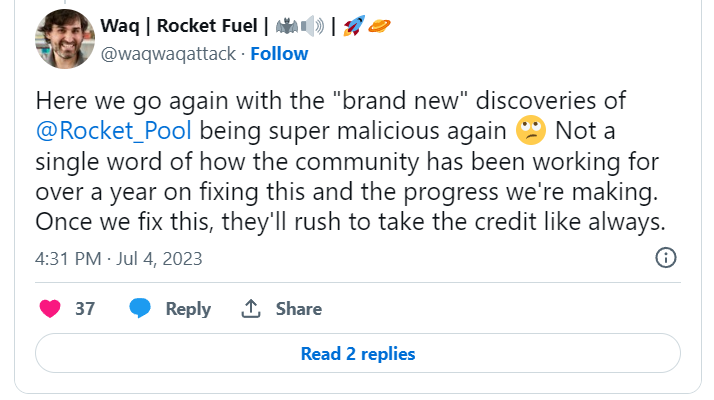
In response to the accusation, Waq, a member of the management committee at Rocket Pool, acknowledged the existence of the vulnerability and assured that it is already known to the team. Furthermore, Waq accused the Lido team of attempting to claim credit for identifying an issue that was already recognized within the Rocket Pool community.
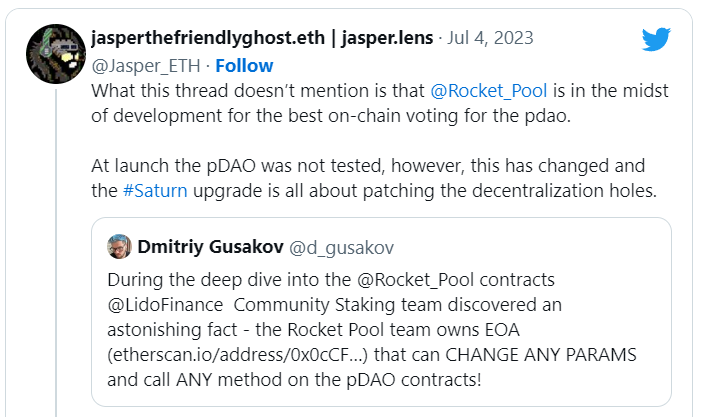
As stated in Gusakov's post, the Ethereum address 0x1d8f8f00cfa6758d7bE78336684788Fb0ee0Fa46 houses the RocketStorage contract, which includes a specific parameter known as "guardian." Additionally, numerous functions within the Rocket Pool contracts are designated as "onlyGuardian," indicating that they can solely be invoked by the account specified in this parameter. Presently, the RocketPool deployer account, registered at 0x0cCF14983364A7735d369879603930Afe10df21e, is assigned as the guardian account.
The "guardian" role enables certain actions such as modifying the "RPL InflationIntervalRate" and the "ETH DepositFee," which implies that the team has the ability to increase the inflation rate of the Rocket Pool governance token (RPL) or potentially eliminate users' deposits by setting the fee to 100%, as highlighted by Gusakov.
Sharing the post, content creator Chris Blec asserted that this evidence demonstrates that the "pDAO is not a DAO" or that RPL tokenholders do not possess actual control over Rocket Pool's governance.
Jasper.lens, a community advocate for Rocket Pool, responded by acknowledging that the centralization issue had been identified by the community. They reassured that the upcoming Saturn upgrade will address and resolve this concern. Jasper explained that the centralization occurred during the developmental phase of Rocket Pool's DAO voting systems, where on-chain voting was not initially implemented for testing purposes. However, after completing the testing phase, the team has focused on rectifying these centralization gaps through the forthcoming Saturn upgrade.
Adding to Jasper.lens' comment, Waq concurred and mentioned that the Rocket Pool community has been diligently working for over a year to address and resolve this matter. Additionally, Waq predicted that once the problem is fixed, the Lido team would swiftly attempt to claim credit, as they have done in the past.
The popularity of liquid staking protocols has experienced significant growth in recent months. According to DefiLlama, a blockchain analytics platform, these protocols have surpassed decentralized exchanges and emerged as the leading category in decentralized finance in terms of total value locked as of May 1. Furthermore, on May 30, Tenet announced a partnership with LayerZero to expand the implementation of liquid staking across additional blockchains in the coming future.











