



Token swaps on Becoswap — an easy way to exchange one BEP-20 token for another through automated liquidity pools.
Contents:
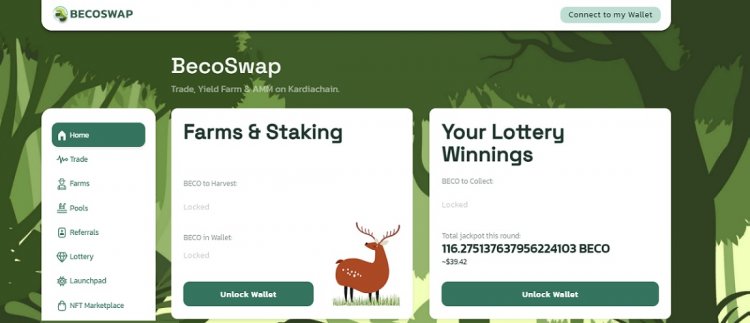
About the BecoSwap project
When you make a token exchange (trade) on the exchanger, you pay a trading fee of 0.3 percent, which comes back to the liquidity pools as a reward to the liquidity providers. Becoswap pools allow you to provide liquidity by adding your tokens to liquidity pools. When you add your token to the liquidity pool, you receive liquidity pool (LP) tokens. For example, if you put BECO and BNB in the liquidity pool, you will receive BECO-BNB LP tokens. The number of LP tokens you receive represents your share of the BECO-BNB liquidity pool. You can also redeem your funds at any time.
The ticket gives them the right to participate in the lottery. If, after the drawing of the winning numbers, your ticket numbers match the drawn numbers, you will win BECO tokens!
Other features of the lottery:
| 1 | Cost of 1 lottery ticket: 1 BECO |
| 2 | Only 50 tickets can be purchased at a time through the user interface. |
| 3 | When paying for one ticket, users receive a random combination of 4 digits, each of which ranges from 1 to 14, for example "1-9-3-2". |
To win the lottery jackpot (50 percent of the total lottery pool), users need to match all 4 numbers on their ticket in the same order as the 4 winning numbers. If all 4 don't work for you, there is nothing to worry about. If you match 2 or more numbers in the correct order, you are guaranteed to win a prize. BecoChain is a blockchain software system, developed by Beco Swap and its community. Beco Chain scales up to 5,000 transactions per second per segment to make applications faster and cheaper to use.
What else should you know?
There is an introductory document on the site. With its help, you can study the features of the project in more detail. Also, the developers maintain a blog, where news articles are available.
From social networks, the community leads:
- twitter;
- telegram.
Subscribe to follow the latest news. Smart contract audit is presented here.