



Orbit Bridge has worked to overcome the ubiquitous scalability and connectivity limitations that have limited traditional public networks. Improvements and innovations increase accessibility and user experience, so blockchain-based protocols and services can be more integrated into real life.
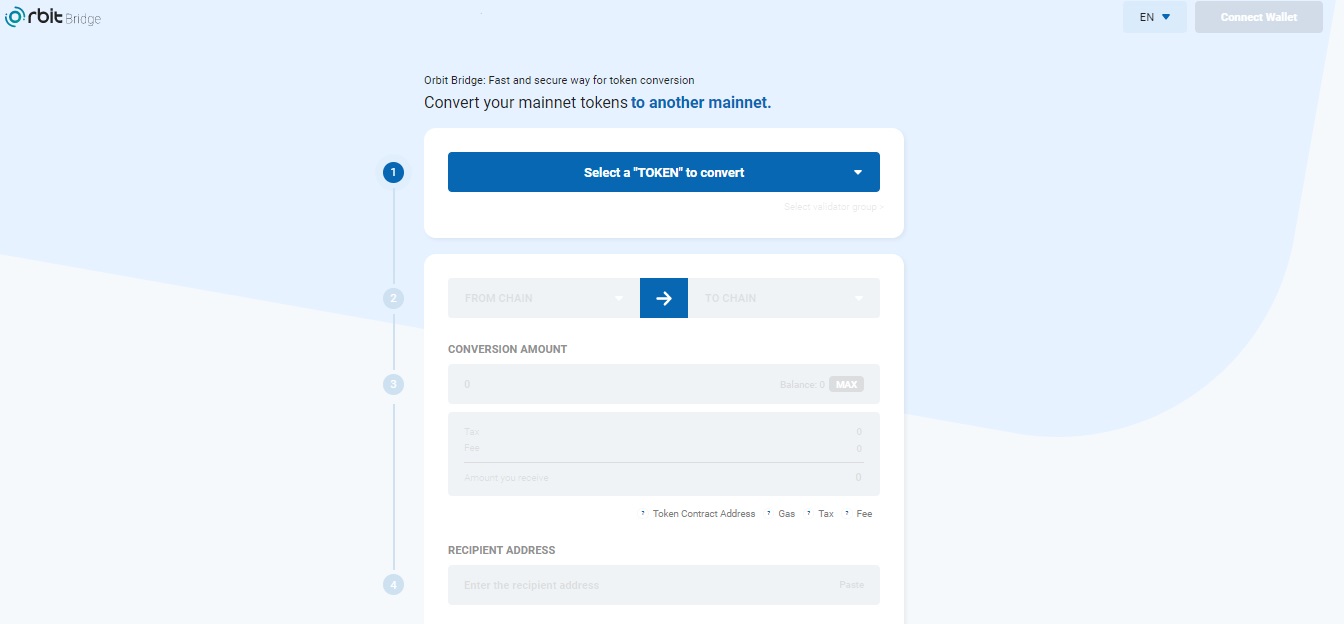
Description of the Orbit Bridge project
Orbit Bridge — an intermediate service that supports token conversion between main chains and supports 15 blockchains and 58 tokens. One of the main keywords in the current crypto market - cross chain. Orbit Bridge currently supports MetaMask, Kaikas, Klip and D'CENT. Each token supports different wallets, so please check FROM CHAIN after choosing a TOKEN to convert.
The transformation of all tokens occurs through a consensus of governance among the designated validators of each chain. Leading global blockchain infrastructure companies such as Everstake, DSRV, GBV and Cosmostation have participated in OrbitBridge as validators.
Main features:
| 1 | Sending cross-network data between heterogeneous chains. |
| 2 | Users can send assets or data to any chain, connected to OrbitBridge. |
| 3 | Robust, secure verification of multiple signatures. All consensus happens within the network, and all authority is decentralized throughout this process. |
Previously, with Orbit Pegging IBC, assets were integrated and used on the Orbit Chain through inter-blockchain communication, including the Orbit Chain. OrbitBridge IBC allows different blockchains to interact with each other, using the Orbit Chain. It was built by using BFT multi-signature consensus to establish a decentralized, trustless consensus process. This allows users to use different assets on different chains across all dApps through simple transactions on each chain.
How does the defi app work?
The Orbit Bridge system has management groups, consisting of roles: Operator and Validator. Bridge protocols use either the MPC-based transaction consensus method or the multi-signature-based transaction consensus method. Orbit Bridge uses multisig transaction consensus. Thanks to this, the Operator, who sends the data, and the Validator work together to process transactions efficiently and quickly. In addition, since the consensus and verification processes take place through transactions on the Orbit Chain, they are transparent and trustless. Validators use a separate private channel and blockchain without centralized control to complete their tasks.