



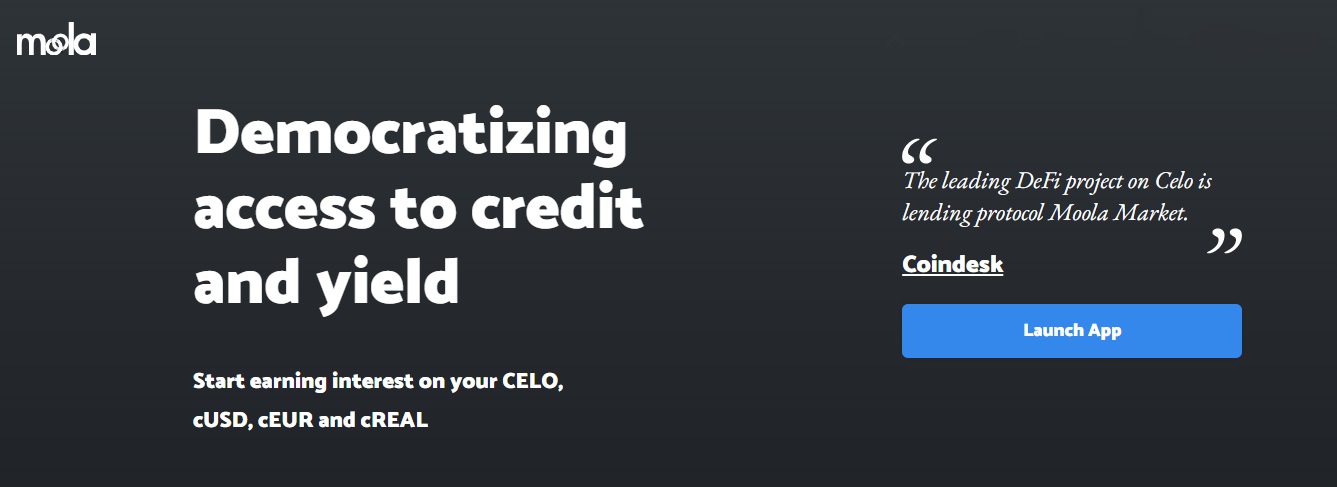
Moola Market — a non-custodial liquidity protocol, built on the Celo blockchain, that democratizes access to income and credit. Depositors actively earn income, which is paid for by borrowers, who can take out overcollateralized loans indefinitely or undersecured short-term loans. Moola shares a common ancestry with Aave v2.
About coin defi Moola Market
The Moola protocol has been independently reviewed since the open source was ported from Ethereum to Celo. The original Aave codebase has also been checked. Moola is open source, so anyone can check the codebase for themselves, as well as build apps that interact with Moola.
Usage features:
| 1 | To use Moola, you need to connect a supported wallet and initiate a deposit transaction. |
| 2 | After making a deposit, you will receive passive income. You can borrow against your deposited assets. |
| 3 | Any interest you earn as a saver offsets the portion of the interest you pay as a borrower. |
Moola does not charge any fees for deposits or withdrawals. All transactions on Moola, including deposit, withdrawal, borrowing and redemption, are subject to the Celo network transaction fee, which helps to secure the Celo network (currently ~$0.001 per transaction). Overcollateralized borrowers carry debt, compounded at either fixed or variable interest rates.
Moola tokens such as mcUSD, mcEUR, mcREAL and mCELO - transferable cERC20 tokens that represent rights to deposited assets plus accrued income. Each mToken costs exactly one token (for example, 1 mcUSD = 1 cUSD). When a user contributes tokens to Moola, they receive an equivalent amount of mTokens in return. mTokens can be exchanged for tokens at a 1:1 ratio at any time by sending a withdrawal transaction.
Are any risks there?
As with any new technology, not all risks can be eliminated. Some of the risks, associated with Moola, include smart contract risk (an unknown vulnerability in the code) and liquidation risk, associated with the collateral liquidation process. Steps, taken to mitigate these risks, include opening the codebase to the public, conducting a code audit and publishing an open source kill bot.