



Holdefi — an open source decentralized non-custodian money market protocol, where users can participate as savers or borrowers. Investors provide the market with liquidity to generate passive income, and anyone can borrow from this liquidity and repay it after a while. The borrower must add collateral before borrowing tokens. The value of the collateral must be greater than the value of the assets they want to borrow. This collateral is actually a guarantee that they will return the borrowed assets.
Contents:
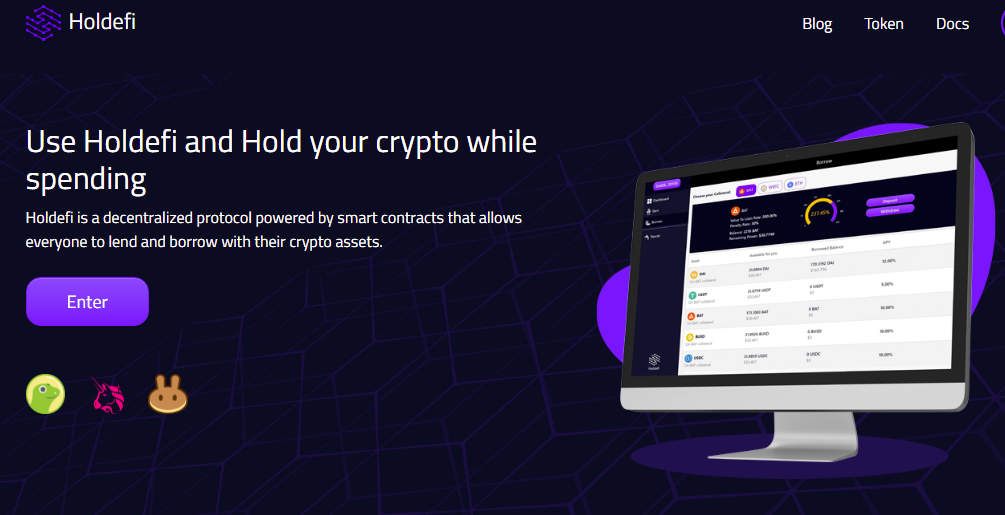
Description of the Holdefi
Holdefi — a lending platform where users can store their assets and receive interest or borrow tokens and return them after a while. There are two main roles: supplier and borrower.
In the beginning, the Holdefi mechanism determines and sets the interest rate. Then, every seven days, the administrator can increase it to a maximum of 5%. In addition, the Holdfi mechanism has a limit on the maximum interest rate on a loan - 30%. Interest rates fluctuate in real time, depending on the volume of the offer and the loan amount. When the offer exceeds the borrowed amount, the interest rate decreases, and when the borrowed amount exceeds the offered amount, the interest rate increases.
| Suppliers | Interest, received from borrowers, is distributed among suppliers in accordance with the amount, provided by them. Thus, the delivery rate will be automatically calculated, based on the total quantity in the protocol. |
| Borrowers | Borrowers must add collateral before borrowing any token. The value of the collateral must be greater than the value of the assets they want to borrow. This collateral is actually a guarantee that they will return the borrowed asset. |
If the user is not active for one year at one collateral, the user's collateral will be canceled. Administrators do not have access to users' funds, so this mechanism helps to prevent debt defaults for extended periods of time or events such as death or loss of a private key.
Additional data
Holdefi has a pool of liquidity to aggregate user supply. The provider can earn interest by supplying assets in the liquidity pool, and the borrower can borrow supported assets from the liquidity pool. Interest, received from borrowers, is distributed among suppliers in accordance with the amount, supplied by them. Thus, the feed rate is calculated automatically, based on the overall proposal in the protocol. The site has an introductory document and WhitePaper. You can study the platform in more detail this way.
From social networks, the community leads:
- twitter;
- telegram;
- discord.
Subscribe to stay up to date with all updates. Also, the community maintains a blog where news articles are published. Smart contract audit is available here.