



SnowSwap, based on the AMM model, allows users to get in and out of yVaults and other profitability tokens for just the cost of the swap fee.
Contents:
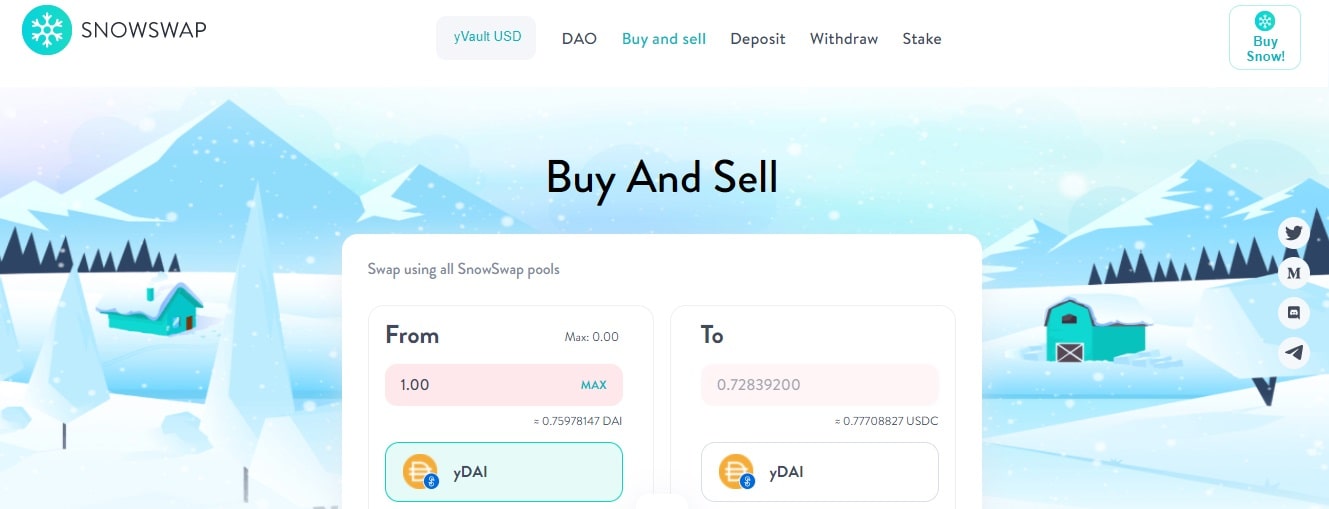
Description of the SnowSwap project
The SnowSwap developers have introduced a new pool, called eth2SNOW, designed to drive the adoption of Eth2. SnowSwap at eth2SNOW aims to create new markets and utilities through the ability to enter, exit and swap between popular eth2 with low slippage. This pool includes vETH2, aETH from ANKR, CRETH2 from CREAM, WETH.
eth2SNOW provides users with several key benefits:
| 1. | Allows users to enter and exit Eth2 staking services conveniently, using WETH. |
| 2. | Allows users to optimize for highest APY% with low slippage. |
| 3. | Facilitates the minimum ETH entry, required for AETH. |
| 4. | Liquidity providers gain access to the Eth2 rate and earn a portion of the swap fees. |
Overall, providing liquidity to Snow Swap pools provides an easier and more cost effective way to access a basket of profitable assets. When a user provides liquidity to the Snow Swap pool, they receive tokens ySNOW, ycrvSNOW, btcSNOW, eth2SNOW. Liquidity providers can place bets on these tokens to gain additional profitability in the form of SNOW management TOKEN, Snow Swap.
SNOW - a SnowSwap governance token that is distributed as part of a fair launch among LPs. Only 10% of SNOW will be distributed to the team and 80% will be distributed to LP.
Additional information
Snow Swap is already in operation and currently offers DeFi “farmers” a way to switch between different yTokens from the Yearn project quickly. Each step requires high gas charges potentially and users must pay high exit fees, which can be the equivalent of a monthly profit. There are ways to reduce steps and gas fees, such as enabling “wrapped” token escrow or using zap contracts, but these require DeFi expertise. With Snow Swap, users can simply trade between yUSDT and yUSD in one step with minimal gas fees and no exit fees, using a simple and intuitive interface.
There is no WhitePaper document on the site, but you can find all necessary information on the Medium blog. Articles are regularly published there.
From social networks, the community actively conducts:
Subscribe to stay updated on all news. The smart contract has not been audited.