The advent of Web3, the successor to the internet powered by blockchain technology, has redefined virtual interactions, particularly within finance. The concepts of blockchain and tokenization have long been celebrated as drivers of change, offering the potential to revolutionize sectors and reimagine our engagement with digital assets. Despite the excitement and in-depth conversations, many have questioned the tangible, real-world applications that can effectively exhibit the prowess of these innovations.
The realm of decentralized finance (DeFi) has emerged as a fertile ground for transformation, promising financial inclusivity and transparency. Yet, the journey towards broad acceptance has been laden with obstacles. Complex interfaces, high entry thresholds, and a lack of clear benefits for everyday users have hindered DeFi's ability to revamp conventional financial systems.
Enter the notion of on-chain loyalty – a fresh concept that melds blockchain's security and transparency with the established business strategy of customer retention. While the potential of tokenized loyalty programs has been a topic of discussion within crypto circles, the creation of a truly efficient, user-driven system has remained out of reach until now.
Amidst the technological ferment, a platform has surfaced with a solution that not only tackles real-world challenges but also showcases a compelling use case for tokenization that transcends mere theoretical deliberations. This platform is Zeebu, and its method of on-chain loyalty is proving to be a game-changer in propelling DeFi adoption.
Zeebu's unique approach lies in seamlessly integrating a tokenized loyalty program into a pragmatic solution for the telecommunications industry. By concentrating on a specific sector marked by distinct challenges, such as the necessity for more efficient, transparent, and gratifying payment systems, Zeebu has cultivated an ecosystem that highlights the true capabilities of blockchain technology in reshaping traditional business models.
Understanding On-Chain Loyalty
On-chain loyalty programs mark a significant advancement from traditional loyalty schemes. These programs leverage blockchain technology and cryptocurrencies to establish a more dynamic, adaptable, and valuable rewards system. Unlike conventional points-based systems, on-chain loyalty programs utilize tokens residing on a blockchain, ensuring transparency, security, and tangible value.
Core Features of On-Chain Loyalty:
- Blockchain-Based Tokens: Customers accumulate tokens with intrinsic value that can be traded or swapped instead of abstract points.
- Smart Contract Fusion: Rewards dissemination and redemption are overseen by smart contracts, guaranteeing impartiality and eliminating manual procedures.
- Real-Time Monitoring: All transactions and reward accruals are promptly recorded on the blockchain, providing immediate insight.
- Enhanced Security: The decentralized nature of blockchain technology renders these programs highly resilient to fraud and tampering.
Zeebu: Leading the Charge in Next-Generation Loyalty in Web3
Recognizing the transformative potential of on-chain loyalty, Zeebu has introduced a pioneering program tailored for the telecom industry. The ZBU Token transcends conventional rewards, striving to overhaul transaction and invoice settlements within the telecom landscape.
Zeebu's strategy stands out for several reasons:
- Industry-Specific Focus: By zeroing in on the telecom sector, Zeebu addresses precise pain points and delivers a bespoke solution.
- Dual-Purpose Tokens: ZBU Tokens serve as both loyalty rewards and settlement mediums, augmenting their usefulness and worth.
- Web3 Integration: The program is tailored to expedite the integration of Web3 technologies in the financial facets of the telecom sector.
- Ecosystem Cultivation: Zeebu is fostering a network effect by incentivizing telecom companies and their clientele to engage with the program.
- Concrete Advantages: Participants can earn a percentage of the invoice value in ZBU Tokens with every transaction, presenting immediate, quantifiable incentives.
ZBU Token Performance Overview
Zeebu unveiled its proprietary cryptocurrency, ZBU, in 2023 at an initial rate of approximately $0.80 amidst a notable market downturn. Despite significant volatility and bearish conditions, ZBU showcased resilience, surprising stakeholders with sustained growth. Since December, the ZBU token has maintained an upward trajectory, displaying robust growth.
At present, the ZBU token is valued at $4.65, denoting a 2% upswing in the last 24 hours. Its trading volume amounts to $22 million, with a market capitalization of $1.5 billion.
Historical Performance of ZBU Token
The upward trajectory of ZBU persisted until it reached a new peak of $4.89 in May 2024, preceding an accumulation phase poised for a potential peak. Early investors have experienced returns surpassing 500% within a brief period, underscoring the token's bullish fundamentals.
Zeebu's Distinctive Position in the Payment Domain
Setting itself apart from traditional payment platforms, Zeebu provides users with loyalty rewards for every successfully concluded transaction. The platform's analytics indicate that Zeebu has exceeded $2.5 billion in settlement volume and is approaching the $3 billion threshold, currently standing at $2.86 billion with 53,390 invoices settled.
Technical Analysis of ZBU: Identifying Bullish Trends in this Loyalty Token
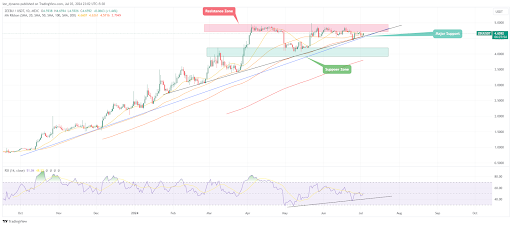
Source: Tradingview
On the daily price chart, Zeebu's ZBU token has exhibited a pattern of ascending highs and lows since December. This bullish price structure has attracted investors to ZBU, retaining their positions along the bullish trendline (highlighted in blue and black). Recently, the ZBU token price rebounded from the critical support trendline, signaling a potential continuation of the bullish trend surpassing the previous peak.
The key moving averages are positioned beneath ZBU's current price, indicating the conclusion of the accumulation phase. The 100-day moving average serves as a significant demand area for buyers.
Moreover, the Relative Strength Index (RSI) shows bullish divergence, with ascending lows evident on the chart. The RSI, presently at 51 and trending towards the bullish zone, suggests the potential for a fresh wave of buyers propelling the upcoming bullish phase towards higher levels like $6.5, $8.0, and $10.