When it comes to cryptocurrencies, grasping market dynamics is crucial for successful trading and investing. The Bitcoin Dominance Chart is a useful tool that offers insights into the market's behavior, aiding traders and investors in making well-informed decisions.
In this article, we will explore the significance of the Bitcoin Dominance Chart, how it is calculated, how to interpret it, and its implications for investing and trading.
Significance of the BTC Dominance Chart
The Bitcoin Dominance metric expresses the market capitalization of Bitcoin as a percentage of the total market value of cryptocurrencies. It acts as an indicator of how investors perceive Bitcoin in relation to other cryptocurrencies, serving as a valuable tool for traders and investors to gauge the market's condition and Bitcoin's influence on it.
For instance, if Bitcoin's dominance is 60% at a given point, it means that 60% of the current cryptocurrency market is attributed to Bitcoin transactions.
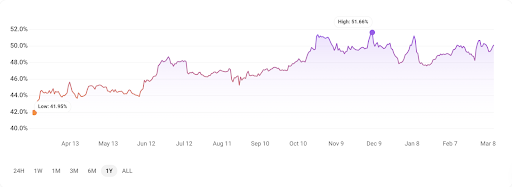 Bitcoin Dominance Percentage Trends: A Year in Review from April Last Year to March This Year, Highlighting a Low of 41.95% and a Peak at 51.66%
Calculating Bitcoin Dominance
Calculating Bitcoin Dominance is a simple process that involves dividing Bitcoin's market capitalization by the total market capitalization of all cryptocurrencies. The formula is as follows:
BTC Dominance (%) = (Bitcoin Market Cap / Total Cryptocurrency Market Cap) * 100
Market capitalization is determined by multiplying a cryptocurrency's current price by its circulating supply, offering a snapshot of the market's perception of each cryptocurrency's value.
Factors Affecting Bitcoin Dominance
Various factors can influence Bitcoin's market dominance at any given time, reflecting the market's perception of Bitcoin's position among cryptocurrencies. Understanding these factors is essential for traders, analysts, and investors seeking to comprehend the cryptocurrency market's intricacies.
Market Sentiment
Market sentiment plays a significant role in driving Bitcoin Dominance. In times of market volatility or uncertainty, investors often turn to Bitcoin as a safe-haven investment, leading to an increase in Bitcoin's market cap relative to the overall market cap.
Conversely, during optimistic periods with strong risk appetite, traders may explore alternative cryptocurrencies (altcoins), reducing Bitcoin Dominance as funds flow into a wider range of assets.
Technological Developments
Technological advancements within the cryptocurrency ecosystem can impact Bitcoin Dominance. Introduction of new blockchain technology, consensus mechanisms, or advanced features in altcoins may diminish Bitcoin's prominence.
For example, the emergence of smart contract platforms like Ethereum provided features beyond Bitcoin's capabilities, potentially influencing investor interest and Bitcoin's dominance.
Regulatory Developments
Regulatory changes and updates can influence Bitcoin Dominance. As the first and most well-known cryptocurrency, Bitcoin often reacts differently to regulatory news compared to newer projects. Positive regulations may enhance Bitcoin's appeal as an investment, bolstering its dominance.
On the other hand, negative regulatory measures or uncertainties can affect the entire market, impacting not only Bitcoin but also altcoins and potentially altering Bitcoin Dominance.
Market Liquidity
Liquidity, or the ease of buying or selling an asset without affecting its price, significantly impacts Bitcoin Dominance. Bitcoin's high liquidity relative to many other cryptocurrencies makes it attractive to large institutional investors and traders.
Given Bitcoin's liquidity, investors can execute large trades and swift exits during volatile market conditions, potentially strengthening its dominance.
Market Speculation and Trends
Market dynamics and speculative trading behaviors also play a role in determining Bitcoin's Dominance. Excessive speculation, often fueled by influential figures or media coverage, can lead to spikes in Bitcoin Dominance as investors flock to the established cryptocurrency.
Conversely, if there is a trend supporting specific altcoins, Bitcoin Dominance may decline as funds shift towards those alternative assets.
Macro-Economic Factors
Global economic conditions, including concerns about inflation and currency devaluation, can impact Bitcoin's market activity. Bitcoin is often positioned as a hedge against economic uncertainty, attracting investors during challenging economic climates and solidifying its dominance.
However, economic improvements or increased trust in traditional markets may prompt investors to diversify into other assets, potentially affecting Bitcoin Dominance.
Reading the BTC Dominance Chart
Interpreting a BTC Dominance Chart is akin to analyzing traditional crypto price charts. To extract meaningful insights from the data presented:
- Observe patterns over the chart's timeframe to identify trends in Bitcoin dominance.
- Detect trends and divergences that may signal shifts in market dynamics.
- Highlight significant data points, such as record highs or lows, to glean insights into past market trends.
Utilizing the Bitcoin Dominance Chart for Investing
The Bitcoin Dominance Chart serves as a valuable tool for investors navigating the cryptocurrency market. It offers insights into:
- Market Sentiment: Rising BTC Dominance signifies a flight to safety, where investors turn to Bitcoin amid market uncertainty. This trend is evident during periods of heightened volatility or bearish market conditions.
- Diversification Opportunities: Falling BTC Dominance indicates growing interest in altcoins, driven by technological advancements, regulatory developments, or changing market trends. Savvy investors view this as an opportunity to diversify their portfolios and hedge against Bitcoin's volatility.
- Portfolio Adjustment: Monitoring changes in the Bitcoin Dominance chart enables strategic asset allocation adjustments. This dynamic approach empowers investors to capitalize on market trends and safeguard investments against unforeseen market shifts.
Trading Cryptocurrency Using BTC Dominance
Incorporating BTC Dominance into trading strategies allows traders to align their approaches with market movements:
- Day Trading: By tracking daily changes in Bitcoin Dominance, day traders can leverage short-term market sentiment for timely entry and exit decisions, maximizing gains in volatile market conditions.
- Swing Trading: BTC Dominance trends serve as a guide for swing traders holding positions over days or weeks. Identifying dominance trends can inform medium-term trading strategies, balancing the speed of day trading with the patience required for longer-hold investments.
- Long-Term Trading: Significant shifts in Bitcoin Dominance may prompt long-term traders to reassess their portfolio positions. Adapting to market trends ensures investments remain in line with overarching changes, optimizing returns while managing risks.
Best Trading Strategies Based on BTC Dominance
Developing a trading strategy centered on BTC Dominance necessitates an understanding of its implications for market behavior:
- Dominance-Based Diversification: Adjusting portfolio allocations in response to Bitcoin's dominance changes enables traders to capture value across various cryptocurrencies. This strategy aims to balance exposure between Bitcoin and altcoins, optimizing growth while mitigating risk.
- Counter-Trend Trading: Experienced traders may capitalize on contrarian opportunities when BTC Dominance trends strongly in one direction. Positioning trades against prevailing dominance trends can yield significant returns, requiring a nuanced grasp of market cycles and risk management.
- Volatility Trading: Bitcoin Dominance levels correspond to market stability, with high dominance indicating lower volatility favoring a risk-averse Bitcoin-focused strategy. Conversely, decreasing dominance suggests a more volatile market environment where trading altcoins becomes more enticing.
Conclusion
The Bitcoin Dominance Chart is an indispensable tool for navigating the cryptocurrency market, offering valuable insights into Bitcoin's dominance and informing investment and trading decisions. As the crypto landscape evolves, understanding BTC Dominance can serve as a strategic advantage in the realm of digital assets.
By monitoring Bitcoin's market dominance alongside other key metrics, traders and investors can enhance their prospects of success in the ever-changing cryptocurrency landscape.
Disclaimer: This article is intended for informational purposes only and should not be construed as trading or investment advice. It is crucial to conduct thorough research before engaging in cryptocurrency trading or investing, as it carries inherent risks. The content does not constitute financial, legal, or tax advice.
To explore similar articles, visit DeFi Planet.
Written by Rafayel Begoyan, a marketing specialist, AI enthusiast, and crypto advocate with a keen interest in leveraging technology for business growth and innovation in the blockchain and cryptocurrency space. Stay updated on the latest AI and crypto trends with Rafayel's insights.