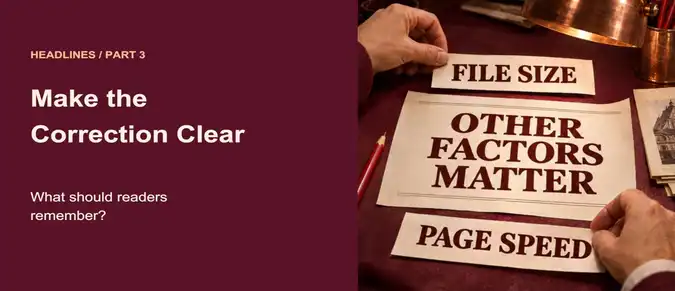

A correction should make its answer easy to find. If the headline repeats an inaccurate claim and the explanation appears much later, a reader who sees only the preview may miss the correction entirely.
Give the correction a clear place
The Debunking Handbook 2020 recommends starting with a fact when it can be stated clearly and briefly. When the truth is complicated, an explanation of why the claim is wrong can be a better opening. The handbook also recommends making the correction as visible as the misinformation, including in the headline.
This is editorial guidance, not a rule that a headline must never mention a false claim. The practical question is whether someone reading only the headline can identify the correction.
Explain the missing distinction
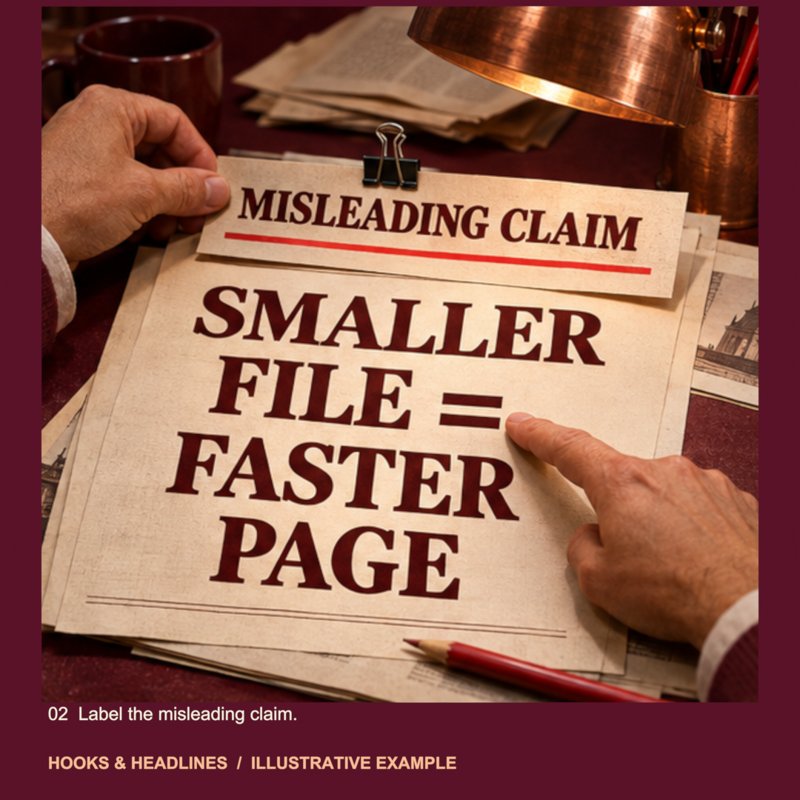
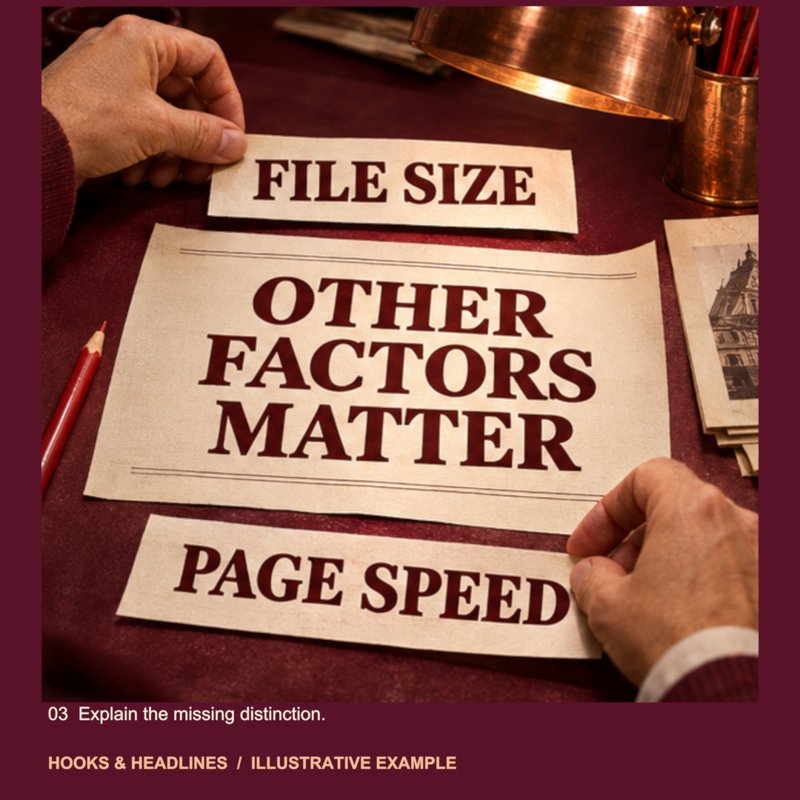
Consider an illustrative technical claim: “A smaller image file guarantees a faster page.” Smaller files can reduce the amount of data downloaded, but page loading also depends on other resources, network conditions and the work the browser performs. A file-size comparison alone does not establish a page-speed improvement.
A useful corrective headline would be “Smaller image files do not guarantee a faster page.” The opening can explain what smaller files change, then distinguish that measurement from a test of page speed. The reader gets a more accurate explanation to use in place of the original claim.
Repeating a claim is not automatically harmful
It would overstate the evidence to say that mentioning a myth necessarily strengthens it. In three experiments reported by Ecker, Lewandowsky and Chadwick in 2020, the overall evidence did not support a familiarity backfire effect from correcting unfamiliar claims. The experiments used novel claims and included a delayed test. They did not compare every possible headline treatment, and correction can still leave residual influence.
The handbook's suggested sequence is useful as an editing check: state a clear fact, flag the inaccurate claim before naming it, explain the error and provide a factual alternative, then return to the fact. Use enough detail to explain the issue. Repetition of the false claim is not the goal.
Check the preview on its own
Read the headline and cover without the article. Is the correction visible?
Find the explanation of what is wrong and what better account replaces it.
Check that the final sentence reinforces the accurate conclusion.
For the file-size example, the conclusion is concrete: measure page speed before claiming a speed gain. A good correction leaves the reader with something accurate to remember and a useful next step.











