

With the development of blockchain technologies and the growing number of decentralized applications (dApps), the need arises for solutions that can provide high transaction processing speed and minimal latency. The MegaETH project offers an innovative approach to scaling the Ethereum network, enabling the processing of more than 100,000 transactions per second with a delay of less than a millisecond.
Contents:
- MegaETH: What is it?
- MegaETH Architecture and Technologies
- Team and Investments
- MegaMafia Program
- Project Prospects and Challenges
- Conclusion
MegaETH: What is it?
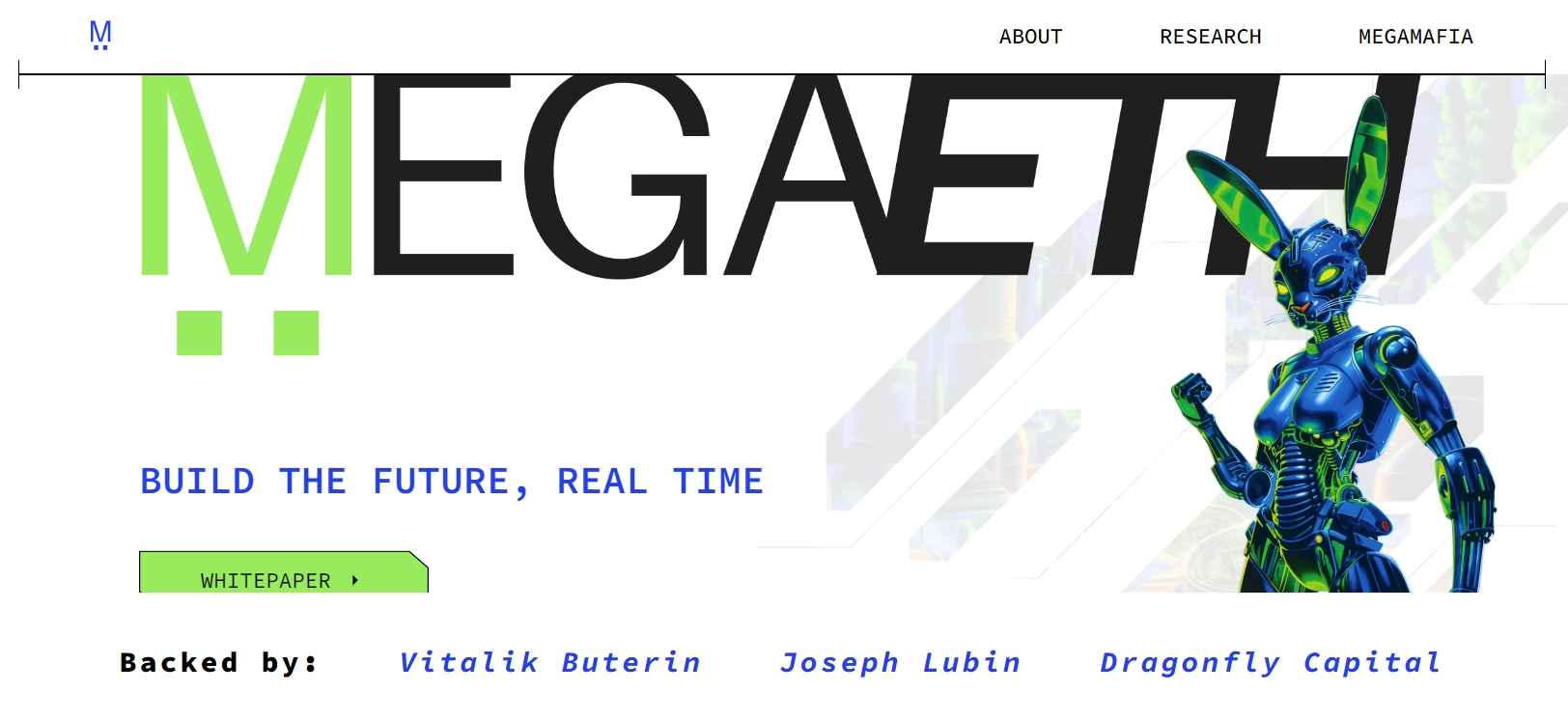
MegaETH is a Layer 2 solution for Ethereum aimed at addressing scalability and speed issues in the main network. The project's goal is to process over 100,000 transactions per second with minimal latency not exceeding a millisecond. This performance enables the creation of decentralized applications (dApps) comparable in efficiency to modern web applications. MegaETH offers an innovative approach to network optimization, unlocking new opportunities for the Ethereum ecosystem's growth.
MegaETH Architecture and Technologies
The MegaETH architecture is designed to deliver high performance and scalability for the Ethereum network. It includes several key components, each playing a specific role in optimizing system operations.
Key Components of MegaETH Architecture:
- Node Specialization: The network designates roles for sequencers, provers, and full nodes. Sequencers handle transaction execution, provers verify blocks, and full nodes maintain blockchain state. This division of responsibilities enhances network efficiency and decentralization.
- In-memory Computing and JIT Compilation: Using RAM to store blockchain state and compiling smart contracts into native code during execution significantly accelerates transaction processing.
- Integration with Ethereum L1 and EigenDA: MegaETH leverages Ethereum’s base layer and EigenDA for security and data availability, achieving high performance without compromising reliability.
Thanks to this architecture, MegaETH processes over 100,000 transactions per second with a delay of less than a millisecond, enabling the creation of decentralized applications with performance comparable to traditional web applications.
Team and Investments
The MegaETH project is developed by MegaLabs, founded in 2023. Key team members include:
| Name | Position | Education and Experience |
|---|---|---|
| Yilong Li | Chief Executive Officer (CEO) | PhD in Computer Science from Stanford University, specializing in algorithms and scalable decentralized systems. |
| Lei Yan | Chief Technology Officer (CTO) | PhD in Computer Science from MIT, with research focusing on blockchain theory and cryptographic protocols. |
| Shuyao Kong | Chief Business Officer (CBO) | Harvard Business School graduate with experience at ConsenSys, contributing to the development of MetaMask and Infura. |
| Namik Muduroglu | Head of Growth | Former ConsenSys team member responsible for project growth and development. |
In June 2024, MegaETH raised $20 million in an investment round led by Dragonfly Capital. Other investors included Figment Capital, Robot Ventures, Big Brain Holdings, and notable figures such as Vitalik Buterin and Joseph Lubin.
MegaMafia Program
The MegaMafia program by MegaETH supports developers and entrepreneurs creating applications on its platform. Participants gain access to key resources, professional consultations, and specialized events. This initiative fosters the expansion of the project ecosystem, the development of innovative solutions, and the attraction of new talent, solidifying MegaETH's position as a leading platform for high-performance decentralized applications.
Project Prospects and Challenges
MegaETH has the potential to become a significant scaling solution for Ethereum, enabling the development of high-performance dApps. However, the project faces several challenges:
- Integration with the Existing Ecosystem: Interoperability with current Ethereum applications and services may require substantial effort.
- Competition: Other Layer 2 solutions aiming to enhance scalability create a competitive landscape.
- Security and Decentralization: Ensuring high performance without compromising security and decentralization remains a critical task.
Given the support of leading industry figures and an innovative approach, MegaETH is well-positioned to play a vital role in the Ethereum ecosystem and advance decentralized technologies further.
Conclusion
The MegaETH project is a powerful and promising solution for scaling the Ethereum network, combining high performance, minimal latency, and innovative technologies. Supported by blockchain industry experts and significant investments, MegaETH is ready to transform the approach to developing decentralized applications, providing developers with a tool for creating high-performance dApps. However, successful integration with the Ethereum ecosystem, overcoming competition, and maintaining decentralization remain key challenges. MegaETH has every chance to play a pivotal role in the future of blockchain technologies.











