

PEPENODE is a blockchain game built around a Mine-to-Earn model, where users create virtual server rooms, purchase digital nodes, and upgrade their attributes. The project does not perform real cryptocurrency mining or provide computing power; instead, “mining” is used as a gameplay mechanic for distributing rewards. The platform’s economy is centered around the PEPENODE ERC-20 token on Ethereum. By combining elements of memecoins, staking, and strategy games, PEPENODE aims to create an interactive GameFi experience, although its long-term sustainability depends on product development, user engagement, and the transparency of reward funding.
Contents
- What Is PEPENODE and How Does the Mine-to-Earn Model Work?
- How Virtual Nodes and Server Rooms Operate
- Comparing PEPENODE with Mining, Staking, and GameFi
- The PEPENODE Token, Rewards, and Ecosystem Utility
- Risks and Future Prospects of the Game

1. What Is PEPENODE and How Does the Mine-to-Earn Model Work?
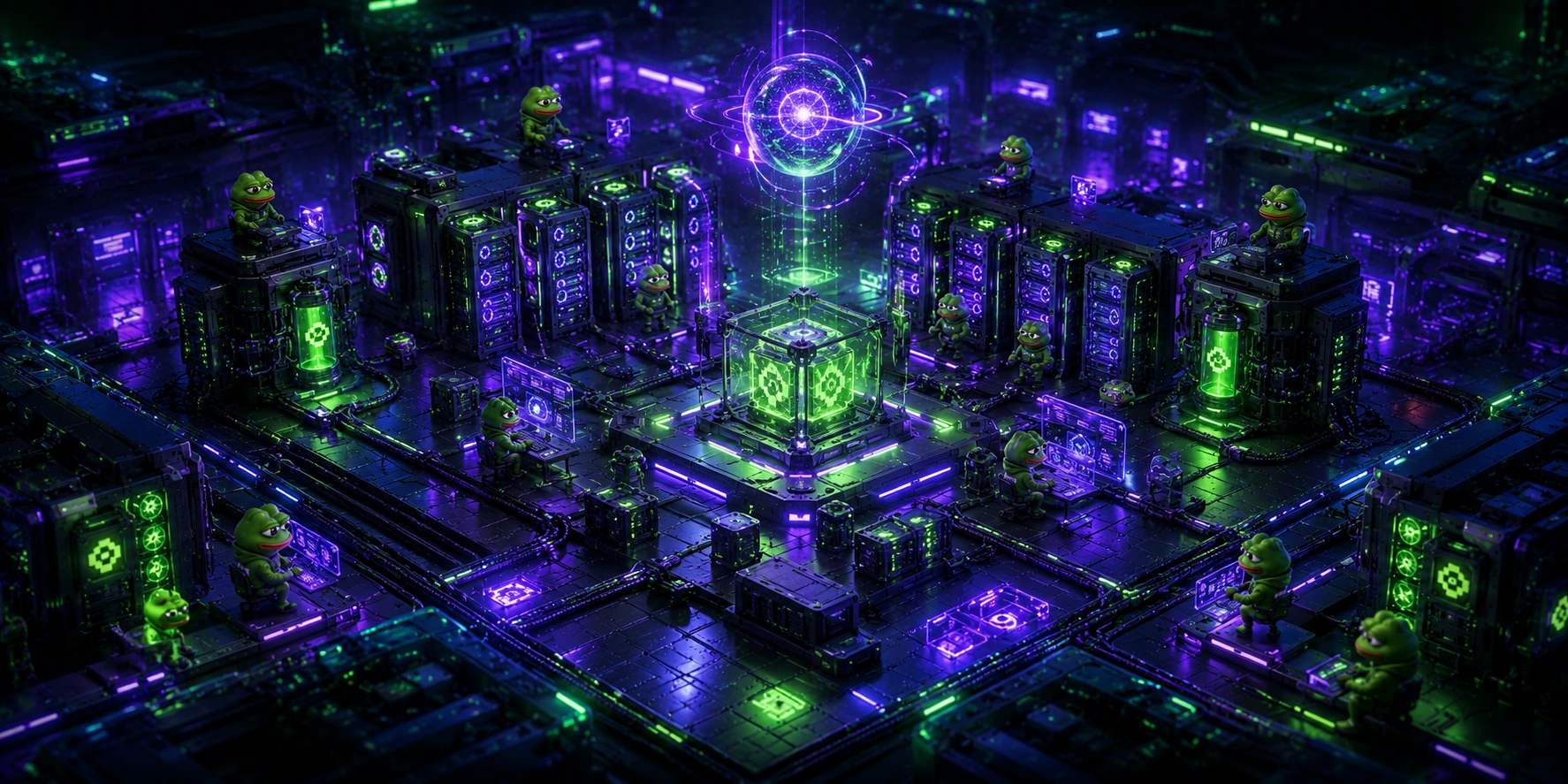
PEPENODE is a gaming platform that simulates the construction of memecoin mining infrastructure. Users connect a compatible Web3 wallet, gain access to a virtual server room, and build custom setups using Miner Nodes and supporting assets. Performance is determined not by physical hardware but by in-game mechanics and reward algorithms.
The project uses the term Mine-to-Earn in a manner similar to Play-to-Earn. Players spend tokens to acquire and upgrade virtual equipment, increase their simulated hash rate, and compete on leaderboards. More efficient configurations can generate larger in-game rewards.
It is important to distinguish this model from Bitcoin mining and other Proof-of-Work systems. PEPENODE does not produce blocks, validate external transactions, or direct user hardware toward cryptographic computations. Ethereum secures the token, while “mining” remains a simulation governed by application logic and smart contracts.
According to the roadmap, the project plans to introduce server room customization, active Miner Nodes, leaderboard functionality, and support for additional memecoin integrations. However, announced features should be differentiated from components already available in production.
2. How Virtual Nodes and Server Rooms Operate
The core gameplay element is the virtual server room. Users install nodes with different characteristics that influence simulated performance, bonuses, and reward generation. Players must balance available resources between purchasing new nodes and upgrading their existing infrastructure.
Technical materials describe two primary components: Miner Nodes and Facilities. Miner Nodes act as virtual equipment that generates gameplay output, while Facilities enhance the overall efficiency of the room. This creates a strategic layer where the most expensive asset is not always the most effective without complementary upgrades.
The platform also introduces multiple node tiers. Early or rare assets may offer higher efficiency, while newer node categories can differ in cost and available bonuses. Although this encourages experimentation and competition, it may also favor users with larger token holdings.
Gameplay statistics are expected to be displayed through a browser-based dashboard showing simulated hash rate, progression, and accumulated rewards. The team has also discussed a potential mobile version. Importantly, server visuals, energy metrics, and hash rate indicators are part of the simulation and do not represent actual computational activity.
3. Comparing PEPENODE with Mining, Staking, and GameFi
PEPENODE combines elements from several crypto models without fitting perfectly into any single category. It borrows terminology and aesthetics from mining, token-locking concepts from staking, and progression systems from GameFi.
These distinctions have practical implications. In traditional mining, rewards are tied to hardware investments and electricity costs. In PEPENODE, outcomes are determined by game mechanics and the amount of tokens allocated to nodes, upgrades, and staking.
| Model | Primary Resource | Source of Rewards | Key Risk |
|---|---|---|---|
| Proof-of-Work | Hardware and electricity | Block rewards and network fees | Operational costs and asset volatility |
| Staking | Locked tokens | Token emissions or protocol revenue | Price decline and lock-up periods |
| Traditional GameFi | Time, skills, and game assets | In-game economies and tokens | Inflation and player churn |
| Cloud Mining | Purchased remote hash power | Actual cryptocurrency mining | Counterparty risk |
| PEPENODE | Virtual nodes and tokens | Reward pools and ecosystem incentives | Tokenomics sustainability and product adoption |
PEPENODE should not be confused with operating Ethereum validator nodes or mining infrastructure. Owning an in-game node does not grant consensus rights or blockchain rewards. All blockchain activity occurs on Ethereum, while game performance is calculated independently.
This approach makes participation more accessible, as users do not need ASICs, GPUs, or specialized knowledge. However, the absence of physical infrastructure means that sustainable rewards require transparent funding mechanisms, such as treasury allocations, fees, or ecosystem revenue.
4. The PEPENODE Token, Rewards, and Ecosystem Utility
PEPENODE is an ERC-20 token deployed on Ethereum. According to publicly available materials, the maximum supply exceeds 210 billion tokens. The asset is used for purchasing Miner Nodes, upgrading facilities, staking, and interacting with the platform’s reward system.
Before gameplay features became available, the project promoted a Buy-and-Stake model. Participants could acquire tokens and lock them to receive additional rewards. Actual yields may fluctuate depending on staking participation, meaning advertised APY figures should not be considered fixed or guaranteed.
- Purchasing virtual Miner Nodes.
- Upgrading server rooms and in-game equipment.
- Increasing simulated hash rate.
- Staking tokens for additional rewards.
- Competing on leaderboards.
- Earning bonuses based on room efficiency.
- Potential rewards in PEPENODE and selected memecoins.
- Paying Ethereum network fees for on-chain actions.
Project materials reference bonus distributions in PEPE and Fartcoin for successful participants. These assets are not generated through actual mining and must originate from dedicated reward pools, treasury reserves, partnerships, or market purchases. Long-term sustainability therefore depends on transparent reporting.
Since its public launch, PEPENODE has appeared on several market aggregators as an Ethereum ecosystem token. However, liquidity remains relatively limited, and price volatility has been significant. Low trading volumes can increase slippage and make large positions difficult to exit.
5. Risks and Future Prospects of the Game
The primary challenge for PEPENODE is evolving from a token concept into a complete game. To maintain user interest, the platform will need meaningful progression systems, diverse node types, regular events, and gameplay that remains engaging regardless of token price movements.
The Mine-to-Earn economy depends on balancing demand for in-game assets with the volume of distributed rewards. If tokens enter circulation faster than they are consumed within the ecosystem, inflationary pressure may increase. Token-burning mechanisms and upgrade costs can partially offset this effect.
Additional risks include smart contract vulnerabilities, website security, treasury management, and dependence on the development team. The project's white paper explicitly notes that the token could lose value, liquidity, or utility if development ceases.
Users should verify official contract addresses, staking conditions, withdrawal mechanisms, and the actual status of the game before participating. References to popular memecoins within the reward structure should not be interpreted as official partnerships unless confirmed by all involved parties.
PEPENODE demonstrates how memecoin projects can introduce gaming utility to traditional token models. However, virtual server rooms do not provide real computing infrastructure, and the project's future will ultimately depend on gameplay quality, reward transparency, and its ability to build sustainable demand beyond financial speculation.











