

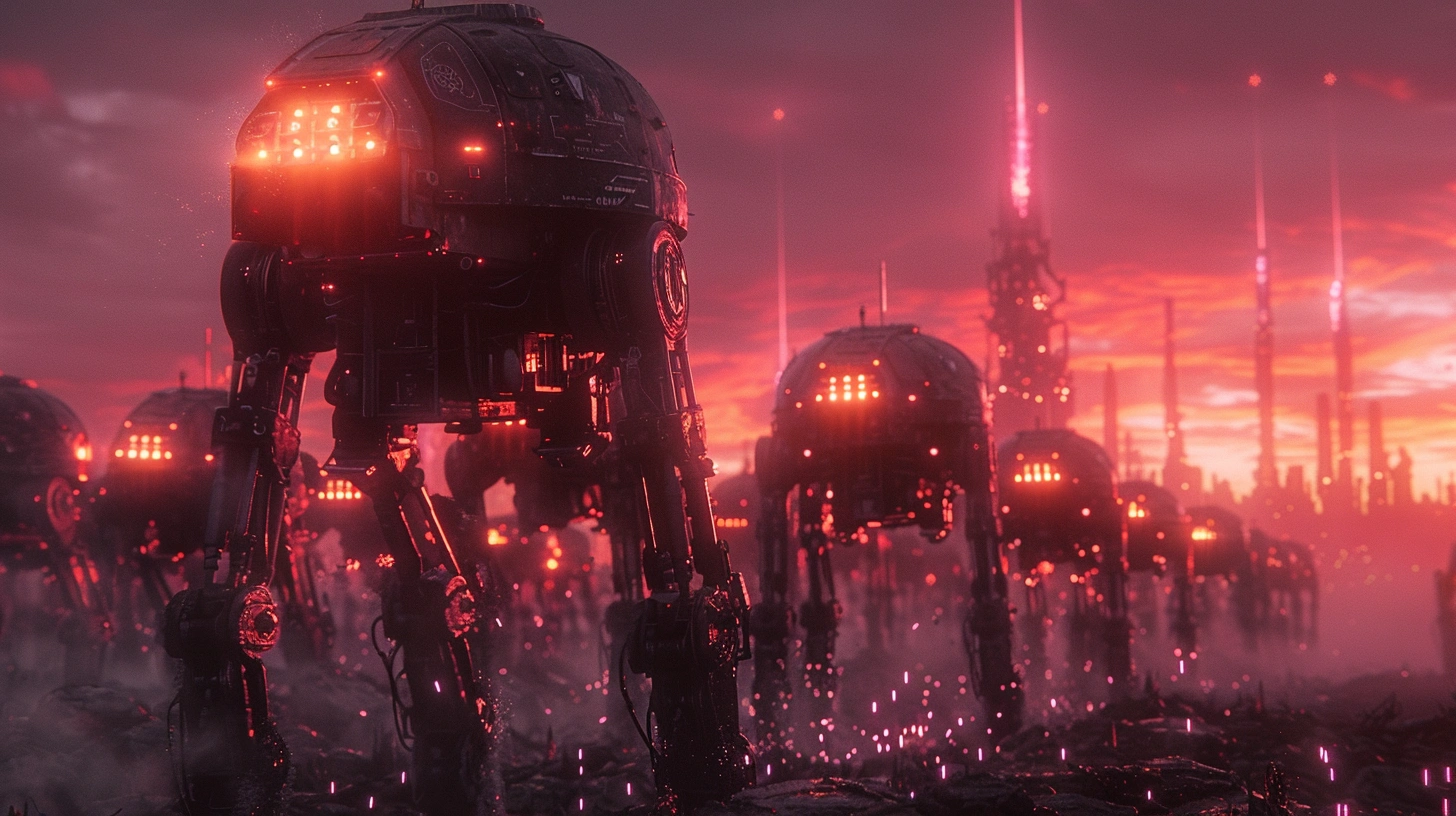
Supremacy is a Web3 game that combines strategy, blockchain economics, and continuous AI-driven battles within a unified metaverse. The action takes place in the year 2149, where traditional nation-states have collapsed and the world is divided among autonomous combat factions. Players own NFT-based war machines, participate in governance voting, influence battle outcomes, and shape an internal marketplace for digital assets. The project aims to merge immersive gameplay with a sustainable tokenized model.
Contents
- World and Concept of Supremacy
- Gameplay and Core Mechanics
- Economy, Tokens, and NFTs
- Factions and Social Model
- Development and Long-Term Outlook

1. World and Concept of Supremacy
Supremacy is built around a futuristic setting in which power has shifted from humans to autonomous machines. This scenario forms the foundation of a global conflict between factions, each striving for dominance. Players choose a side and become part of a large-scale confrontation where strategic decisions affect the overall balance of power.
Unlike traditional online games, Supremacy is not limited to isolated matches. Battles unfold continuously, creating the feeling of an ever-evolving world. Users enter an already functioning ecosystem and begin influencing it through asset ownership and participation in governance voting. The core idea of the project is to provide players with genuine ownership of digital assets. All major elements exist as NFTs, allowing them to be freely managed outside centralized control. This approach strengthens trust in the ecosystem and adds tangible value to participation.
The developers are building a layered lore that gradually unfolds through updates and in-game events. The world’s storyline is not static — it evolves alongside player actions. Economic and military decisions shape the broader narrative, creating a living digital environment. As a result, the concept merges strategy, storytelling, and digital ownership into a cohesive system.
2. Gameplay and Core Mechanics
The foundation of gameplay is the Battle Arena — an automated combat system operating 24/7. Owners deploy their NFT war machines into the arena, where algorithms determine outcomes based on machine characteristics and upgrades. Victories generate rewards and increase faction influence.
The participation model is designed to accommodate different types of users — from active asset holders to spectators.
- Continuous AI Battles — fully automated combat without manual control.
- Play-to-Earn — rewards for deploying NFT war machines.
- Watch-to-Earn — incentives for watching battles and voting.
- Machine Upgrades — enhanced performance through additional modules.
- Global Rankings — faction dominance leaderboards.
This structure blends strategic planning, economic participation, and competitive dynamics. Players can focus on expanding their machine fleet, trading assets, or strengthening their chosen faction.
Beyond the arena, additional interaction modes between factions are planned. Machine balancing is continuously refined to maintain fairness and prevent dominance by specific assets. This ensures a competitive environment that requires ongoing strategic evaluation.
3. Economy, Tokens, and NFTs
The economic model of Supremacy revolves around the SUPS utility token and a range of NFT assets. SUPS is used for upgrades, governance participation, and reward distribution. Token issuance is designed to balance supply and demand, supporting long-term sustainability.
NFTs represent war machines, weapons, and supporting modules. Their rarity and attributes directly affect battle performance. Additionally, asset rental options provide passive income opportunities for owners.
Key Supremacy Assets
| Name | Type | Function | Economic Role |
|---|---|---|---|
| SUPS | Utility Token | In-game transactions and governance voting | Primary medium of exchange |
| War Machine NFT | NFT | Combat unit deployed in the arena | Generates rewards |
| Weapon NFT | NFT | Enhances machine performance | Increases effectiveness |
| Syndicate NFT | NFT | Faction management asset | Supports collective development |
The model emphasizes long-term engagement rather than short-term speculation. Economic value is derived from active in-game usage. Demand is further stimulated through updates and in-game events. Regular introduction of new asset types maintains market interest, while blockchain transparency strengthens user trust. Together, these elements create a multi-layered digital economy.
4. Factions and Social Model
The social structure of Supremacy is built around a faction system. Players align with a chosen side and collectively influence the outcome of the global conflict. Battle results affect rankings and, consequently, reward distribution. Governance voting allows participants to adjust strategic parameters, reinforcing a sense of involvement in metaverse management.
Future development includes Syndicate HQ — virtual headquarters where members coordinate actions and allocate resources. This strengthens the decentralized character of the ecosystem. Team dynamics encourage long-term engagement and community formation. Players develop shared strategies and exchange analytical insights, making faction support both a strategic and economic decision. The social layer thus becomes a stabilizing force within the ecosystem.
5. Development and Long-Term Outlook
Supremacy continues to expand its functionality by introducing new gameplay elements, refining the user interface, and enhancing economic systems. The roadmap includes virtual territories, expanded trading infrastructure, and improved mobile accessibility to increase engagement and streamline participation. The team is also focused on scalability, reducing transaction costs, and optimizing user experience, as ease of entry directly impacts audience growth.
The project’s outlook is closely tied to the broader Web3 gaming sector, where users gain genuine control over digital assets. Sustainability will depend on maintaining a balance between engaging gameplay and economic viability, avoiding overreliance on speculative demand. With an active community and stable tokenomics, Supremacy has the potential to secure a notable position among blockchain-based strategy games. More broadly, it reflects the transformation of entertainment toward decentralized metaverse ecosystems.
By combining continuous AI battles, NFT ownership, and a tokenized economy, the platform creates a comprehensive Web3 environment in which players act as ecosystem participants rather than passive consumers. Despite market and regulatory risks inherent to the sector, ongoing infrastructure development and a balanced strategic approach may support long-term resilience.











