
With the development of the NFT (non-fungible tokens) market and the growing popularity of digital collections, the need for analytical tools to evaluate and analyze such collections is becoming increasingly relevant. These tools allow investors, collectors, and developers to obtain crucial information about the value, rarity, and popularity of various NFTs.
Contents:
Why NFT Analytics are Needed
NFT analytics help users understand the market and make more informed decisions about buying or selling tokens. These tools allow:
- Tracking trends and changes in the market
- Evaluating the rarity and uniqueness of tokens
- Analyzing sales history and price fluctuations
- Identifying promising projects and collections
Key Tools for NFT Analytics
Rarity Tools
Rarity.tools addresses three main tasks:
- The platform displays collections that are scheduled for upcoming sales or have already started, providing an opportunity to join the whitelist.
- Evaluating the rarity of NFTs in a specific collection: the fewer available copies, the higher the potential profit from their resale.
- Providing information on trading volumes and the number of token owners for each collection. Collections on the site are sorted by total sales volume in ETH.
All collections are available in the "All collections" section, where each has its own page with a full grid of images. By default, the service sorts NFTs from the rarest to the less valuable. The sidebar allows you to customize filters by rarity, price, minting type, and other characteristics.
To obtain detailed information about a specific NFT, you can click on the image or enter its ID in the "ID" field for search. However, the service is limited to checking tokens only on the Ethereum platform.
HowRare.is
HowRare.is is similar to Rarity.tools but operates on the Solana blockchain.
Key tracking functions and parameters include:
- Price of each NFT.
- Number of images in each collection.
- Number of token owners.
- Sales volume.
Like Rarity Tools, each collection on the HowRare.is site allows sorting NFTs by uniqueness. Each NFT has its rarity level, rating, and detailed attribute information.
The service also provides a section of blockchain movement history with data on recent sales.
A unique feature of HowRare.is is the ability to track projects planning to conduct an airdrop. Under each such collection, links to authors' official websites and their social media (Twitter, Reddit, Discord) can be found. This is useful for monitoring project funding plans and evaluating founder interaction with the community.
CryptoSlam
CryptoSlam analyzes all released NFT collections, assessing them based on the value of sold tokens. This resource tracks activity on various blockchains, including BNB, Polygon, and Tezos.
On the site, you can observe price dynamics over the last day and study token behavior on different networks. The service provides the ability to consider transferring tokens from one blockchain to another and view top sales and other important aspects.
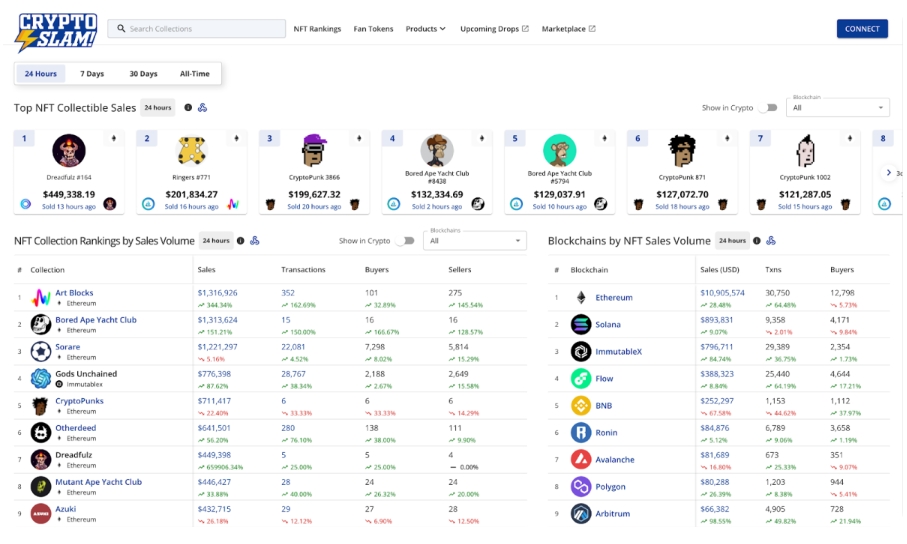
CryptoSlam is not only convenient for analyzing individual collections but also provides an overview of the entire NFT market. All necessary indicators are available on the main page, and the "NFT Rankings" section allows viewing collection tables with trader dynamics and successful transactions.
A feature of the resource is the ability to track fan tokens of sports clubs.
NFT Scoring
NFT Scoring is a service used to find popular collections over a specific period.
The resource analyzes the following criteria:
| Criterion | Description |
|---|---|
| Favorable purchase price | Price considered favorable for potential NFT purchases. |
| Actual sale price | Actual sale price based on previous transactions in the collection. |
| Number of trading participants and volume | Total number of trading participants and aggregate volume of all collection transactions. |
| Number of unique buyers and NFT holders | Number of unique individuals making purchases and holders of NFTs in the collection. |
| Total sales amount of the collection | Total amount of all sales within a specific collection. |
There is also a unique Whale Owners section where you can track how many large players have invested in the project. The combination of a low initial price and active bulk buyers indicates the project's potential.
The main drawback of the service is its high subscription cost. Access to a Premium account with advanced analytics requires a payment of 0.15 ETH. Therefore, this service is recommended for experienced NFT buyers. Novices will find sufficient resources mentioned earlier.
Conclusion
NFT analytics have become an integral part of the work of collectors and investors in this rapidly developing market. Using tools such as Dune Analytics, Nansen, CryptoSlam, Rarity Tools, and NFT Stats allows for a deeper understanding of the market and making more informed decisions. Each of these tools has its advantages and disadvantages, so the choice of the right one depends on the specific needs and goals of the user.
Analyzing and understanding the NFT market using specialized tools provides users with the ability to effectively manage their investments and collections, reducing risks and increasing profit potential.











