

Valley of Guardians — is a blockchain game in the Play-to-Earn (P2E) format, combining strategy, collecting, and a real token-based economy. Unlike simple clicker games, here players are encouraged to build teams of characters, fight world bosses, participate in rankings, and receive rewards both in in-game resources and in stable currency USDT. The game ecosystem is built on a clear economic model, seasons, and leaderboards, as well as the possibility of future NFT hero trading.
- Valley of Guardians Concept and Basic Gameplay
- Guardians Characters and Development System
- Valley of Guardians Rankings and Seasons
- Project Economy and Tokenomics
- Roadmap and Future Development
- Project Benefits and Risks
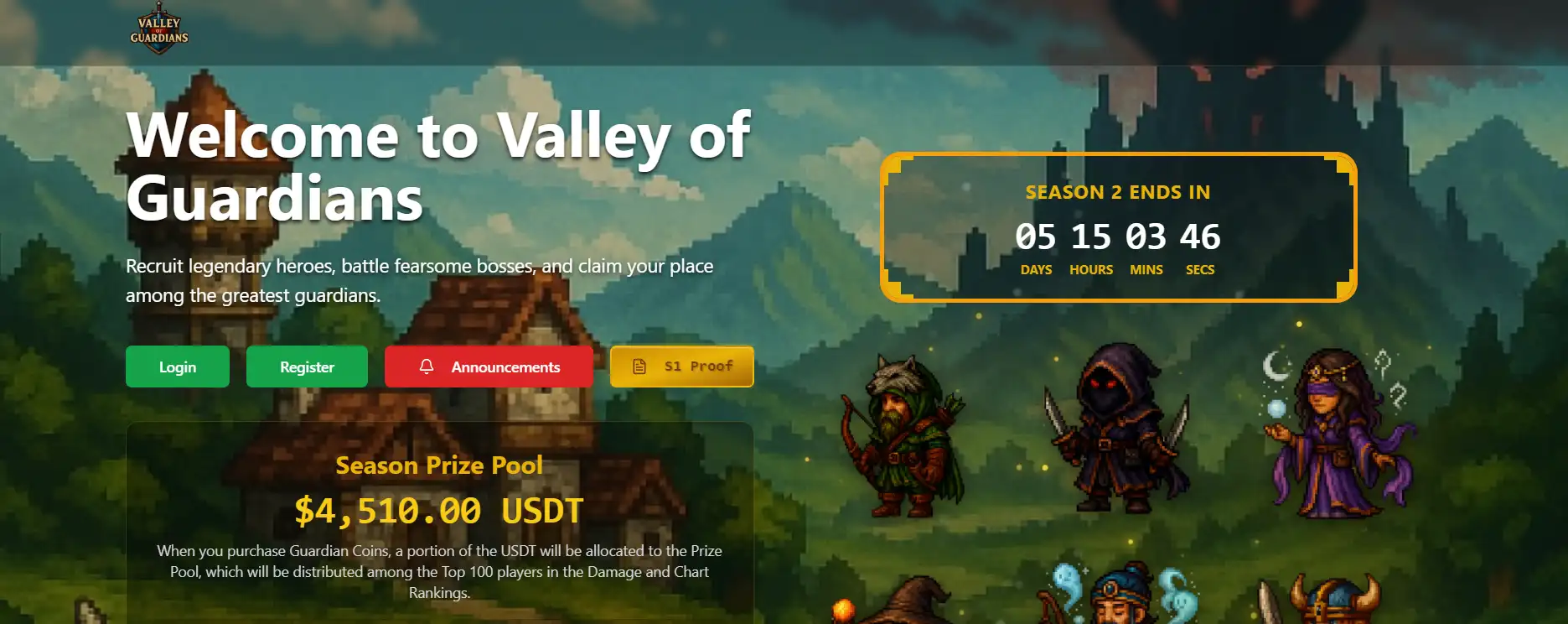
Valley of Guardians concept and core gameplay
Valley of Guardians was created as a Web3 game, where each gameplay element is tied to the economy. The main idea is to give users the opportunity not only to develop a team of characters but also to earn by participating in battles and seasons. Players begin with summoning characters of various rarity and classes. A key feature is the World Boss system: all participants fight one massive enemy, and rewards are distributed proportionally to the damage dealt.
In addition to battles, there is an idle mechanic: players earn resources even when offline. The ecosystem is complemented by missions and in-game tasks that unlock access to new resources, as well as a referral program that stimulates community growth. This approach creates a strong link between gameplay and economic participation.
Guardians and character progression system
The core of the game is the Guardians — unique characters of different rarity and attributes. Players can strengthen them through a fusion system, combining duplicates to increase star levels. The higher the star level, the stronger the hero and their battle abilities.
Rarity defines not only visual quality but also strategic potential. Powerful rare heroes become the main weapon in world boss battles and progression through missions. Character development requires a long-term strategy: investing resources in upgrades, forming a balanced team, and preparing for new seasons.
The inventory and the future marketplace enhance the value of Guardians: in the future, players will be able to trade them as full-fledged NFT assets. This opens opportunities not only for competition but also for turning achievements into digital investments.
Valley of Guardians Rankings and Seasons
The competitive aspect of Valley of Guardians plays a key role in audience retention. Developers introduced a ranking and mission system that motivates players to participate regularly. Thanks to seasons, every 15 days the balance of power is refreshed, and activity results are summarized.
Main elements:
-
Damage Ranking — leaderboard of the top players by damage dealt to the world boss.
-
Guardian Chart — ranking reflecting collection growth and character upgrades.
-
Seasons — each cycle lasts about 15 days, after which results are tallied, and prizes distributed.
-
Missions — individual tasks allowing players to develop heroes faster.
-
Referral Program — rewards for bringing new participants, helping expand the ecosystem.
This combination ensures continuous progress and creates a competitive atmosphere. Players feel growth not only in upgrading characters but also in their personal ranking, which boosts engagement.
Project economy and tokenomics
The financial model of Valley of Guardians demonstrates an interesting balance between in-game spending and real rewards. Players purchase resources to develop characters, and part of these transactions directly fills the prize pool, later distributed in USDT. This mechanism increases trust and makes participation more attractive.
| Resource / Token | Purpose | Distribution Features |
|---|---|---|
| USDT | Real prizes | Distributed to top players at the end of each season |
| GC (Guardians Coin) | In-game currency | 50% of all purchases go into the USDT Prize Pool |
| GS (Guardians Shard) | Fragments / resources | Used for upgrades and in-game progression |
| $VOG | Project token | Potentially used in governance and future functions |
Unlike many other P2E games, Valley of Guardians focuses on stable payouts and seasonal cycles, which increases economic predictability. This approach reduces token inflation risk and creates long-term interest in the project.
Roadmap and future development
The Valley of Guardians team has presented a clear roadmap aimed at 2025. Key goals include launching the NFT character marketplace, integrating new game modes, expanding the mission system, and developing the $VOG token. These steps aim to deepen gameplay and diversify the economy.
The project has already completed its launch phase and is running the first seasons. Players actively compete for spots in the Damage Ranking and Guardian Chart, and USDT rewards confirm the model’s viability. In the future, the focus will be on strengthening the community and adding more strategic elements. This direction will allow the project to compete with other major P2E games.
Advantages and risks
Valley of Guardians has a number of strong points that make it stand out among competitors. A transparent reward distribution model, regular seasons, and stable USDT payouts make participation attractive to a wide audience. The Guardian progression mechanics through fusion and star upgrades give the project depth, and the prospect of NFT trading enhances the value of in-game achievements.
However, the project also faces challenges. The $VOG tokenomics has not yet been fully disclosed, which creates risks for long-term sustainability. The economy heavily depends on the influx and activity of new players, meaning constant marketing and engagement are necessary. In addition, the P2E market is saturated, and competition requires Valley of Guardians to continuously improve. Regulatory and technical issues cannot be excluded either, as they traditionally accompany blockchain games.











