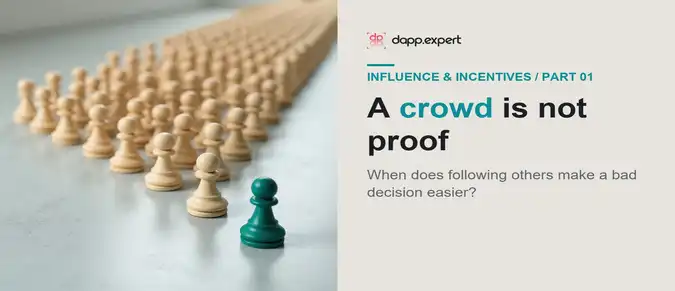

AI tools helped gather research and write the first draft of this article. I edited it and checked every study figure against the paper, its official abstract or a published summary of it, listed at the end. The cover illustration is AI-generated. Details at the end.
In a five-month experiment on a social news site, researchers gave some comments one extra up-vote at random, before any reader had seen them. That single vote made the next reader 32% more likely to up-vote too. By the end, those comments had final ratings 25% higher on average than comparable comments that got no help [1].
Nothing about the comments had changed. Only the visible signal of what other people seemed to think.
That is social proof: when we are not sure what to do, we look at what others have done. Most of the time it is a reasonable shortcut. A busy restaurant is often busy for a reason. But the shortcut has a weak point. It works only when the crowd's choices are honest and independent of one another, and many of the numbers we see online are neither. When that condition fails, social proof does not just fail to help. It makes a poor choice feel safe.
This is the first part of a new series, Influence & Incentives, on how other people, rules and rewards shape what we decide, write and publish. It starts with the most familiar principle of influence and the research on where it goes wrong.
What social proof is, and why it usually helps
The psychologist Robert Cialdini made "social proof" one of the best-known principles of persuasion. The idea is simple: other people's behaviour is information. If many travellers choose one route, it is probably passable. If most readers of a site save a guide, it may be useful.
The shortcut saves time and is often rational. The problem is not that people copy each other. It is that the signal can be distorted at three points: when people go along with a crowd they can see is wrong, when early choices snowball into a ranking, and when the crowd is not real. The research covers all three.
Going along with a crowd that is plainly wrong
The classic study is Solomon Asch's line experiment from the 1950s. One participant sat with a group of people who were secretly working with the experimenter. Each person in turn said which of three lines matched a reference line. The right answer was obvious. On the critical rounds, the group gave the same wrong answer.
Across 123 real participants, the average error rate on those rounds was 36.8% [2]. People knew what they saw, and about a third of the time they said what the group said.
This is old research, and much old social psychology has not survived re-testing. This finding has. In 2023, Axel Franzen and Sebastian Mader at the University of Bern repeated the experiment with 202 valid participants and found an error rate of 33% [2]. When they paid participants for correct answers, the rate fell to 25%, but did not disappear [2].
Two lessons follow. Pressure from a visible group works even when the right answer is available to everyone. And a direct incentive to be right reduces conformity without removing it. Online, the pressure is weaker than a room full of strangers, but the situation is usually harder: the right answer is rarely as plain as the length of a line.
When one early vote snowballs
The experiment that opens this article was run by Lev Muchnik, Sinan Aral and Sean Taylor and published in Science in 2013 [1]. It covered 101,281 comments on a news aggregation site. Comments were randomly given one positive vote, one negative vote or nothing at the moment they appeared.
The results were not symmetrical:
- A fake positive vote snowballed. The first reader was 32% more likely to up-vote, and the effect grew over time, ending in a final rating 25% higher on average [1].
- A fake negative vote did not. Later readers corrected it, and those comments ended with ratings close to the control group [1].
- The effect depended on topic. It appeared in politics, culture and business, not everywhere [1].
The authors' conclusion is that prior ratings created significant bias in individual rating behaviour [1]. In plain terms: a rating is not only a measurement of quality. It is also partly a record of who arrived first and what they saw.
This matters for anyone reading a feed. Likes, up-votes and "trending" labels are counts of decisions that were not made independently. Each reader saw the earlier count before adding to it.
When success becomes unpredictable
Matthew Salganik, Peter Dodds and Duncan Watts asked a bigger question in 2006: what happens to a whole market when people can see what others chose? They built an online music market where 14,341 participants listened to and downloaded songs by unknown bands [3]. Some participants saw how often each song had been downloaded; others did not. The socially influenced participants were split into several separate "worlds", each starting from zero.
Their summary is direct: "Increasing the strength of social influence increased both inequality and unpredictability of success" [3]. When download counts were visible, a few songs took a much larger share, and which songs those were differed from world to world. Quality still mattered at the edges: the best songs rarely did poorly and the worst rarely did well. But almost any other result was possible [3].
For a reader, this means a popular item is not necessarily the best one. It may be the one that got an early lead. For a writer, it means that a viral post is weak evidence that the idea in it was the best of its kind.
The famous field example is weaker than its reputation
Social proof is not magic in the other direction either, and the research is honest about that. A well-known 2008 study by Noah Goldstein, Robert Cialdini and Vladas Griskevicius reported that hotel guests reused towels more often when a card said most other guests did so: 44.1% against 35.1% with a standard environmental card, as the replication paper summarises it [4].
When Gerd Bohner and Lena Schlüter tested the idea in German hotels, the social-norm message did not beat a standard environmental message. In their first study, with 724 cases, reuse was 81.9% with the norm messages and 83.7% with the standard one, a difference that was not significant [4]. In a second, smaller study the standard message did better [4].
So social proof is real but uneven. It depends on context, topic and what people already intend to do. That is one more reason to be careful with anyone who promises that a single phrase such as "thousands already joined" will reliably change behaviour.
When the crowd is manufactured
The three effects above assume the crowd is made of real people. In some corners of the internet it is not, and crypto is one of them.
A team led by Leonardo Nizzoli and Emilio Ferrara analysed more than 50 million messages from almost 7 million users on Twitter, Telegram and Discord over three months [5]. They found 296 Telegram channels involved in pump-and-dump schemes and 432 involved in Ponzi schemes, "accounting for a striking 20% of the total" of the Telegram channels they examined [5]. Among the Twitter accounts sharing invite links to Telegram and Discord, more than 56% were bots or suspended accounts, and 93% of the invite links shared by Twitter bots pointed to Telegram pump-and-dump channels [5].
That is social proof turned into a tool. A crowded channel, a stream of excited replies and a high follower count all look like evidence that others have checked. In these cases they were part of the scheme.
Regulators treat fake signals of popularity as deception. In August 2024 the US Federal Trade Commission announced a final rule against fake reviews and testimonials [6]. Among other things, it prohibits selling or buying fake indicators of social media influence, such as followers or views generated by bots or hijacked accounts, when the buyer knew or should have known they were fake and used them to misrepresent influence for a commercial purpose [6].
Three conditions that turn a shortcut into a trap
The research points to three conditions. Social proof misleads most when:
- The count is not independent. Every person saw the earlier count before adding to it, so an early lead, real or planted, grows on its own [1], [3].
- The crowd is not real. Followers, replies or channel members are bought, automated or coordinated [5], [6].
- The crowd is answering a different question. Many people liking a post about a token says something about how the post feels to read. It says little about whether the token is sound, and the people liking it may hold it.
A visible group can also push someone to say something they know is wrong, as Asch's participants did [2]. In a public thread, disagreeing with a hundred enthusiastic replies takes more effort than adding the hundred and first.
Five questions before a number decides for you
- Who is in the crowd? Can you see real accounts, or only a number?
- Did they choose independently? Were people reacting to the thing itself, or to a count, a "trending" label or each other?
- What exactly did they do? A like, a follow and a purchase are different signals. "Everyone is talking about it" is not a measure of anything.
- What do they gain? If the people praising something benefit when you join, their enthusiasm is a statement of interest, not independent evidence.
- What would you decide without the number? Cover the count and judge the thing itself: the code, the terms, the source, the argument.
A worked example (fictional)
The project and all figures below are invented to show the questions in use.
A new token launches with a page that shows "18,400 holders", a Telegram channel with 52,000 members and a pinned post: "Everyone is getting in before the listing."
Run the five questions. The holder count is a number on the project's own page; a blockchain explorer would show how many wallets hold more than a trivial amount and how concentrated the holdings are. The channel members cannot be inspected, and an invite link that arrives through a wave of new, similar accounts matches the pattern Nizzoli and colleagues described [5]. "Everyone is getting in" names no one. The people promoting the launch benefit if you buy. Covering the numbers leaves the actual questions: who controls the supply, what the token does and whether the listing is confirmed by the exchange itself.
None of this proves the project is a scam. It shows that the social signals on the page carry almost no information, and that the decision has to rest on something else.
What honest social proof looks like
The research does not say that showing numbers is wrong. It says that numbers should be real, dated and checkable. For anyone who publishes, including this site:
- Show real figures with a date and a source: "saved by 240 readers in the first week (site analytics)", not "everyone is reading this".
- Do not buy or trade followers, likes or reviews, and do not coordinate reactions.
- Disclose a stake. If an author holds an asset they write about, say so next to the claim.
- Put the evidence, not the crowd, at the centre. A link to the source does more for a careful reader than a counter.
What this article cannot tell you
The experiments described here were run in specific settings: a laboratory room, one news aggregator, one artificial music market, hotels in particular countries. Their numbers do not transfer directly to X, Telegram or a token launch page. The crypto study covered three months and three platforms several years ago; the share of manipulated channels today may be higher or lower. Nothing here measures how social proof affects readers of Dapp.Expert or of crypto media in general; that has not been tested. And this is not legal or investment advice; the FTC rule is described only as an example of how regulators treat fake popularity.
How this article was made
| Task | What the AI did | What a person did | How it was checked |
|---|---|---|---|
| Research | Collected studies on influence and online behaviour into research notes | Chose the question and the studies to rely on | Figures checked against the papers, their official abstracts or published summaries [1]–[6]; one figure in the research notes about Telegram channels was wrong and was corrected from the paper's abstract |
| Draft | Wrote the first draft from the notes | Edited the text, the structure and the worked example | A separate review compared figures and claims with the sources |
| Images | Generated the cover photograph-style illustration | Chose the illustration; designed the explanatory diagrams | Labelled as AI-generated in the disclosure line and alt text |
| Not done by AI | — | The decision to publish and responsibility for the text | — |
Conflicts of interest: none. The author has no commercial relationship with the researchers or organisations named; the token in the example is fictional.
Responsible for this article: Dmitriy Lastovka, author. Corrections: contact form.
Sources
Labels: paper (peer-reviewed study, read in full or via its official abstract), summary (a published summary of a paper), official (regulator's own page).
- Lev Muchnik, Sinan Aral, Sean J. Taylor, "Social influence bias: a randomized experiment", Science 341 (2013), 647–651. https://doi.org/10.1126/science.1240466 Paper, official abstract. Figures from the BPS Research Digest summary: https://www.bps.org.uk/research-digest/online-initial-positive-rating-surprisingly-influential Summary.
- Axel Franzen, Sebastian Mader, "The power of social influence: A replication and extension of the Asch experiment", PLOS ONE (29 November 2023), which also reports Asch's original figures. https://doi.org/10.1371/journal.pone.0294325 Paper.
- Matthew J. Salganik, Peter S. Dodds, Duncan J. Watts, "Experimental study of inequality and unpredictability in an artificial cultural market", Science 311 (2006), 854–856. https://doi.org/10.1126/science.1121066 Paper, official abstract.
- Noah J. Goldstein, Robert B. Cialdini, Vladas Griskevicius, "A room with a viewpoint", Journal of Consumer Research 35(3) (2008). Gerd Bohner, Lena E. Schlüter, "A Room with a Viewpoint Revisited: Descriptive Norms and Hotel Guests' Towel Reuse Behavior", PLOS ONE (1 August 2014). https://doi.org/10.1371/journal.pone.0104086 Paper.
- Leonardo Nizzoli, Serena Tardelli, Marco Avvenuti, Stefano Cresci, Maurizio Tesconi, Emilio Ferrara, "Charting the Landscape of Online Cryptocurrency Manipulation", IEEE Access 8 (2020). https://arxiv.org/abs/2001.10289 Paper, official abstract.
- US Federal Trade Commission, "Federal Trade Commission Announces Final Rule Banning Fake Reviews and Testimonials" (14 August 2024). https://www.ftc.gov/news-events/news/press-releases/2024/08/federal-trade-commission-announces-final-rule-banning-fake-reviews-testimonials Official.











