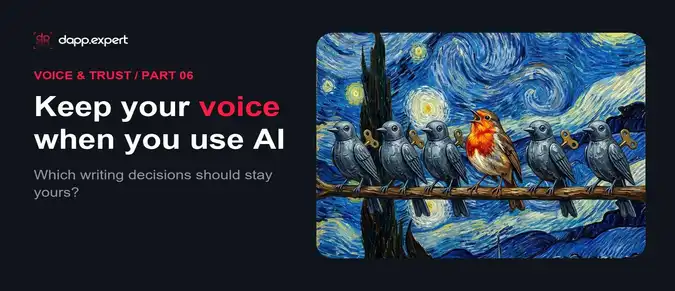

AI tools helped gather research and write the first draft of this article. I edited it and checked the quotes against the original pages (study abstracts via Europe PMC and arXiv; the writers' own sites; Vox). The writing-style figures come from an internal study prepared for Dapp.Expert with AI research tools; it is not peer-reviewed. The cover illustration is AI-generated. Details at the end.
Ask an AI tool for a paragraph about a new token bridge and you will get something fluent, balanced and correct-sounding. Ask it again tomorrow, or ask a different tool, and you will get almost the same paragraph. That is not a bug in one product. It is what happens when many writers draw on the same suggestions.
A voice is not a vocabulary or a tone you can switch on. It is a small set of decisions you make the same way every time: how you open, what you count, how sure you sound, and how you end. AI can help with almost everything around those decisions. If you hand over the decisions themselves, your writing drifts toward everyone else's.
This is the sixth part of a series on making editorial work inspectable. Earlier parts covered showing your evidence, disclosing how AI tools were used, correcting mistakes visibly, attributing other people's research honestly and keeping a confident tone honest. This one is about the voice all of that is written in.
Why AI drafts drift toward the average
Two experiments show the pull directly.
More creative alone, more alike together. Anil Doshi and Oliver Hauser ran an online experiment in which some writers received story ideas from a large language model before writing a short story. Access to AI ideas made the stories "evaluated as more creative, better written, and more enjoyable, especially among less creative writers." But "generative AI-enabled stories are more similar to each other than stories by humans alone." The authors describe the result as a social dilemma: each writer is better off, but "collectively a narrower scope of novel content is produced" [1]. (Peer-reviewed experiment, Science Advances 2024.)
Suggestions change how people write, not only what. Dhruv Agarwal, Mor Naaman and Aditya Vashistha asked 118 participants from India and the United States to complete culturally grounded writing tasks with and without AI suggestions. The suggestions "led Indian participants to adopt Western writing styles, altering not just what is written but also how it is written" [2]. (Peer-reviewed conference paper, CHI 2025.)
Neither study tested crypto writing or journalism, and both measured short tasks. What they show is a direction: when the same model offers the same kind of suggestion to many people, their texts move closer together. For a publication, that is a practical risk. Readers who see the same balanced paragraph everywhere have little reason to come back to any one source.
What a voice is actually made of
In November 2026, Dapp.Expert prepared an internal study of 148 writers that editors and readers often treat as reference points: columnists, analysts, reporters and essayists, from Hersey and Orwell to Matt Levine and Vitalik Buterin [3]. It is an editorial study, not a measurement: a single coder, working with AI research tools, scored the writers on several axes, at least one text was read for 45 of them, 101 were assessed from reference sources, and 2 could not be checked. (Internal research, not peer-reviewed; agreement between coders was not tested.) With those limits, four patterns stood out.
The first sentence is a contract. In all 45 texts that were read, the opening line makes a promise the rest of the piece keeps: a thesis, a scene, a definition or a question.
Recognition comes from two or three repeated moves, not from range. The writers people recognise tend to reuse the same structure: a mechanism, then a case, then a conclusion; or a framework they apply to every new event; or a scene with an exact time. The study's own interpretation, which it marks as an assumption, is that repetition rather than variety makes a voice recognisable.
Calibrated uncertainty is rare. Only 14 of the 148 writers scored 4 or 5 out of 5 for clearly separating what is known from what is guessed. Most scored low on irony (107 of 148) and on metaphor (108 of 148). Plain, careful writing is common. Plain writing that also says how sure it is was much less common in this sample.
Numbers sit inside sentences, with a source. Strong business writers put a figure in the middle of a normal sentence and link it, rather than leaving it to a table.
None of these are things an AI tool cannot write. They are things it will not choose for you, because they depend on what you decided the piece is about and how much you actually know.
Three writers, three fingerprints
To see whether these habits show up in measurable ways, the same study took a closer look at three writers who cover AI, technology and crypto, and who each publish openly online: Ethan Mollick (One Useful Thing), Benedict Evans (his essays) and Molly White (Citation Needed) [4]. It collected 24, 28 and 26 full texts respectively, about 160,000 words in total, and counted simple features. (Internal research. The writers are compared with each other, not with general English; the coding was done by machine, and the study rates its own reliability as class B, below its target.)
| Per 1,000 words, unless noted | Mollick | Evans | White |
|---|---|---|---|
| "I" | 16.8 | 6.4 | 9.8 |
| Questions, share of sentences | 4.3% | 13.7% | 2.2% |
| Numbers | 8.5 | 9.6 | 17.6 |
| Links | 9.2 | 3.1 | 14.7 |
| Average sentence length, words | 19.7 | 23.7 | 24.6 |
The differences match what a reader notices. Mollick writes as a practitioner who tries things: first-person accounts of his own tests appeared in about a third of the sampled passages (34%), against 12% for Evans and 9% for White. Evans writes as an analyst who works through questions; he describes his job on his own site as "trying to work out what questions to ask" [5]. White writes as a documentarian, with the most numbers and links of the three.
All three also mark uncertainty in their own way. Mollick, weighing four explanations for why Google's new model came out so close to GPT-4: "I think 2 is most likely, but I have no idea if that is true" [6]. Evans, after listing possible reasons why many people use chatbots only now and then: "I don't think we can know that" [7]. White, in an essay critical of AI's costs, says how sure she is in the subtitle: "AI can be kind of useful, but I'm not sure that a 'kind of useful' tool justifies the harm" [8].

The point is not to copy any of them. Their names, catchphrases and coined terms belong to them, and the study's own rules forbid reusing them. The point is that each voice is a consistent pattern of choices, and the pattern is visible in the numbers. In the study, 74 of 78 texts were matched to the right writer from simple word counts alone.
How one of them uses AI
Mollick studies AI and writes about it every week, so his own practice is a useful reference. The About page of his newsletter says: "I do write every post myself, only asking for AI feedback after I have finished a complete draft" [9]. In a 2024 interview with Vox, he described much of his creative use of AI as "unsticking": when a transitional sentence would not work, he asked for "30 versions of this sentence in radically different styles"; when he needed an analogy, he asked for 25 to choose from [10].
That is one writer's method, not a rule. But it shows a clear division. The AI produces options and feedback. The writer keeps the structure, picks what fits, and owns the result.
What to keep, what to delegate
The same split works for most writing with AI tools. Keep the decisions that make up your voice. Delegate the work that only produces options, and check whatever comes back.
| Keep for yourself | Delegate, then check |
|---|---|
| The first sentence: what the piece promises | Thirty alternative phrasings of a sentence you already wrote |
| Which facts go in, and which are left out | A list of objections to your argument |
| How sure each claim sounds | Summaries of sources (then open the sources) |
| Your two or three repeated moves | Grammar, length and consistency edits |
| The ending: what the reader should do or watch | Formatting, headings, alt-text drafts |

The left column is short on purpose. These are the places where a draft becomes yours. Everything in the right column can save hours, and none of it decides what you think.
A worked example
The network and the figures below are invented for illustration.
Suppose you are writing about a bridge between two networks that paused withdrawals for six hours after a bug report.
The default AI draft. "In the fast-moving world of crypto, security remains a top concern. The recent pause highlights both the challenges and the opportunities facing cross-chain infrastructure. While some users expressed frustration, others praised the team's quick response. Only time will tell what this means for the future of bridges."
Every sentence is grammatical, and none of it is yours. The opening promises nothing. "Some users" and "others" are unnamed. The ending predicts nothing and asks nothing of the reader.
The same paragraph after your decisions. "The bridge paused withdrawals for six hours on Tuesday after a researcher reported a bug in how it checked messages from the other chain. No funds were lost, according to the team's linked incident note. What is not known yet is whether the fix has been audited; the note does not say. If you have funds on the bridge, the useful check is the team's status page, not social media."
The AI can still help with the second version: tightening a sentence, suggesting a clearer word, checking that the times match the incident note. But the decisions are the writer's. The first sentence is a fact with a time. The source is named. The paragraph says what is not known. The ending gives one practical step.
A voice check before you publish
Before you publish a piece written with AI help, ask five questions:
- Did I write the first sentence? If the opening came from the tool, rewrite it as the promise you actually want to keep.
- Can I name the source of every number? If a figure arrived in a draft, find it in the original before it stays.
- Does it say how sure it is? Look for at least one sentence that separates what is known from what is guessed.
- Would a regular reader recognise it as mine? Check for your usual structure, not a generic one.
- Is the ending mine? Replace "only time will tell" with something a reader can check, watch or do.
Common mistakes and how to fix them
1. Letting the tool open the piece. Generic openings ("In today's fast-moving world…") are the first sign of a borrowed voice. Fix: write the first sentence yourself, before you ask for any draft.
2. Accepting balance as a position. "Some say X, others say Y" reads as fair but tells the reader nothing. Fix: say which side the evidence supports, and how strongly.
3. Copying a famous writer instead of learning from one. Borrowing a writer's coined terms, signature lines or name ("in the style of…") is imitation, not voice. Fix: take a technique, such as asking one sharp question per section, and use it in your own words.
4. Smoothing away your own habits. Editing tools tend to remove short sentences, questions and plain admissions of doubt. Fix: keep a short list of your habits and check that the final draft still has them.
5. Hiding the AI's role. A recognisable voice does not replace disclosure. Fix: say what the tool did and what you did, as this article does at the top and at the end.
What this article cannot tell you
The two experiments measured short writing tasks with online participants, not journalists or crypto writers, and they do not show how large the effect is over months of publishing. The 148-writer study and the three-writer comparison are internal, not peer-reviewed: the axis scores come from a single coder working with AI tools, the corpus coding was done by machine, and three writers say nothing about writers in general. No one has yet tested whether readers can tell these voices apart blind. This article also cannot tell you what your own voice should be; it can only show which decisions it is made of.
How this article was made
| Task | What the AI did | What a person did | How it was checked |
|---|---|---|---|
| Research | Ran the internal 148-writer study and the three-writer corpus comparison; searched for experiments on AI and writing | Chose the question and the sources to rely on | Experiment abstracts [1], [2] retrieved from Europe PMC and arXiv and compared with the quotes; writers' quotes [5]–[10] checked on the original pages; corpus figures taken from the study files [3], [4] |
| Draft | Wrote the first draft from the notes | Edited the text, the structure and the worked example | A separate review compared figures and quotes with the sources |
| Images | Generated the cover illustration | Chose the illustration; designed the explanatory diagrams | Labelled as AI-generated in the disclosure line and alt text |
| Not done by AI | — | The decision to publish and responsibility for the text | — |
Conflicts of interest: none. The author has no commercial relationship with the writers or the researchers named; the bridge in the example is fictional.
Responsible for this article: Dmitriy Lastovka, author. Corrections: contact form.
Sources
Labels: research (peer-reviewed unless noted), internal research (not peer-reviewed), primary text (the writer's own page), interview.
- Doshi, A. R., & Hauser, O. P. (2024). Generative AI enhances individual creativity but reduces the collective diversity of novel content. Science Advances, 10(28), eadn5290. doi:10.1126/sciadv.adn5290. Research.
- Agarwal, D., Naaman, M., & Vashistha, A. (2025). AI Suggestions Homogenize Writing Toward Western Styles and Diminish Cultural Nuances. Proceedings of CHI 2025. doi:10.1145/3706598.3713564; arXiv:2409.11360. Research (peer-reviewed conference paper).
- Dapp.Expert, "Anatomy of style: 148 reference writers" (internal study, November 2026). Internal research.
- Dapp.Expert, "Author style pilot: Mollick, Evans, White" (internal corpus study, November 2026; 24, 28 and 26 texts). Internal research.
- Benedict Evans, About & Contact. https://www.ben-evans.com/contact Primary text.
- Ethan Mollick, "Google's Gemini Advanced: Tasting Notes and Implications", One Useful Thing (8 February 2024). https://www.oneusefulthing.org/p/google-gemini-advanced-tasting-notes Primary text.
- Benedict Evans, "GenAI's adoption puzzle" (25 May 2025). https://www.ben-evans.com/benedictevans/2025/5/25/genais-adoption-puzzle Primary text.
- Molly White, "AI isn't useless. But is it worth it?", Citation Needed (17 April 2024). https://www.citationneeded.news/ai-isnt-useless/ Primary text.
- Ethan Mollick, About, One Useful Thing. https://www.oneusefulthing.org/about Primary text.
- Noam Hassenfeld, "What a practical approach to AI looks like, according to an expert", Vox (5 September 2024). https://www.vox.com/the-highlight/370246/what-a-practical-approach-to-ai-looks-like-according-to-an-expert Interview.











