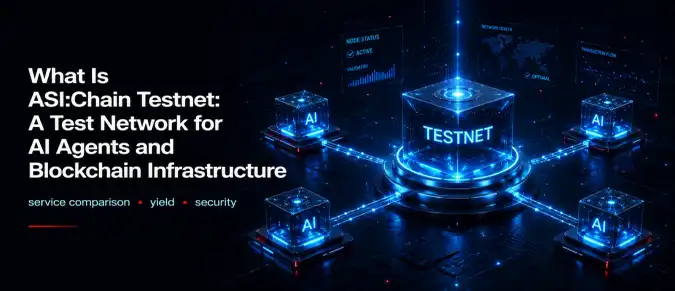

A testnet is a blockchain testing environment where developers can evaluate transactions, smart contracts, node operations, and economic mechanisms before launching the main network. Within the Artificial Superintelligence Alliance ecosystem, this stage is connected to the development of ASI:Chain, a Layer 1 designed to coordinate AI agents and decentralized applications. At the current stage, ASI:Chain's public DevNet environment is available, while the documentation treats Testnet as a subsequent development phase before Mainnet. It is therefore important to distinguish between the existing development network and the future test network with a more mature architecture.
Contents
- What Is a Testnet and Why Blockchain Projects Need Test Networks
- How ASI:Chain DevNet and the Future Testnet Work
- How DevNet, Testnet, and Mainnet Differ
- Validators, Rholang, and DevNet Infrastructure
- Testnet Risks and Prospects in the ASI Ecosystem

1. What Is a Testnet and Why Blockchain Projects Need Test Networks
A testnet is a separate version of a blockchain designed for experimentation without using assets from the main network. Developers can send transactions, deploy contracts, test applications, and identify errors before similar operations begin carrying real economic consequences.
Test networks are particularly important for new Layer 1 blockchains. Before Mainnet launches, developers need to test consensus, node synchronization, network load, fees, wallets, and development tools. Problems can be addressed more freely at this stage because the network is not expected to permanently secure user assets with real market value.
For ASI:Chain, testing infrastructure is part of the development of the Artificial Superintelligence Alliance blockchain. The network is being designed for use cases involving autonomous AI agents, smart contracts, and parallel processes. This makes testing especially important because the system must eventually handle not only standard transfers but also interactions between potentially large numbers of software agents.
However, the term testnet should not automatically be applied to every testing version of ASI:Chain. Current documentation describes the publicly available network as DevNet, or development network. Testnet and Mainnet are presented as later stages in which some rules governing nodes and network infrastructure are expected to change.
2. How ASI:Chain DevNet and the Future Testnet Work
ASI:Chain is built on F1R3FLY technology and uses architectural concepts originating from the RChain ecosystem. The official repository describes CBC Casper with Proof of Stake as the consensus architecture. Validators participate in block production and confirmation of network state, while smart contracts are written in Rholang.
Rholang is designed around a concurrent process model. Instead of treating all operations as a single sequence, independent processes can communicate through channels and execute in parallel. This approach is relevant to AI-agent infrastructure because multiple autonomous programs may need to make payments, access services, and coordinate actions simultaneously.
DevNet includes a bootstrap node, validators, and infrastructure for reading blockchain state. The bootstrap node helps new nodes discover network participants but does not perform the same role as a standard validator. Developers can interact with the network through a wallet, public interfaces, a block explorer, and contract deployment tools.
An observer node is another component designed to provide access to blockchain data. Current documentation notes that the dedicated DevNet observer may still be unstable, so a public validator can be used for some queries. A different architecture is planned for future Testnet and Mainnet environments, where data access is expected to rely on observer infrastructure.
3. How DevNet, Testnet, and Mainnet Differ
Blockchain development commonly progresses through several network stages. Terminology varies between projects, but DevNet is generally focused on active development and early experiments, Testnet provides a broader environment for testing a more mature architecture, and Mainnet is the production network where assets can carry real economic value.
This distinction has practical significance for ASI:Chain. DevNet already allows participants to operate nodes, deploy Rholang contracts, obtain test ASI through a faucet, and inspect transactions. However, its current parameters should not be treated as the final design of the future production network.
| Feature | DevNet | Testnet | Mainnet |
|---|---|---|---|
| Primary purpose | Development and early experimentation | Comprehensive network testing | Production blockchain operation |
| Assets | Test tokens | Typically test tokens | Assets with real economic value |
| Stability | Architecture can change frequently | Closer to the planned production network | Requires stable infrastructure |
| Participants | Developers and node operators | Developers, validators, and testers | Users, applications, and validators |
| Risk to real value | Test tokens have no real value | Test assets generally have no real value | Errors can affect real assets |
A transition to Testnet usually indicates that the core components are mature enough for broader testing. At this stage, developers can examine network behavior with more validators, applications, and transactions, test protocol upgrades, and identify issues that may be difficult to detect in a smaller development environment.
However, the existence of a Testnet does not prove that Mainnet is ready. Performance in a testing environment can differ from production conditions, while the economic security of Proof of Stake becomes significantly more important once assets with market value are introduced.
4. Validators, Rholang, and DevNet Infrastructure
ASI:Chain DevNet provides the basic components needed to test an independent Layer 1 network. Users can create an address, obtain test ASI, send transfers, and inspect results through the block explorer. Developers can also deploy Rholang smart contracts and interact with network APIs.
Test ASI is distributed through a faucet and has no real economic value. These tokens are intended exclusively for experimentation, including paying for test operations, deploying contracts, and examining network behavior. Their designation does not mean that the Mainnet economic model has already been finalized.
- Create and use addresses through ASI Wallet.
- Obtain test ASI through the faucet.
- Send transfers between DevNet addresses.
- Deploy smart contracts written in Rholang.
- Inspect blocks and transactions through the explorer.
- Operate validator nodes and participate in consensus.
- Use observer infrastructure to read blockchain data.
- Test applications before moving to a more mature network.
- Evaluate network architecture and developer tooling.
For validator operation, the DevNet documentation specifies a minimum configuration of a four-core processor, 16 GB of RAM, and at least 250 GB of available disk space. A stable network connection is also required. These requirements apply to the current environment and may change as the protocol develops.
A validator must connect to the network, configure its keys, and complete the bonding process to participate in consensus. DevNet makes it possible to test this workflow without the economic risk associated with staking assets of real value. It also helps developers evaluate node-operation complexity and prepare infrastructure for broader network decentralization.
5. Testnet Risks and Prospects in the ASI Ecosystem
The main risk comes from the project's development stage. DevNet remains an experimental environment, so services may be unstable and the architecture or rules governing node interaction may change. Results from current testing therefore cannot be directly extrapolated to the future Testnet or Mainnet.
Another challenge is the use of Rholang and concurrent execution, which differ from conventional EVM development. This approach requires specialized tooling, documentation, and developers familiar with a different programming model.
Launching the network alone also does not guarantee the emergence of an active AI-agent economy. Applications, standardized interfaces, and practical use cases are needed for blockchain infrastructure to become a meaningful settlement and coordination layer for autonomous software.
The future Testnet should make it possible to evaluate consensus stability, independent node operation, parallel execution performance, and smart contract security under conditions closer to those expected on Mainnet.
Testnet should therefore be viewed as an intermediate stage between the experimental DevNet and a production-ready Layer 1. The long-term potential of the infrastructure will depend on its stability under real workloads and actual demand from AI agents, developers, and decentralized applications.











