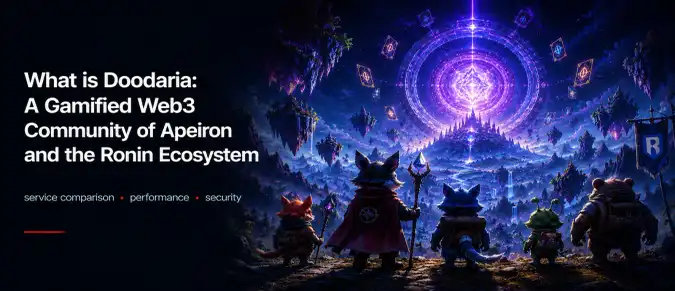

Doodaria is not a standalone blockchain game, but a gamified community built around Apeiron, a Web3 project developed by Foonie Magus. The name is used for Apeiron’s official Discord environment, where participants can earn an internal currency called Souls, join events, and interact with the broader game ecosystem. Apeiron itself combines god game, roguelite, strategy, card-based mechanics, and PvP, while its blockchain layer is connected to NFTs, tokens, and the Ronin network. Doodaria is therefore better understood as the community layer of Apeiron’s broader gaming economy rather than an independent GameFi product.
Contents
- What Is Doodaria and How Is It Connected to Apeiron?
- How Apeiron, Doods, and the Core Gameplay Mechanics Work
- How Doodaria Differs from Apeiron’s Game, NFTs, and Web3 Infrastructure
- Souls, NFTs, APRS, and ANIMA in the Ecosystem
- Ronin, Risks, and the Future of Doodaria and Apeiron
1. What Is Doodaria and How Is It Connected to Apeiron?
Doodaria emerged as the name of Apeiron’s official Discord community. Project documentation describes it as a gamified server — a community where regular communication is supplemented by progression systems, internal rewards, and events. Members of the ecosystem are referred to as Doods, echoing the creatures that inhabit the game’s Planets.
Participants can earn Souls through community activity and use them to obtain various rewards. The documentation mentions in-game items and physical merchandise among the examples. Doodaria therefore adds a gaming layer to Discord, turning community participation into a separate engagement system.
Events also play an important role. They include gaming competitions, entertainment activities, social media campaigns, and collaborative initiatives with other communities. Dedicated roles are associated with moderation and the organization of Doodaria, creating an additional participation structure around the main game.
However, Doodaria should not be described as a standalone NFT game with its own blockchain or token. Official materials primarily associate the name with Apeiron’s community environment. The main gameplay mechanics, NFTs, and crypto economy belong to Apeiron, while Doodaria focuses on social interaction and audience engagement.
2. How Apeiron, Doods, and the Core Gameplay Mechanics Work
Apeiron is being developed by Foonie Magus as a hybrid of several gaming genres. Its current description combines god game, roguelite, card battler, and strategy elements. Players take the role of a Godling, manage their own Planet, and control an Avatar in combat modes.
Doods — the inhabitants of Planets — are a central part of the game world and its visual identity. Players can use elemental Miracles and influence the development of their worlds. Decisions within the god game layer are connected to Planet progression, the behavior of its inhabitants, and the capabilities of the Avatar.
The combat system revolves around the Avatar and Apostles. Apostles belong to different classes and have distinct skills and attributes. Players build teams and use their abilities in PvE or PvP, combining character collection with tactical squad composition.
The project is not limited to a Web3 interface. Apeiron is available on mobile platforms, while its Steam page describes it as a free-to-play strategy game featuring PvP, roguelite, deckbuilding, and RPG elements. This structure allows the core gameplay loop to remain separate from blockchain functionality: players can interact with the game itself, while NFTs are used for specific asset types and economic operations.
3. How Doodaria Differs from Apeiron’s Game, NFTs, and Web3 Infrastructure
The project consists of several layers that can easily be confused when describing the ecosystem. Doodaria represents the community, Apeiron is the actual game, Ronin provides blockchain infrastructure, and NFTs and tokens support specific mechanisms of digital ownership and the game economy.
This distinction is important when evaluating the project. A reward earned within Discord is not necessarily a blockchain asset, and a character used in the game does not automatically have to exist as an NFT. The Web3 layer is used where the project provides transferable ownership or economic interactions involving specific digital assets.
| Component | Primary Function | Type of Interaction | Role in the Ecosystem |
|---|---|---|---|
| Doodaria | Gamified community | Discord, events, and rewards | Engagement and social activity |
| Apeiron | Main game | PvE, PvP, god game, and roguelite gameplay | Core gameplay |
| Planets | Game worlds | Progression and digital ownership | One of the main NFT asset types |
| Apostles | Combat characters | Team building and battles | Game assets, some represented as NFTs |
| Ronin | Blockchain infrastructure | Transactions and NFTs | Web3 layer of the ecosystem |
Doodaria acts as a social layer connecting different parts of the ecosystem. Gaming events can direct community members toward Apeiron, while activity within the game generates opportunities for competitions, discussions, and other community mechanics. This creates a feedback loop between the game and its community without requiring every social interaction to be recorded on-chain.
This approach differs from GameFi models in which most user activity revolves around earning liquid tokens. Doodaria uses its own community reward mechanisms, while Apeiron’s blockchain economy operates as a separate layer.
4. Souls, NFTs, APRS, and ANIMA in the Ecosystem
Souls are Doodaria’s internal currency, which participants can earn through community engagement. Official documentation describes them as rewards for activity and participation in events. Souls should be distinguished from Apeiron’s cryptocurrency tokens, as their primary purpose is tied to the gamification of the Discord community.
The blockchain economy of the main game operates separately. Apeiron documentation describes Apeiros (APRS) and Anima (ANIMA). APRS belongs to the broader ecosystem layer and is associated with NFT creation and other economic functions, while ANIMA is more closely tied to gameplay mechanics and asset progression. The project also uses in-game versions of currencies that are not necessarily tradable blockchain tokens.
- Souls earned through activity within the Doodaria community.
- Events and gaming competitions for Discord participants.
- Planets as one of Apeiron’s main NFT asset types.
- Apostles as characters used to build combat teams.
- APRS as a token within the broader ecosystem economy.
- ANIMA as a token associated with gameplay progression and NFT mechanics.
- Avatar as the controllable embodiment of the Godling in combat modes.
- PvE and PvP as the main directions of the combat system.
- Ronin as the blockchain environment for Apeiron’s Web3 assets.
The NFT infrastructure covers several types of assets. Planets represent game worlds, while Apostles can be used as members of a combat team. Historically, the project has also described Stars, Relics, and other categories of digital items. Tokenization allows certain assets to exist separately from conventional records stored only within a player account.
However, NFTs do not define Apeiron’s entire gameplay experience. Battles, character progression, and interaction with Planets rely on traditional game logic, while blockchain primarily supports the economic layer of selected assets. This enables the project to combine conventional gaming infrastructure with Web3 mechanics without recording every player action on-chain.
5. Ronin, Risks, and the Future of Doodaria and Apeiron
Apeiron initially used Polygon but later migrated its Web3 infrastructure and game assets to Ronin. The migration highlighted an important risk of blockchain gaming: an NFT may continue to exist on-chain, but its practical utility depends on support from the game client, smart contracts, and the current version of the project’s economy.
Economic risks are associated with APRS, ANIMA, and NFTs, whose value depends on demand, liquidity, tokenomics, and audience activity. Changes to game balance or declining interest in the project can affect asset values regardless of an individual player’s progress.
Doodaria additionally depends on community activity and the connection between its gamified mechanics and Apeiron. Without a sustainable core gameplay loop, community features and rewards are unlikely to maintain long-term engagement on their own. At the same time, this format can extend interaction with the ecosystem beyond individual gaming sessions and connect social participation with broader game progression.
Ronin provides specialized infrastructure for Web3 gaming, but the network itself does not guarantee demand for game assets. The key factor remains Apeiron’s ability to retain an active audience and create practical reasons to use NFTs and tokens within gameplay rather than treating them primarily as tradable assets.
Doodaria is therefore better viewed as an extension of the Apeiron ecosystem rather than a standalone Web3 game. The long-term prospects of this model will depend on gameplay quality, community activity, and the project’s ability to combine digital ownership with a sustainable game economy.











