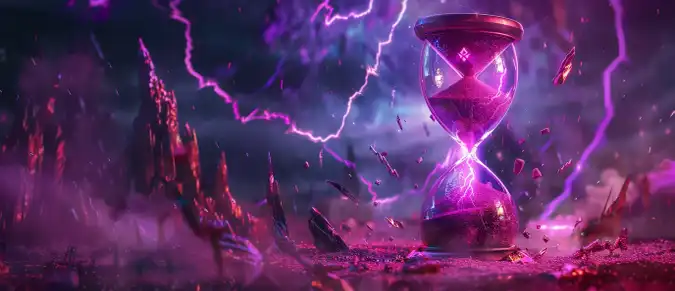

Hourglass World is a fantasy Web3 game with a seasonal strategy model built around control over time streams. Here, time is not just a narrative device, but a resource over which entire races battle. Players assemble armies, manage unique heroes, form alliances, and engage in large-scale conflicts. The game’s economy is powered by NFTs and blockchain, allowing every participant to earn through tactical mastery rather than monetary investment. The project offers equal starting conditions and a deeply strategic system, making it ideal for both Web3 newcomers and experienced players.
Table of Contents
- The World, Lore, and Races of Hourglass World
- Seasonal Format and Gameplay Cycles
- Heroes and Their Roles in the Project
- Economy and NFT Mechanics
- Unique Features of Hourglass World
- Conclusion

1. The World, Lore, and Races of Hourglass World
The world of Hourglass World descended into chaos after the disappearance of the Keeper of Time — the entity responsible for life’s natural cycles. Disrupted temporal flows shattered civilizations, reducing them to myths. Players enter the story at a point of rebirth, as each race — dwarves, elves, orcs, and humans — returns to reclaim their place in a fractured reality. This setting sets a high standard for narrative and strategic engagement.
Abandoned regions hold not just resources, but ancient ruins containing magical keys capable of restoring temporal balance. Some territories transform over time — a forest today could be a wasteland tomorrow. Players must account for this instability when planning expansions. This unpredictability makes each campaign unique and risky, as terrain shifts are never certain.
Additionally, every player becomes a part of the evolving story — discovering new zones, rebuilding ruined cities, or uniting factions directly impacts the overarching narrative. Gameplay and storytelling are tightly intertwined, and every action has consequences. Hourglass World isn't just a map for combat — it’s a living ecosystem.
2. Seasonal Format and Gameplay Cycles
Hourglass World uses a seasonal structure, with each cycle lasting around 45 days. All players start on equal footing at the beginning of each season, eliminating advantages for veteran accounts. Throughout the season, players develop settlements, recruit heroes, forge alliances, and engage in large-scale battles. The season is split into three major phases: early, mid, and final.
| Season Phase | Description | Player Objective |
|---|---|---|
| Early | Base building, scouting, early alliances | Lay foundations for expansion |
| Mid | Territory battles and resource competition | Secure position and defenses |
| Final | Fights for temporal artifacts and flow control | Seize victory and rewards |
Each season comes with a unique theme — such as a time storm, inter-racial conflict, or the return of ancient powers. These affect the map, available quests, and player strategies. At season's end, participants receive token rewards and exclusive NFTs commemorating their achievements. Champions are recorded in the game's chronicle, shaping the world's evolving history based on real player actions.
3. Heroes and Their Roles in the Project
In Hourglass World, heroes are more than just units — they are characters with backstories, roles, and unique skills. Key figures include Baldric Stonehammer, a dwarven blacksmith and leader; Redhead, a mage holding ancient wisdom; Arrowfinger, an elven sniper; and strategist Roy Vicewise. Their abilities influence battles, economy, and environmental interactions.
Heroes fall into different classes: combat, magical, economic, and diplomatic. This allows players to form teams with strong synergy. For example, Redhead boosts magic in unstable time zones, while Baldric increases resource yields in mountain regions. Strategic role combinations can shift battle outcomes or enhance development.
Characters can level up, unlock new skills, and gain seasonal or conditional bonuses. Some abilities scale with the game phase or world state, encouraging adaptive tactics. Rare heroes available only during events also become valuable NFT collectibles, adding depth to collection and gameplay.

4. Economy and NFT Mechanics
Hourglass World’s economy is fully built on Web3 principles. All in-game assets — heroes, artifacts, land — are implemented as NFTs. Players can buy, sell, and rent these assets, creating a decentralized player-driven economy.
- NFT heroes, artifacts, buildings, and resources hold real value
- Trading occurs in-game and via external marketplaces
- 50% of in-game purchase volume funds the seasonal prize pool
- Smart contracts ensure fairness and secure transactions
- Renting and delegated usage systems are available
Additionally, players have an in-game wallet displaying transaction history and earnings. User reputation influences trade conditions and access to rare assets. Thus, active participation and honest play are rewarded on par with performance.
5. Unique Features of Hourglass World
Hourglass World stands out from other Web3 games with its balance of strategy, RPG elements, and social dynamics. The seasonal format provides a level playing field, while its deeply integrated economy allows users to earn without initial investments. Success depends on critical thinking, cooperation, and adaptability.
The atmospheric design combines dark fantasy with temporal anomalies, and adaptive audio evolves with the game's current phase. The community has real influence on the game’s future through in-game voting — developers have implemented a content governance system that includes players in decision-making.
As a result, the project aims not just to be a game but a growing Web3 ecosystem with DAO elements. This expands participation opportunities and adds long-term value. Hourglass World is a platform shaped not only by its developers but also by its active community.
6. Conclusion
Hourglass World is more than a blockchain strategy game — it's a living world where past, present, and future are shaped by player decisions. Every season is a challenge, every victory a meaningful accomplishment, and every NFT a fragment of history. The game combines RPG depth, strategic gameplay, and economic realism into a single experience.
If you're looking for a Web3 project with real meaning, fair earning mechanics, and a deep, evolving world — Hourglass World may be the place where time itself becomes your greatest weapon. Prepare for the next season: build your army, forge alliances, and fight for control over time itself.











