

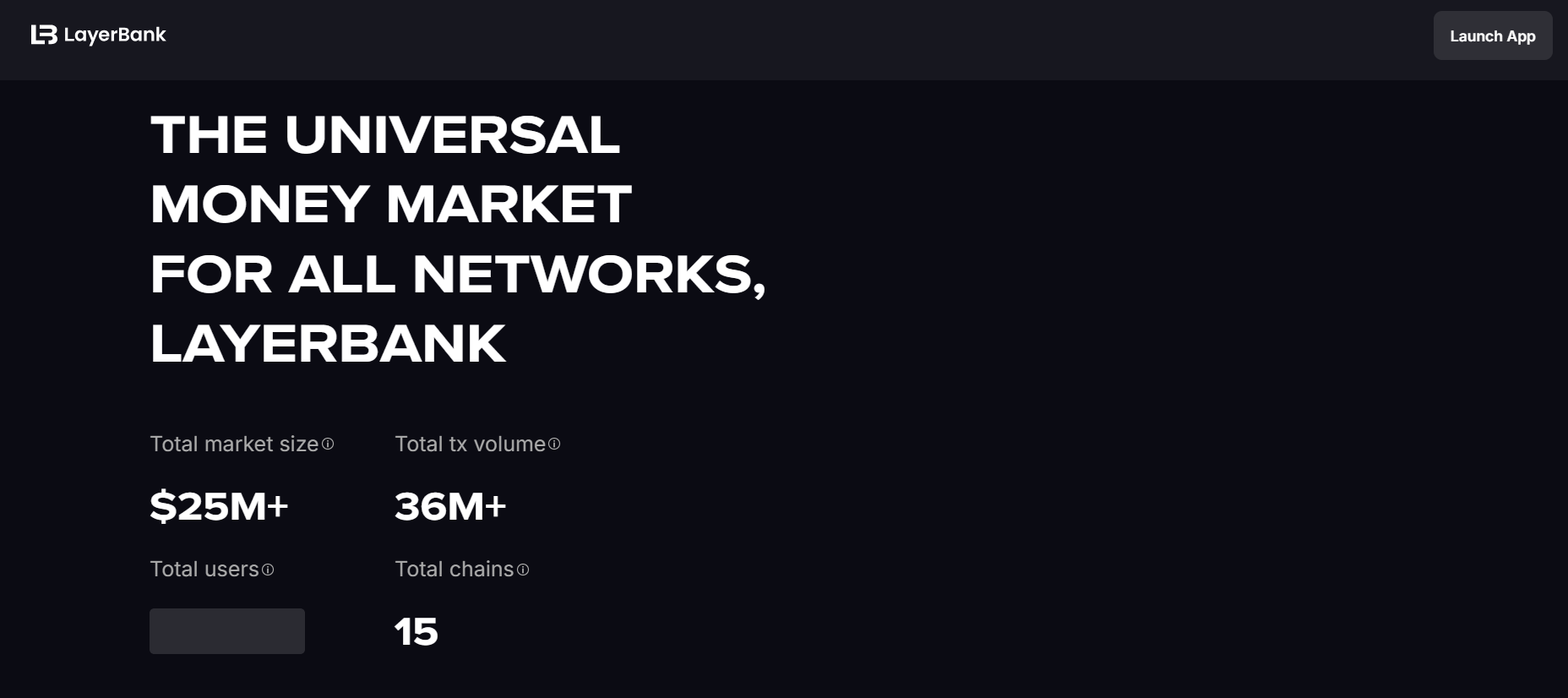
LayerBank is a DeFi lending and borrowing protocol operating in a multi-network environment. The platform follows an omni-chain money market model: users supply assets to pools, earn interest, take collateralized loans, and manage positions through a single interface, while the protocol supports markets across different blockchains and connects user activity through a unified incentive system. Core components of the model include dynamic interest rates, risk management via LTV and liquidations, price oracle integrations, and an economic layer represented by the ULAB token and the L.Points program.
- LayerBank: concept and multi-chain architecture
- Lending and borrowing in LayerBank: market mechanics and risk parameters
- Participation incentives in LayerBank: user opportunities
- ULAB token: distribution and vesting
- LayerBank security, audits, and practical risks
LayerBank: concept and multi-chain architecture
LayerBank is positioned as an omni-chain money market where lending operations retain familiar logic while scaling across multiple networks. This approach addresses liquidity fragmentation: instead of searching for optimal rates and conditions in each blockchain separately, users gain a unified entry point, a shared reward layer, and a clearer overview of available markets. In practice, the “omni-chain” concept is reflected in a unified UX, global incentive campaigns, and the use of cross-chain token infrastructure, including the LayerZero OFT standard for distributing ULAB.
An important nuance is that money markets are technically deployed on specific blockchains, making the parameters of each market—supported assets, limits, rates, and oracles—critically important. LayerBank unifies these markets through product logic and incentive economics, directing user capital toward areas where the protocol seeks to strengthen liquidity and overall resilience.
Lending and borrowing in LayerBank: market mechanics and risk parameters
The core model is over-collateralized lending, where borrowers take loans backed by excess collateral. For depositors, yield is generated from borrower interest and depends on pool utilization. LayerBank documentation describes an interest rate model based on a utilization curve, with accelerated rate growth beyond an optimal utilization point, designed to increase borrowing costs during liquidity shortages and incentivize new deposits.
Risk management is centered around Max LTV and the Health Factor. When collateral prices fall or debt grows due to accrued interest, the health factor declines; once it reaches a critical level, the position becomes eligible for liquidation. Liquidation mechanics typically involve partial debt repayment by a liquidator in exchange for a portion of the collateral plus a bonus, allowing the protocol to protect the pool and restore the position to safer parameters.
For pricing accuracy, the protocol relies on external price oracles. Documentation indicates the use of different providers depending on the network, such as eOracle and RedStone, which is an important consideration when assessing risk within a specific ecosystem.
A separate feature is E-Mode (Efficiency Mode), designed for correlated assets where higher LTV thresholds may apply. This improves capital efficiency but increases vulnerability to stress scenarios such as stablecoin depegging or liquidity issues affecting wrapped assets.
Participation incentives in LayerBank: user opportunities
LayerBank’s economic model is designed to encourage comprehensive participation rather than a single isolated action. Rewards are distributed among depositors, borrowers, and active users, forming a balanced money market where borrowing demand directly supports depositor yields. As a result, the incentive system spans multiple layers of interaction with the platform.
-
Supply (pool deposits): users provide assets and earn floating yield driven by borrowing demand and pool utilization.
-
Borrow (collateralized loans): enables access to liquidity without selling the underlying asset, while borrowing activity is additionally incentivized by the protocol.
-
E-Mode strategies: a higher capital-efficiency mode for correlated assets, allowing greater borrowing capacity than standard settings.
-
L.Points: points are awarded for supply and borrow actions using different multipliers and aggregated globally across supported networks.
-
Liquidity incentives and campaigns: long-term token distribution programs aimed at sustaining liquidity and user engagement.
Together, these mechanisms create an environment where it is beneficial not only to hold assets but also to actively manage positions and participate in the protocol’s ecosystem. This approach strengthens LayerBank’s network effect and enables capital reallocation across chains without compromising a unified economic logic.
ULAB token: distribution and vesting
The ULAB (Universal LayerBank Token) serves as a core element of the protocol’s economic and governance model. Its distribution reflects LayerBank’s long-term development strategy, with a primary focus on incentivizing liquidity and user activity while limiting early-stage pressure from the team and investors.
| Category | Share | TGE Unlock | Cliff | Vesting |
|---|---|---|---|---|
| Core Team | 15.0% | 0% | 6 months | 24 months |
| Investors | 15.0% | 5% | 3 months | 13 months |
| Public Sale | 1.0% | 100% | — | — |
| Liquidity Provision | 7.5% | 100% | — | — |
| Liquidity Incentives | 45.0% | 10% | — | 36 months |
| Airdrops | 10.0% | 100% | — | — |
| Strategic Reserves | 6.5% | 0% | 3 months | 24 months |
This distribution structure allows the protocol to maintain attractive user conditions over an extended period through incentives, without creating abrupt token market pressure. Gradual vesting for the team and investors helps reduce short-term volatility risks and supports greater economic stability for ULAB in the medium term.
LayerBank security, audits, and practical risks
LayerBank reports multiple audit engagements, including PeckShield (V1/V2), MoveBit (Move-based implementation), and AstraSec (v3 components, Leverage Vault, and E-Mode enhancements). This reflects a mature development process, though audits do not eliminate risk—they primarily reduce the likelihood of critical vulnerabilities.
Common money market risks include collateral volatility and liquidations, rising borrow APR during high pool utilization, oracle failures, and network or infrastructure risks tied to specific blockchains. In a multi-chain model, an additional “environment variable” emerges: the same strategy may perform differently across networks due to variations in liquidity, latency, price feeds, and market parameters.
User discipline in practice comes down to monitoring LTV and health factor, selecting assets with reliable liquidity, exercising caution with E-Mode, and understanding that point-based programs are incentives for activity rather than guaranteed financial outcomes.











