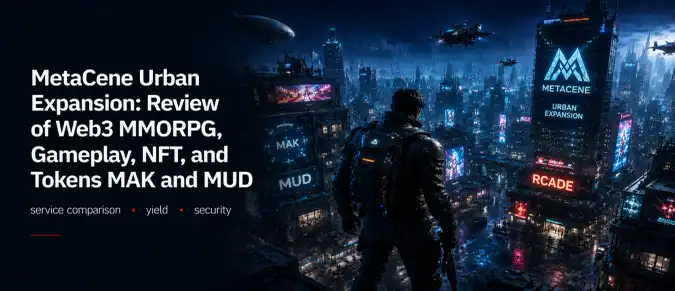

MetaCene is a blockchain MMORPG featuring an open post-apocalyptic world, PvE, PvP, guilds, trading, and a digital asset economy. The project has been in development since 2021, has gone through several testing stages, and has gradually expanded from its original Rangers Sub-Chain model to a multi-chain infrastructure with integration into Mantle. In 2026, the mobile version is presented as METACENE:ASCEND, while the developers continue to update game environments, seasonal economy mechanics, and content. However, MetaCene Urban Expansion is not documented as a separate official release in the available project materials, so the term is more accurately considered in the context of the expansion of MetaCene's world, servers, and user-driven infrastructure.
Contents:
- MetaCene Urban Expansion: Development of the Game World
- Open World, PvE, PvP, and Guild System
- NFTs, Realms, and the Expansion of the Player Economy
- MAK and MUD Tokens and MetaCene Blockchain Infrastructure
- MetaCene Development, Urban Expansion, and Key Risks
1. MetaCene Urban Expansion: Development of the Game World
MetaCene is being developed as an MMORPG that combines traditional game mechanics with digital asset ownership and elements of decentralized governance. The project is built with Unreal Engine 5 and was originally planned for PC, mobile devices, and cloud gaming. Its setting is based on a post-apocalyptic world where players explore territories, collect resources, fight enemies, and form communities.
Development began in 2021, while the first major public tests took place in 2023. Alpha Test V.1 attracted more than 2,900 users, while the second testing phase involved more than 5,000 participants. In March 2024, MetaCene announced a $10 million Private A funding round led by Folius Ventures and SevenX Ventures, with participation from Spartan Group, Mantle, Animoca Ventures, and other investors. The project later reported approximately $17 million in total funding.
The official roadmap described the development of the world through three stages: Genesis of Fire, Realm of Apocalypse, and Spirit of All Things. The first establishes the core MMORPG, the second is intended to expand the world through private servers, governance, and user-generated content, while the third is connected to the broader Pangu Universe and World Island concept. The expansion of cities, territories, and social spaces therefore fits into the project's long-term architecture.
However, a separate product or major update officially titled Urban Expansion is not sufficiently documented in MetaCene's public materials. When analyzing this term, it is important not to attribute unconfirmed districts, buildings, or mechanics to the game. What has been confirmed is a broader direction of development involving new maps and game environments, expansion of the server network, seasonal content, and a transition toward user-created worlds.
2. Open World, PvE, PvP, and Guild System
MetaCene retains the traditional structure of an MMORPG. Players explore open areas, develop their characters, obtain equipment and resources, complete dungeons, and interact with other participants. Game areas are divided by security level into Safe Zones, Neutral Zones, Danger Zones, and Ruins Zones. Available activities and the degree of PvP risk depend on the type of territory.
PvE includes both open-world activities and dedicated dungeon scenarios. Dynamic activities may appear throughout the world, including resource gathering, character escort missions, monster attacks, and other events. PvP is available in some of the more dangerous areas, while the MMORPG's social structure is built around teams and guilds.
The main gameplay areas include:
- Open World — exploring post-apocalyptic territories and searching for resources.
- PvE — fighting regular enemies and bosses and completing dungeons.
- PvP and GvG — competition between individual players and guilds.
- Mining — obtaining materials through resource extraction mechanics.
- Trading — exchanging weapons, materials, and other in-game assets.
- Guilds — bringing players together for cooperative activities and governance.
- Seasonal Content — rankings, events, and economic changes introduced through seasons.
The current mobile version, METACENE:ASCEND, maintains its focus on open-world exploration, PvE, PvP, dungeons, and social interactions. In August 2026, the application received an update featuring the Alloy Rush season, a new seasonal ranking system, changes to the game economy, and updated game environments. This indicates that the project continues to evolve through regular content expansion rather than blockchain features alone.
3. NFTs, Realms, and the Expansion of the Player Economy
MetaCene's Web3 model provides digital ownership of certain in-game resources. According to the project's documentation, NFT assets include various categories of equipment, land, and other objects. Early collections included MetaCene Apostle NFTs and Cece Cube, while the further development of the economy introduced Realms NFTs and the concept of server-based assets.
Realms are connected to the Realms Private Server Network concept. Under this model, a server is viewed not only as technical infrastructure operated by the developer but also as a separate economic unit. The concept allows Realm owners to participate in user acquisition, asset distribution, governance, and content development. In 2024, MetaCene also introduced CARRY, a product built around the ServerFi model.
The next stage of development is intended to give users a more active role in creating the game world. MetaCene's documentation describes AIGC tools and UGC designed to allow the community to participate in creating objects, game mechanics, and content. Under the long-term World Island concept, land may be used to host both gaming and non-gaming content, including user-created modules.
This architecture explains the importance of expanding the game world for MetaCene's economy. New territories could potentially increase the number of use cases for resources, land, and server infrastructure. However, plans related to UGC, World Island, and later stages of the metaverse should be distinguished from features that are already available in current versions of the game.
4. MAK and MUD Tokens and MetaCene Blockchain Infrastructure
MetaCene's economy uses two primary fungible tokens — MUD and MAK. MUD serves as an in-game utility asset and unit of account. According to the documentation, it can be used to purchase equipment, conduct P2P trading, participate in auctions, settle transactions involving in-game NFTs, pay for teleportation, and perform other operations.
MAK is the ecosystem's governance token. Its stated total supply is 1 billion tokens. MAK is used in mechanisms related to governance and the creation of more advanced digital assets, including staking. MAK trading began in September 2024, after which the token became a separate market component of the MetaCene economy.
| Component | Purpose | Web3 Connection |
|---|---|---|
| MUD | In-game unit of account | Trading and in-game operations |
| MAK | Governance token | Governance, staking, and digital assets |
| Realms | Server infrastructure | ServerFi and governance |
| NFT | In-game assets | Digital ownership and trading |
| Mantle | Blockchain infrastructure | On-chain ecosystem operations |
| UGC / AIGC | Content creation | Expansion of the user-driven world |
The project's blockchain architecture has also evolved. The original documentation described the launch of Genesis of Fire on Rangers Sub-Chain, followed by a multi-chain deployment. Gold Rush in 2024 was connected to Mantle, and in January 2025, the MetaCene Software Foundation announced the migration of MetaCene to Mantle Network. The project is therefore more accurately viewed as an evolving multi-chain ecosystem rather than a game permanently tied to a single blockchain.
5. MetaCene Development, Urban Expansion, and Key Risks
MetaCene's expansion covers several areas at once: growth of the game world, server development, seasonal content, user governance, and the creation of digital objects. The Realm of Apocalypse concept envisions a more open world with the Realms Private Server Network and UGC, while Spirit of All Things extends this model toward the Pangu Universe and World Island.
At the same time, a long-term roadmap does not guarantee that every feature will be implemented exactly as originally described. MetaCene has already changed its blockchain infrastructure and gradually expanded its product model. Early documentation concerning Realms, land, AIGC, and future development stages should therefore be compared with current versions of the game and official updates.
For players, the main risks are not limited to MAK and NFTs. Relevant factors include the condition of the in-game economy, liquidity of digital assets, changes to reward rules, blockchain transaction costs, and demand for server-based assets. The market value of MAK may fluctuate independently of the quality of the MMORPG itself, so the token should not be treated as an indicator of the game's success.
For MetaCene, the key priority remains the development of a complete MMO: the quality of the open world, PvE and PvP, economic balance, performance, frequency of new content, and the ability to retain an active community. In this context, Urban Expansion is better understood as a direction for expanding the game world and social infrastructure until the developers formally assign the name to a specific release. The current METACENE:ASCEND and Alloy Rush season confirm continued development, but the prospects of the broader model involving Realms, UGC, and World Island will depend on its actual implementation.











