

In the world of decentralized finance (DeFi), a new and ambitious platform is emerging — Panoptic. This protocol, built on the Ethereum blockchain, offers a unique approach to options trading by eliminating the need for oracles and intermediaries. By leveraging the liquidity of the largest decentralized exchange, Uniswap v3, Panoptic enables the creation, buying, and selling of perpetual options on a wide range of tokens. This opens up new opportunities for traders and liquidity providers to earn income, hedge risks, and implement complex strategies.
Contents:
- What is Panoptic and its Main Mission
- Technological Foundation: Integration with Uniswap v3
- Key Capabilities and Protocol Advantages
- Ecosystem Participants and Benefits for Different User Types
- Security, Audits, and Future Development of Panoptic
- Conclusion
What is Panoptic and its Main Mission
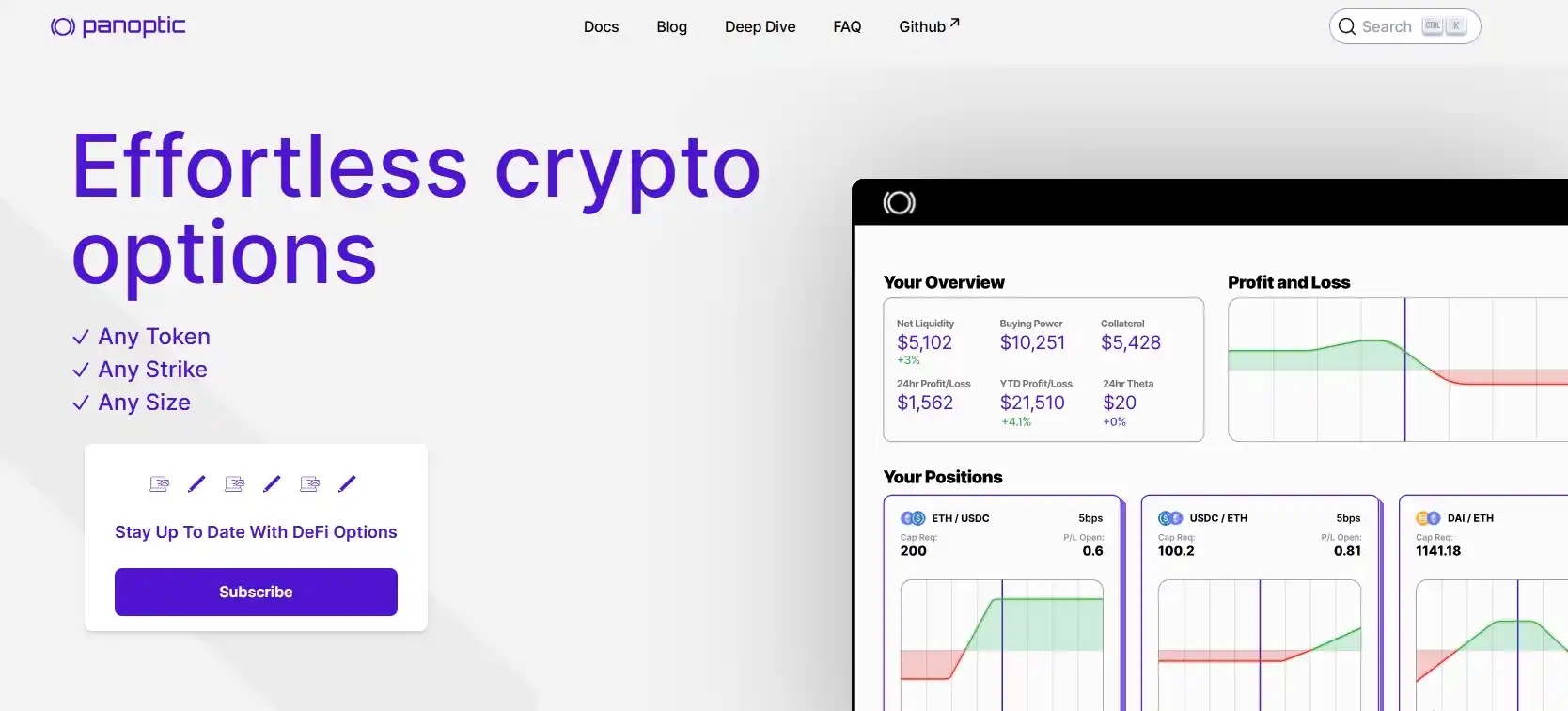
Panoptic is an innovative protocol created for trading derivatives in the world of decentralized finance. Its key mission is to develop an open, 24/7 operational platform for perpetual options. Unlike classic option contracts with fixed expiration dates, Panoptic's instruments have no expiry. This gives traders the ability to build long-term strategies without being tied to constantly rolling over positions.
A key feature of the system is the rejection of using oracles to determine the price of the underlying asset. Instead, the protocol relies on Automated Market Maker (AMM) mechanisms and Uniswap liquidity, which enhances decentralization and resistance to manipulation. Panoptic has become the first implementation of such a complex financial instrument as options directly on the Ethereum blockchain, representing a significant technological achievement.
Technological Foundation: Integration with Uniswap v3
The fundamental technological innovation of Panoptic is its deep integration with the decentralized exchange Uniswap and its third version. The protocol does not create liquidity from scratch but utilizes existing Uniswap v3 pools. This allows Panoptic to offer options on a vast number of tokens, including ETH, USDC, UNI, AAVE, MATIC, and many others, provided liquidity for them exists on Uniswap.
This approach solves several complex challenges. Firstly, it ensures high capital efficiency, as the same capital in a liquidity pool can be used simultaneously for ordinary swaps and for backing option positions. Secondly, it eliminates reliance on external oracles — the strike price and the calculation of profits and losses are determined based on the internal AMM mathematics and liquidity positions. Integration with Uniswap makes the protocol truly public and open.
Key Capabilities and Protocol Advantages
The Panoptic protocol offers users a number of unique advantages that radically distinguish it from traditional and existing decentralized options platforms. Its architecture removes many limitations of classical derivative markets, providing unprecedented flexibility and control. Key system capabilities include:
- No Expiration: Positions in perpetual options have no expiry date, allowing traders to implement long-term strategies without the need for constant contract rollovers.
- Liquidation Protection: Option buyers face only limited risk, not exceeding the premium paid, and are completely protected from forced position closure.
- 24/7 Access: Like any smart contract on Ethereum, the protocol is available 24/7 for interaction without intermediaries such as banks or centralized exchanges.
- Full Decentralization: Trading and settlements occur directly between users through automated contracts, eliminating the need for clearinghouses or market makers.
Thus, Panoptic opens access to complex option strategies for a wide range of market participants. These features make the platform particularly attractive both for experienced traders seeking new tools and for passive liquidity providers looking to increase the yield on their assets.
Ecosystem Participants and Benefits for Different User Types
The Panoptic ecosystem is designed for various categories of decentralized finance participants, and each finds their own benefit in the protocol. The platform provides tools for both active market players and those who choose passive strategies, which helps form a stable and liquid-rich market. The following table shows how the system works with different user types.
| Participant Category | Main Benefit from Panoptic | Key Characteristic |
|---|---|---|
| Options Traders | A full-fledged platform for profitable strategies on any asset with any strike price. | Trading combined strategies (e.g., "Jade Lizard") with no expiration date. |
| Perpetual Contract Traders | Ability to trade using leverage without the risk of forced liquidation and with limited downside. | Free access to any token available in Uniswap v3 liquidity pools. |
| Uniswap Liquidity Providers | Increased profit and protection from impermanent loss on existing investments. | Application of advanced tactics and risk control methods. |
| Passive Investors | Earning income without the need to actively manage positions and constantly monitor the market situation. | A simple way to earn that minimizes interaction with impermanent loss. |
Thus, the protocol forms a mutually beneficial environment where some participants gain access to advanced financial instruments, while others get new opportunities to earn on their capital. This diversity of roles strengthens the entire system, ensuring a constant influx of funds and a variety of trading approaches.
Security, Audits, and Future Development of Panoptic
Security is an absolute priority for the Panoptic team, given the complexity of the smart contracts for working with derivatives. The protocol undergoes rigorous, multi-level audits by leading companies in blockchain security. At the time of writing, the first audit by Obsidian is complete, the second by Nethermind is in progress, and a third, competitive audit is planned for the future. This comprehensive "360-degree" approach sets new standards for DeFi platform security.
The first version of the protocol (V1) encountered a vulnerability; however, the team successfully rescued all user funds, demonstrating a high level of responsibility. Current focus is on the launch of Panoptic V2. The protocol already operates on the Ethereum, Base, and Unichain networks, with expansion to other blockchains planned in the near future. The development of Panoptic and its integration into various ecosystems confirms the growing demand for decentralized, transparent, and accessible tools for managing financial risks in the crypto industry.
Conclusion
Panoptic represents a landmark breakthrough in the development of decentralized finance, taking complex derivatives to a fundamentally new level of accessibility and efficiency. Thanks to deep integration with proven Uniswap v3 liquidity and the rejection of external price feeds, the protocol creates a stable, open, and capital-efficient ecosystem for trading perpetual options.
By focusing on multi-level security and meeting the needs of different user types — from active traders to passive investors — Panoptic lays a solid foundation for future growth. Its development, including the launch of the second version and expansion to new networks, confirms the growing demand for transparent and democratic financial instruments, reinforcing the very idea of decentralized risk and capital management in the crypto industry.











