
Pixels: Countryside Update represents a stage in the development of the Pixels Web3 game in which farming, land management, resource production, and player interaction within a shared economy remain central elements. Pixels is a social farming MMO with pixel-art graphics where users grow crops, develop professions, complete tasks, and use virtual land plots. The game operates within the Ronin ecosystem, which transitioned to an Ethereum Layer 2 architecture in May 2026, while the Pixels digital economy includes the PIXEL token and NFT assets. The Countryside direction continues the project's core concept by making the development of virtual rural land part of a broader system of resources, professions, and digital ownership.
Contents:
- What Is Pixels: Countryside Update and How the Game Is Evolving
- Farming, Resources, and the Development of the Rural Economy
- NFT Land, Specks, and the Role of Landowners
- PIXEL, Game Economy, and Web3 Mechanics
- Pixels Development, Open Ecosystem, and Key Risks
1. What Is Pixels: Countryside Update and How the Game Is Evolving
Pixels was originally built around farming and life-sim mechanics. Players begin with basic activities such as growing crops and collecting resources before gaining access to more complex production chains. Unlike a traditional single-player farming game, Pixels features a shared social world with the central Terra Villa location, quests, professions, events, and interactions between users.
The concept of the Countryside Update is primarily associated with the development of Pixels' agricultural component rather than the creation of a separate game or a new blockchain. Farms, resources, processing, and land management are already fundamental elements of the project. Changes in this area should therefore be viewed in the context of the continuous evolution of the overall game economy.
Pixels operates as a live-service product: resource balance, quests, methods of earning PIXEL, and NFT Land benefits can change over time. For example, the developers previously reworked the BERRY model, concentrating the blockchain economy around PIXEL, and later began moving part of PIXEL reward distribution to the Stacked system. These changes demonstrate that the project's economy is not static.
At the same time, the team is expanding Pixels beyond a conventional farming game. In 2026, the client-side source code was opened, followed by the project's backend. Developers also began building tools for creating custom quests, mechanics, and separate versions of the game world, gradually transforming Pixels from a single MMO into a broader gaming platform.
2. Farming, Resources, and the Development of the Rural Economy
Farming remains one of the core professions in Pixels. Players use seeds and prepared soil plots to grow plants through several development stages. Water is an essential resource: without watering, growth stops, and crops may die if left unattended for too long. Additional items, including fertilizers, can also affect the production cycle.
The economy extends beyond harvesting crops. Pixels documentation describes several resource categories, including soil, crops, wood, water, stone, power, and metal. Resources can vary in rarity, while certain materials are available only on specific types of land. As a result, territory serves not only as a visual environment but also as part of the production system.
- Farming — growing crops and obtaining agricultural resources.
- Forestry — working with wood and related production chains.
- Mining — extracting materials required for other professions and crafting.
- Animal Care — interacting with animals and related production activities.
- Crafting — processing basic resources into more complex items.
The profession system creates interdependence between different activities. Collecting a single type of resource is often not enough: some items require sequential production stages or the use of specialized industries. This creates an economic cycle in which a resource's value is linked to its use in other recipes and quests.
The Task Board and its associated assignments also play an important role. Players deliver specific items to NPCs in exchange for Coins, experience, and, in some cases, PIXEL. In 2026, the reward system continued to evolve, with part of the PIXEL rewards moving to Stacked. For the economy, this represents a gradual separation between standard gameplay progression and blockchain token distribution.
3. NFT Land, Specks, and the Role of Landowners
Land is one of the main Web3 components of Pixels. The ecosystem includes 5,000 NFT Farm Lands, each represented by an individual NFT. Owning land is not required to start playing: users can access basic Specks and other available territories. However, NFT Land provides additional opportunities related to plot size, industries, production, and management.
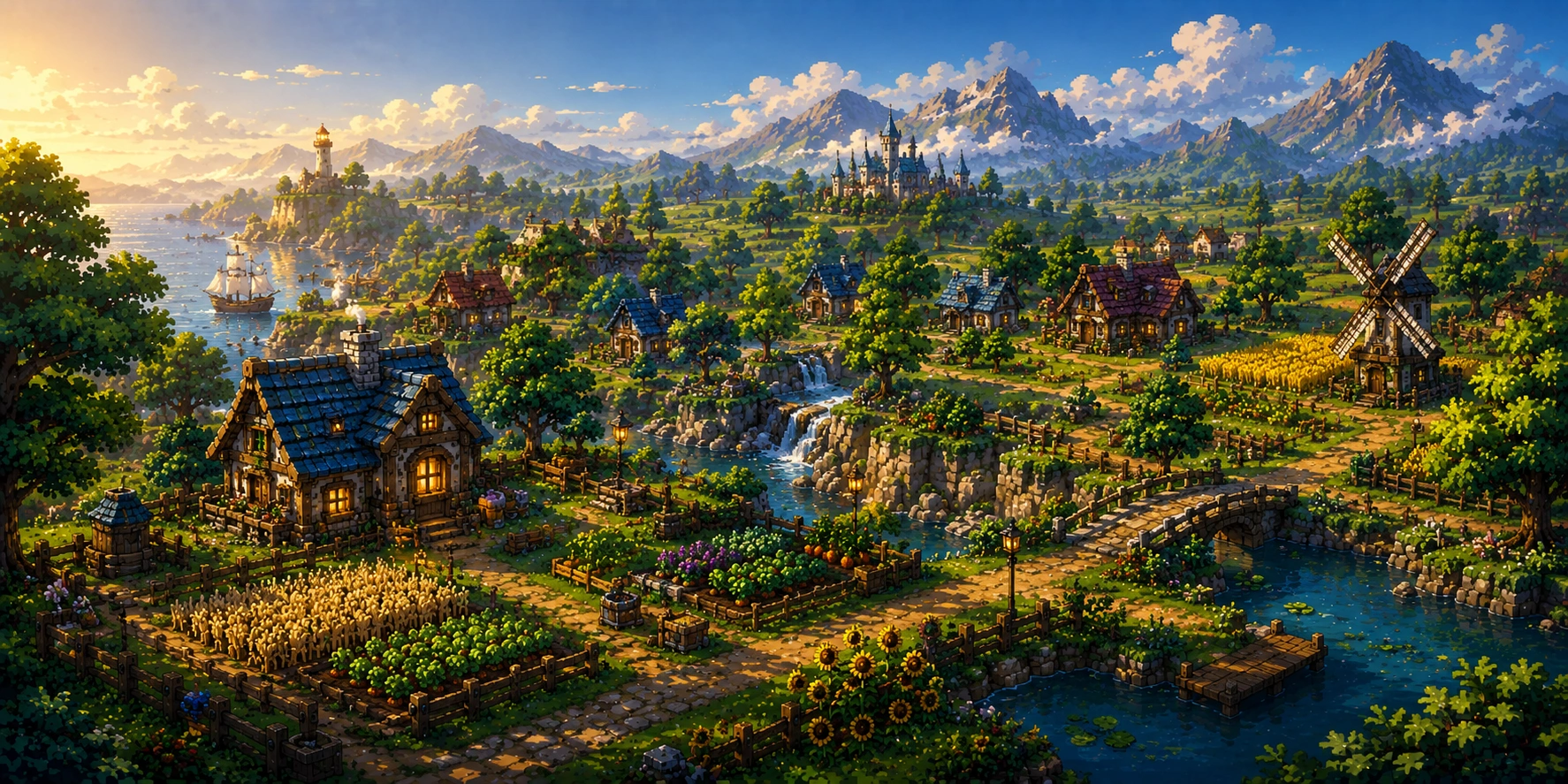
Land plots have different characteristics, including size, environment, tree density, and the presence of structures such as a Coop, Windmill, or Silo. These characteristics can influence available resources and farming capabilities. Land also supports the placement of industries and decorative objects, allowing owners to develop a particular specialization for their property.
Pixels includes mechanics that allow other players to interact with land and production infrastructure owned by someone else. For landowners, this creates an additional gameplay layer: rather than being used exclusively for personal farming, a plot can function as a production area accessible to other participants. Pixels documentation has historically described such relationships through sharecropping and surplus models.
However, the economic role of NFT Land depends on the current game balance. Reward levels, resource availability, industry restrictions, and additional bonuses can be changed by the developers. NFT Land is therefore more accurately viewed as an in-game asset with specific utility rather than an instrument that guarantees returns.
4. PIXEL, Game Economy, and Web3 Mechanics
PIXEL is the primary blockchain token of the Pixels ecosystem. The project gradually moved away from a model in which PIXEL and BERRY were both actively used as on-chain assets. One of the reasons cited was BERRY inflation and the difficulty of balancing an MMO economy where game resources can be freely withdrawn and sold.
PIXEL is used across different parts of the ecosystem, including in-game purchases, selected NFT mechanics, VIP features, and related Pixels products. At the same time, regular gameplay does not require constant blockchain transactions. This approach reduces the number of wallet interactions and separates core gameplay activity from operations involving digital assets.
| Element | Function in Pixels | Web3 Connection |
|---|---|---|
| PIXEL | Ecosystem utility token | Blockchain asset |
| Coins | In-game transactions and rewards | Primary in-game currency |
| NFT Farm Land | Land, industries, and plot management | NFT with in-game utility |
| Specks | Basic plots available to players | Allow users to play without purchasing NFT Land |
| NFT Avatars | Use of compatible digital characters | Integration of third-party NFT collections |
| Stacked | Tasks and distribution of part of PIXEL rewards | Token-related infrastructure |
A distinctive feature of Pixels is its support for NFTs from third-party collections as in-game avatars. This is an example of interoperability in which a digital asset created outside Pixels receives a visual use case within the game world. This model differs from an approach where all NFTs are issued exclusively by the game's developer.
Pixels' blockchain infrastructure is connected to Ronin. The game migrated to the ecosystem in 2023, while Ronin itself completed its transition to an Ethereum Layer 2 architecture in May 2026. For Pixels, this means maintaining its existing Web3 model while the underlying network infrastructure evolves. NFT Land, Pets, PIXEL, and other on-chain components continue to interact with the Ronin ecosystem.
5. Pixels Development, Open Ecosystem, and Key Risks
In 2026, Pixels began expanding beyond standard farming mechanics. The team opened the source code for both the client and backend, allowing developers to create modifications, custom mechanics, and their own versions of the game through sandbox infrastructure. A community platform also enables users to test community-created projects and evaluate new ideas. This direction could expand farming, crafting, professions, and social mechanics through user-generated content. However, features created by the community do not necessarily become part of the main Pixels game.
The main risks are associated with balancing both the in-game and blockchain economies. Excessive resource production can increase in-game inflation, making stable demand, bot prevention, and player retention important factors. Additional risks involve PIXEL and NFTs, whose market value depends on broader crypto market conditions as well as changes to token rewards, utility, and NFT Land rules. Pixels: Countryside Update expands farming, crafting, professions, and the land economy within a social MMO environment. Ronin's transition to Ethereum L2 and the opening of the Pixels codebase broaden the project's technical foundation, but its sustainability will depend on gameplay quality, community activity, and a balanced in-game economy.











