

AI tools helped gather research and write the first draft of this article. I edited it and checked every definition and quote against the page it comes from, listed at the end. The cover illustration is AI-generated. Details at the end.
Picture a post about an article that collects 40 likes, 6 replies and 3 quotes in a week. Written into a spreadsheet, that is three numbers, and the six replies look like a small, pleasant figure.
Open them and the picture changes. Two readers ask the same question the article never answered. One points out that a date in the third section is wrong. One quote disagrees with the main argument and explains why. Most of the rest say thanks. None of that is in the number 6.
An engagement count tells you how many times readers did something. The conversation behind it tells you what the article did to them, and that is the part that can change the next article. This piece sets out what X, LinkedIn and Telegram actually record about replies, quotes and comments, where the text of the conversation sits on each platform, and a simple way to sort it.
This is part 8 of the Platforms & Metrics series. Part 7 put one column for replies or comments into a small author dashboard and noted that a reply is something a reader wrote, which makes it the easiest signal to inspect. This part opens that cell and reads what is inside.
What the counters record
Each platform gives a count for the conversation around a post. None of them gives more than a count.
| Platform | Conversation counters | What the documentation says | Where the text is |
|---|---|---|---|
| X | Replies, quotes | reply_count and quote_count are among the public metrics of a post [1][2] | Replies in the post's conversation; quotes are separate posts [2][3][4] |
| Comments, reposts | Comments: "The number of times members or pages commented on your posts" [5] | Under the post | |
| Telegram | Comments (replies) | The total number of replies in the post's comment section [8] | A comment thread and the linked discussion group [7][8] |
X's data dictionary lists reply_count and quote_count among a post's "Public engagement metrics for the Tweet at the time of the request" [2].
LinkedIn notes that totals go down when an engagement is removed, for example when "a member removes a reaction, deletes a comment" [5]. A comment count read today can be lower tomorrow.
Two things follow. First, every one of these figures is a count of messages, not of people: the documentation pages quoted here do not say that one person writing three replies is counted once. Second, the counts say nothing about content. Six thank-you notes and six corrections produce the same 6.
Not every count is the same act
Likes and reactions are one click. LinkedIn offers several reactions instead of one like, and its help page gives each a meaning. Insightful "Expresses that you thought the post made a great point, offered a new idea, or shared helpful insights or advice"; Celebrate is for "an announcement, congratulating a personal or professional milestone" [6]. Insightful and Celebrate say different things about an article, but each is still a click, not a sentence.
Reposts pass the post on; quotes pass it on with an opinion. X counts the two separately: a repost count that excludes quotes, and a quote count for "reposts with comment" [1]. A quote is written for the quoter's own followers, not for the author, which often makes it the most candid response, and the easiest to miss.
Replies and comments are written to the author. They are where questions and corrections usually arrive.
The ranking systems make the same distinction. In 2023 X published the code of its home timeline ranking model. Its README describes a model that predicts, for each post, "the probability that the user will engage with the tweet in a particular way", and combines those predictions "by doing a weighted sum" [9]. The weights listed for that date were 0.5 for a like, 1.0 for a repost, 13.5 for a reply and 75.0 for a reply that "is engaged by the Tweet author"; negative feedback carried −74.0 and a report −369.0 [9]. The README explains that the weights "were originally set so that, on average, each weighted engagement probability contributes a near-equal amount", so a reply weighs more partly because it is rarer, and that they "can be adjusted at any time" [9]: a 2023 snapshot, not today's values.
LinkedIn's engineering blog draws a similar line between "passive behaviors such as clicks, dwell time" and "active contribution behaviors such as comments, reshares" [10].
The point is not to chase those weights. The platforms themselves do not treat a like and a reply as the same unit; one combined "engagement" figure throws that distinction away.
Where the conversation actually lives
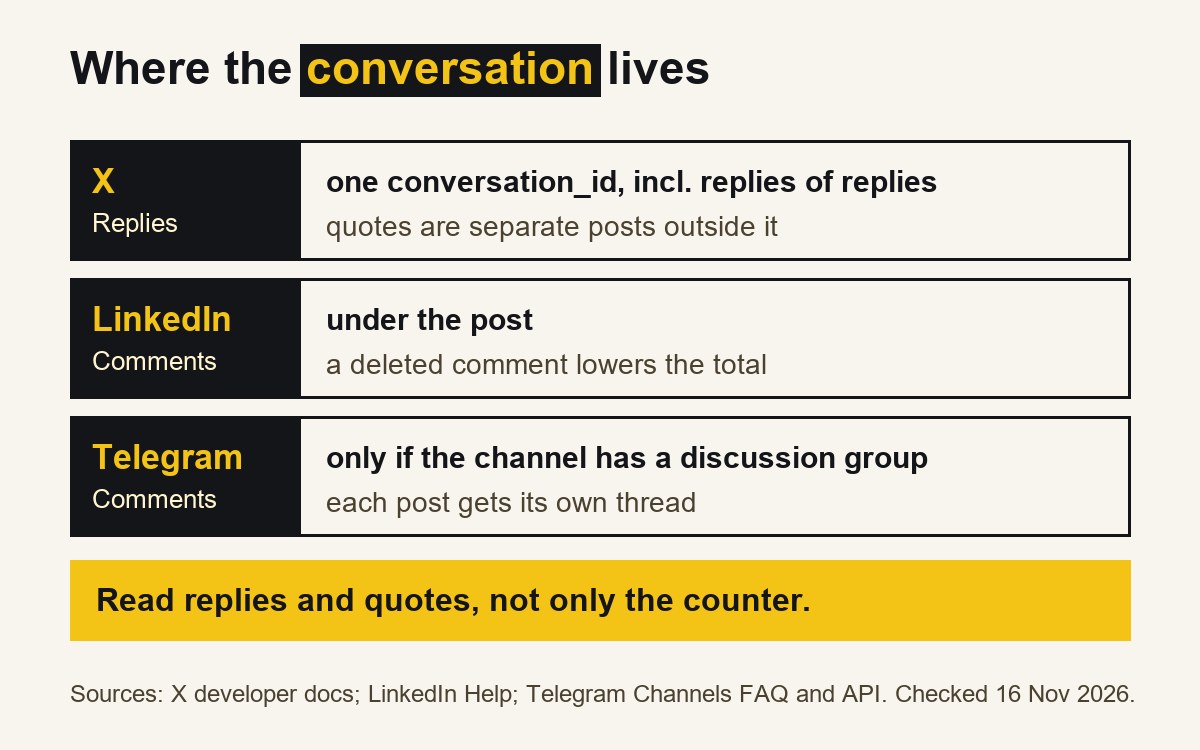
X: replies in one conversation, quotes outside it. X's documentation says that "When someone posts and others reply, all replies share the same conversation_id", and that "No matter how deep the thread goes, all posts share the same conversation_id" [3]. The data dictionary describes the conversation as including "direct replies, replies of replies" [2]. The thread therefore includes exchanges between readers, which are often the most informative part.
Quotes are not part of that conversation. They are separate posts, and the API has a separate endpoint that "Retrieves a list of Posts that quote a specific Post by its ID" [4]. An author who reads only the replies misses every quote.
LinkedIn: comments under the post. The analytics page defines the comment count but does not say whether replies to comments are included [5], so the count and what you see under the post may not match exactly.
Telegram: comments only if the channel has a discussion group. Telegram's channel FAQ explains that when one is added, "your subscribers will see a comment button for each post in the channel", and that "Comments show up in a thread of their own and also land in the discussion group" [7]. In the API, a post's comment section carries the ID of "the associated discussion supergroup" and "the total number of replies" [8]. For a channel without a discussion group, the conversation is not on the post at all; any conversation happens elsewhere, for example where readers forward it.
Six kinds of response
Reading responses one by one leaves an impression, not a record. Sorting each into a small, fixed set of kinds makes them countable and comparable over time. Six kinds cover most of what an article attracts:
- Question. The reader wanted something the article did not give: a definition, a source, a next step. Two or more questions about the same point usually mean a gap in the article.
- Correction. The reader says a fact, figure, date or link is wrong. Each one needs checking against the source. If it is right, the article gets a visible correction.
- Disagreement. The reader accepts the facts but disputes the argument or the conclusion. It shows where the reasoning did not persuade, and is often worth answering in the next article.
- Addition. The reader brings an example, a source or an experience the article did not have. Additions are candidates for a follow-up, once checked.
- Agreement. Thanks, praise, "exactly this". Pleasant, but it rarely says why the piece landed.
- Noise. Spam, promotion, replies that ignore the post. These should be left out of every count the author keeps.
A response can belong to two kinds; a reply can agree and add an example. Put it under the kind that asks more of the author, in this order: correction, question, disagreement, addition, agreement.
The six are a working convention for an author, not a standard taken from any platform. Any fixed set works, as long as it stays the same from article to article, so that "three questions this time, none last time" means something.
A worked example
The responses and numbers below are invented for this article and do not describe any real post.
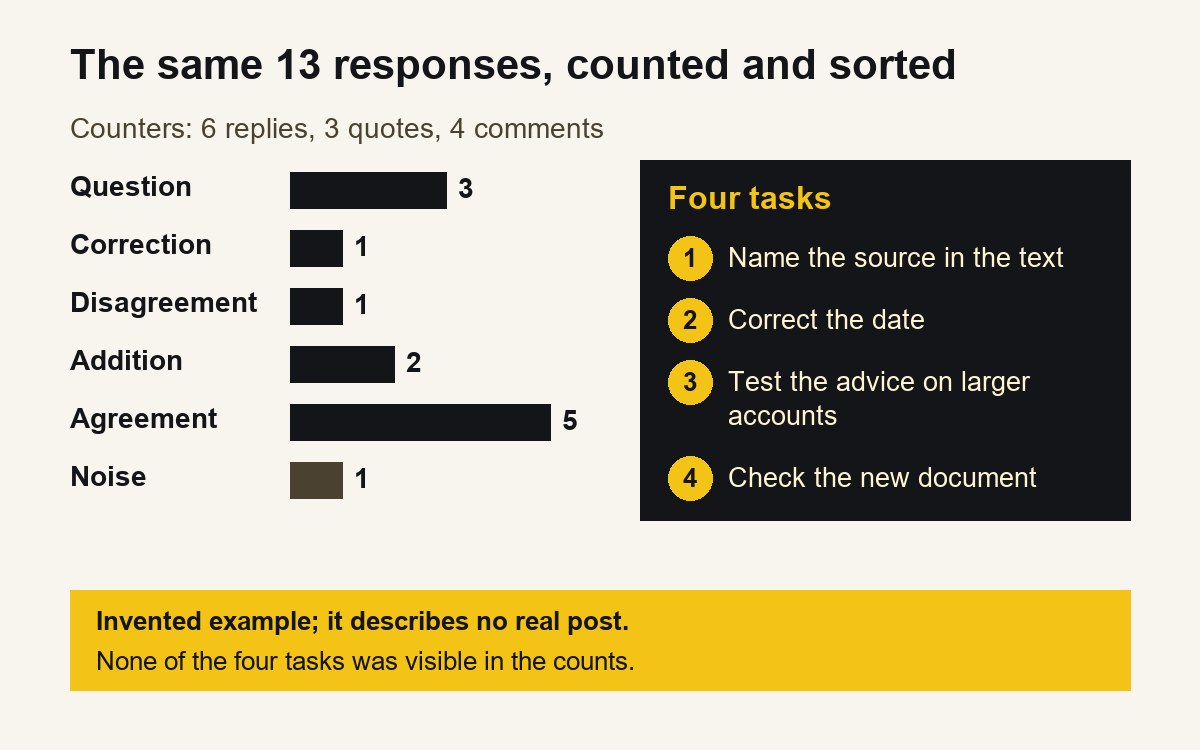
Return to the post from the opening. A week after it went out, the author reads the 6 replies and 3 quotes on X and the 4 comments in the Telegram discussion group, and sorts all 13:
| Kind | X replies | X quotes | Telegram comments | Total |
|---|---|---|---|---|
| Question | 2 | 0 | 1 | 3 |
| Correction | 1 | 0 | 0 | 1 |
| Disagreement | 0 | 1 | 0 | 1 |
| Addition | 0 | 1 | 1 | 2 |
| Agreement | 3 | 1 | 1 | 5 |
| Noise | 0 | 0 | 1 | 1 |
All three questions ask the same thing: which source the main claim came from. The correction is right: a date was copied wrongly. The disagreement, in a quote, argues that the article's advice only works for small accounts. One addition links to a document the author had not seen.
The counts say the post did reasonably well. The sorted table says four concrete things. The source for the main claim should be named in the text, not only in the list at the end. The date needs a correction note. The next article could test whether the advice holds for larger accounts. And there is a new document to check.
None of the four was visible in the counts, and none of them is "post more often".
Keeping it small
A few habits keep the reading to one sitting.
- Read at the same moment as the numbers. If the dashboard from part 7 is filled in at a fixed age, for example seven days after posting, read the conversation on the same day.
- Read everything while it is small; read all quotes and corrections when it is not. For a large thread, read every quote, every correction and a fixed number of the rest.
- Write one line per kind, not a transcript. "Three questions: where is the source for the main claim" is enough. A short paraphrase is better than copying readers' words and names into a file: the note is for the author's decisions, not a record of who said what.
- Leave out your own replies. If the author answers in the thread, those answers are part of the conversation but not part of the response to the article.
- Act on corrections first. A verified correction should reach the article itself, with a visible note, before anything else from the list.
What the conversation cannot tell you
The people who reply are not a sample of the people who read. They chose to write, and they are often the most engaged, the most annoyed or the most expert. A post where most replies disagree does not show that most readers disagreed.
Silence is not data either. A post with no replies may have been read carefully and left nothing to add. The counts from part 7, such as tagged visits and engaged visits, say more about the silent majority than the replies do.
And the sorting is the author's own judgement. Two people can put the same reply under different kinds. Keeping the same six kinds and the same rule for ties makes one author's notes comparable over time, not objective.
A short check after each post
- Did you read the quotes as well as the replies?
- On Telegram, does the channel have a discussion group, and did you read its thread for the post?
- Did each response go under exactly one of the six kinds, with the tie rule applied?
- Is every correction checked against the source, and is the verified one in the article?
- Do any questions repeat? If so, which paragraph is missing?
- Are noise and your own replies left out of the counts?
What this article cannot tell you
The platform pages quoted here describe what is counted, not how often replies are corrections, questions or praise; no source used here measures the mix, so no typical proportions are given. X's help page on reposting and quoting could not be opened for this article; the definitions of quotes come from X's developer documentation. The X ranking weights are from April 2023 and are not presented as current. LinkedIn's help page does not say whether replies to comments are counted in the comment total. Automated sentiment and topic tools were not tested and are not covered. The worked example is invented, and nothing here reports responses to Dapp.Expert's own posts.
How this article was made
| Task | What the AI did | What a person did | How it was checked |
|---|---|---|---|
| Research | Collected platform documentation into research notes | Chose the question and the sources to rely on | Definitions and quotes checked against the pages listed below [1]–[10] |
| Draft | Wrote the first draft from the notes | Edited the text, the six kinds and the worked example | A separate review compared definitions and claims with the sources |
| Images | Generated the cover photograph-style illustration | Chose the illustration; designed the explanatory diagrams | Labelled as AI-generated in the disclosure line and alt text |
| Not done by AI | — | The decision to publish and responsibility for the text | — |
Conflicts of interest: none. The author has no commercial relationship with X, LinkedIn or Telegram.
Responsible for this article: Dmitriy Lastovka, author. Corrections: contact form.
Sources
All sources are official (the platform's own help, developer, engineering or code page), fetched on 16 November 2026.
- X Developer Platform, "Metrics" (public and non-public post metrics). https://docs.x.com/x-api/fundamentals/metrics Official.
- X Developer Platform, "Data dictionary" (Post object: public_metrics, conversation_id). https://docs.x.com/x-api/fundamentals/data-dictionary Official.
- X Developer Platform, "Conversation ID". https://docs.x.com/x-api/fundamentals/conversation-id Official.
- X Developer Platform, "Get Quoted Posts" (/2/tweets/{id}/quote_tweets). https://docs.x.com/x-api/posts/get-quoted-posts Official.
- LinkedIn Help, "Combined post analytics". https://www.linkedin.com/help/linkedin/answer/a701208 Official.
- LinkedIn Help, "Use LinkedIn reactions". https://www.linkedin.com/help/linkedin/answer/a528190 Official.
- Telegram, "Channels FAQ" (feedback options and discussion groups). https://telegram.org/faq_channels Official.
- Telegram API, messageReplies (comment section of a channel post). https://core.telegram.org/constructor/messageReplies Official.
- X (Twitter), the-algorithm-ml, "projects/home/recap/README.md" (home timeline ranking model, weights as of 5 April 2023). https://github.com/twitter/the-algorithm-ml/blob/main/projects/home/recap/README.md Official (published code).
- LinkedIn Engineering, "Leveraging dwell time to improve member experiences on the LinkedIn feed" (1 October 2024). https://www.linkedin.com/blog/engineering/feed/leveraging-dwell-time-to-improve-member-experiences-on-the-linkedin-feed Official.











