
Solana and Ethereum remain the two largest blockchain ecosystems for building decentralized applications, but their competition has become far more compelling in 2026. While Ethereum had few comparable rivals just a few years ago, Solana has rapidly expanded its user base, trading volumes, developer activity, and popularity among memecoin communities. At the same time, Ethereum continues to lead in decentralized finance (DeFi), tokenized real-world assets (RWAs), and institutional blockchain infrastructure. Comparing these two networks is no longer just about transaction speed — liquidity, ecosystem maturity, security, and application quality have become equally important factors.
Contents
- Solana and Ethereum in 2026: Architecture and Ecosystem Development
- Transaction Speed, Fees, and Blockchain Scalability
- TVL, DeFi, and Institutional Capital
- Memecoins and User Activity
- Solana vs Ethereum: Final Comparison and Market Outlook
1. Solana and Ethereum in 2026: Architecture and Ecosystem Development
Ethereum remains the largest smart contract platform thanks to its mature infrastructure and well-established ecosystem. Following its transition to Proof-of-Stake, the network continues to scale through Layer 2 solutions, which reduce transaction costs and increase throughput while maintaining a high level of security.
Solana combines Proof-of-History with Proof-of-Stake, allowing most transactions to be processed directly on the main blockchain without relying on Layer 2 networks. This architecture delivers high transaction speeds, low latency, and minimal fees, making the network well suited for applications with large user bases and high transaction volumes.
Both ecosystems continue to evolve rapidly. Ethereum maintains its leadership in enterprise blockchain solutions, real-world asset tokenization, DeFi protocols, and stablecoins. Meanwhile, Solana has become one of the fastest-growing platforms for consumer applications, NFTs, payment services, GameFi, and high-frequency trading.
The main difference lies in their scaling strategies. Ethereum follows a modular approach by expanding through Layer 2 networks, while Solana focuses on maximizing the performance of a single high-throughput blockchain. As a result, Ethereum is often preferred for large-scale infrastructure and financial applications, whereas Solana is widely chosen for products that require speed, low costs, and a seamless user experience.
2. Transaction Speed, Fees, and Blockchain Scalability
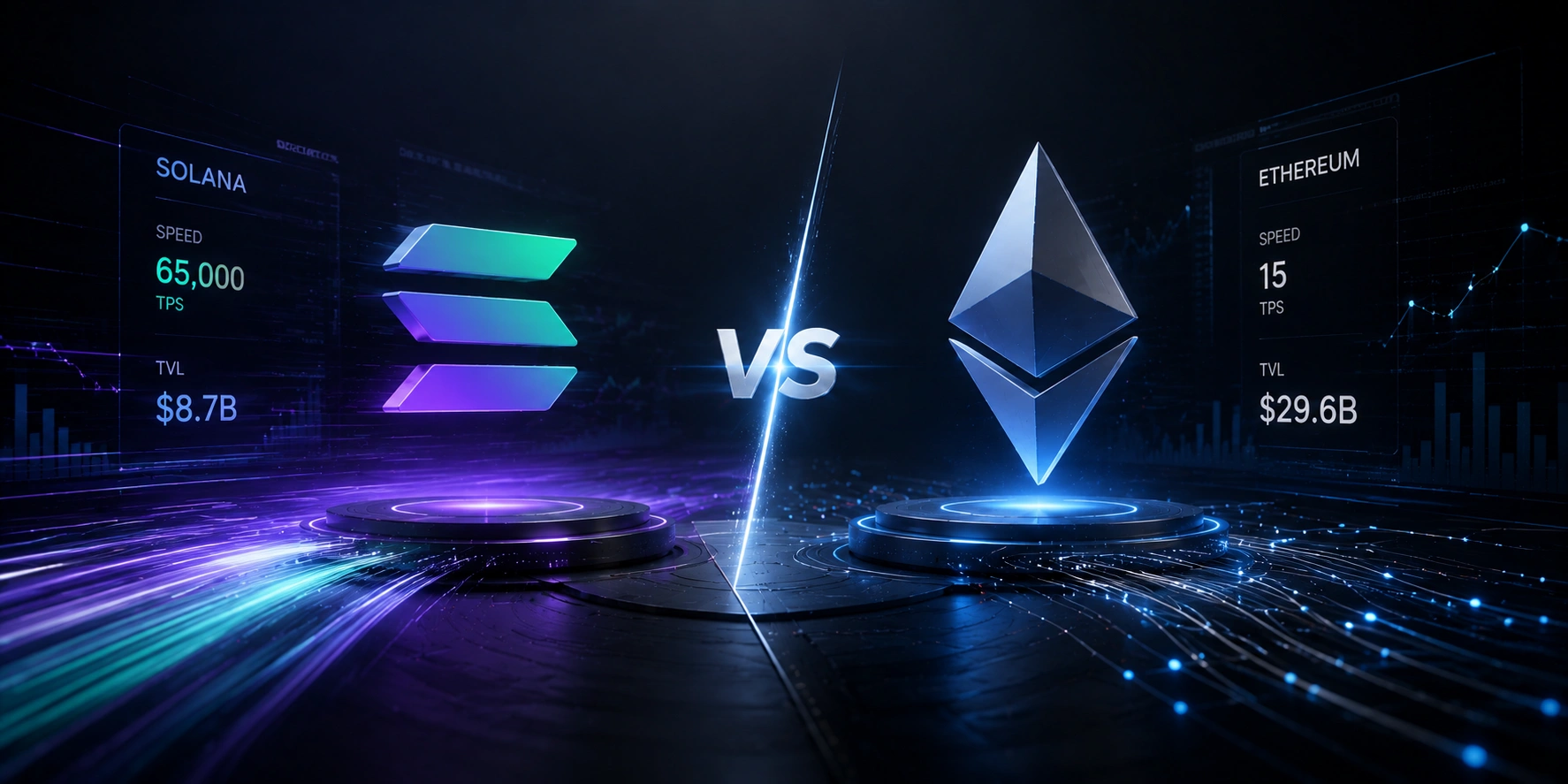
One of Solana's biggest strengths remains its performance. Average transaction confirmation takes less than a second, while transaction fees are typically measured in fractions of a cent. This makes the network particularly attractive for mass payments, gaming applications, and digital asset trading.
Ethereum has significantly improved the user experience thanks to the rapid adoption of Layer 2 networks. Modern scaling solutions enable near-instant transactions at substantially lower fees than in previous years. However, Ethereum's main chain still delivers lower throughput than Solana.
| Parameter | Solana | Ethereum |
|---|---|---|
| Architecture | High-performance Layer 1 | Layer 1 with an extensive Layer 2 ecosystem |
| Transaction Fees | Very low | Low on Layer 2, higher on the main network |
| Confirmation Speed | Under one second | Depends on the selected network |
| Scaling Strategy | Improving Layer 1 performance | Expanding Layer 2 infrastructure |
Overall, Solana provides a simpler user experience with exceptionally fast native transactions, while Ethereum relies on a multi-layer architecture designed to maximize security, decentralization, and flexibility.
In practice, this means Solana is better suited for applications requiring high transaction throughput and minimal costs, including trading platforms, micropayments, gaming, and token launches. Ethereum, by contrast, remains the preferred platform for sophisticated financial applications where security, liquidity, and compatibility with the existing DeFi ecosystem are essential. The key distinction lies not only in speed but also in scaling philosophy: Solana optimizes the base layer, while Ethereum distributes workloads across Layer 2 networks.
3. TVL, DeFi, and Institutional Capital
Total Value Locked (TVL) remains one of the most important indicators of blockchain ecosystem growth. In 2026, Ethereum continues to hold the largest share of locked capital thanks to its leading lending protocols, decentralized exchanges, stablecoin infrastructure, and tokenized asset platforms.
Many institutional blockchain projects operate on Ethereum, including platforms for issuing tokenized bonds, money market funds, and other digital financial instruments. This has helped Ethereum maintain its position as the primary infrastructure for large financial organizations.
Solana has significantly narrowed the gap through rapid DeFi expansion, increasing decentralized exchange volumes, liquid staking adoption, and a steady influx of new users. The network's high throughput supports more transactions while improving overall trading efficiency.
Although Ethereum still leads in overall TVL, Solana remains one of the fastest-growing public blockchain ecosystems by virtually every major adoption metric.

4. Memecoins and User Activity
One of the defining blockchain trends of recent years has been the explosive growth of memecoins within the Solana ecosystem. Extremely low transaction fees and exceptional network speed have enabled developers to launch thousands of new tokens with minimal technical barriers. Today, most newly created memecoin projects debut on Solana, driving higher trading volumes and attracting millions of active users.
Beyond its technical advantages, Solana has benefited from user-friendly token launch platforms and decentralized exchanges that quickly provide liquidity for newly issued assets. As a result, creating a memecoin is no longer limited to experienced blockchain developers, encouraging rapid ecosystem expansion and increased on-chain activity.
- Very low transaction fees make token creation highly accessible.
- High throughput enables thousands of transactions to be processed almost instantly.
- Decentralized exchanges provide deep liquidity for newly launched assets.
- Strong community engagement helps viral projects gain rapid traction.
- The growth of memecoins contributes to increasing activity across the entire ecosystem.
Ethereum continues to host several of the market's best-known memecoins, but the segment has become significantly more active within the Solana ecosystem. At the same time, analysts continue to highlight the increased risks associated with speculative trading, fraudulent projects, and extreme price volatility.
Despite their popularity, most memecoins remain highly speculative assets whose performance largely depends on community sentiment and market momentum. Investors increasingly evaluate not only viral appeal but also liquidity, project transparency, and long-term sustainability. Consequently, the rapid expansion of the memecoin sector creates new opportunities while simultaneously increasing investment risks.
5. Solana vs Ethereum: Final Comparison and Market Outlook
By 2026, identifying a single dominant blockchain has become increasingly difficult. Ethereum continues to lead institutional finance, DeFi, tokenized real-world assets, and enterprise blockchain infrastructure. Its key advantages remain security, ecosystem maturity, and one of the world's largest developer communities.
Solana, meanwhile, has demonstrated some of the fastest growth among major blockchain networks. It has become a leading platform for payment applications, blockchain gaming, NFTs, decentralized exchanges, and particularly the rapidly expanding memecoin market. Its ease of use and high performance make it especially attractive for mainstream users.
The blockchain industry is increasingly moving toward a multichain future, where different networks specialize in different use cases. Ethereum is likely to remain the foundation for sophisticated financial infrastructure, while Solana is expected to strengthen its position in areas where speed, low fees, and high user engagement are critical. The ongoing competition between these ecosystems continues to accelerate innovation and drive the broader adoption of Web3 technologies.











