
SolFarmer is a browser-based idle game built around the Solana economy, where users develop a virtual mining farm, merge and upgrade equipment, manage hashrate, and participate in PvP and guild mechanics. Despite the term mining, the project does not mine SOL through Proof-of-Work: Solana uses Proof-of-Stake, so virtual miners are a gameplay mechanic rather than real cryptocurrency mining hardware. The project states that some rewards are paid in real SOL and can be withdrawn to an external wallet, while in-game transactions following an economic update use a separate SSOL balance. SolFarmer is a relatively new project, so its projected returns and the long-term sustainability of its reward model should be evaluated separately from the gameplay itself.
Contents
- SolFarmer: How Idle Mining on Solana Works
- Miners, Hashrate and Virtual Farm Progression
- SOL, SSOL and the SolFarmer Reward Economy
- Guild Wars, The Camp and Additional Game Modes
- Real SOL Rewards and SolFarmer Risks

1. SolFarmer: How Idle Mining on Solana Works
SolFarmer belongs to the play-to-earn and idle mining simulator category. The game runs directly in a browser on desktop and mobile devices without requiring a separate client download. A free starter miner is available to begin playing, while connecting a cryptocurrency wallet is not required until the user interacts with the on-chain economy or withdraws funds.
The core gameplay loop revolves around virtual mining rigs. Users place equipment in their own cave, increase its performance, and gradually unlock more powerful devices. The system uses simulated hashrate, power consumption, and other parameters, turning farm management into a strategic part of progression.
The term "Solana mining" requires clarification. SOL cannot be mined with GPUs or ASICs in the same way as Bitcoin because the Solana network operates using Proof-of-Stake and validators. Hashrate in SolFarmer is an in-game performance metric. Therefore, the virtual ASICs and GPUs shown in the game do not perform cryptographic SOL mining on the Solana network.
SOL received by users represents a game reward funded by the project's economy rather than a block reward generated by the Solana protocol. This distinction is important when evaluating the model: player earnings depend on SolFarmer's rules and available reward pool rather than the real computing power of mining equipment.
2. Miners, Hashrate and Virtual Farm Progression
Progression begins with basic equipment. As users advance, they can acquire and unlock new miners with different rarity levels. The official website lists more than 60 types of devices, ranging from simulated CPUs to high-level quantum rigs and Solana validators. Each has its own hashrate, power draw, and performance characteristics.
One of the core mechanics is merging. Players combine identical devices to create stronger versions and increase the efficiency of their farms. Additional improvements are available through the Research Lab, leveling system, set bonuses, and other progression mechanics. Duplicate equipment can also be used in the Forge to create rarer variants.
Key SolFarmer gameplay mechanics:
- receiving a free starter miner after registration;
- placing virtual mining rigs on a personal farm;
- increasing hashrate through purchases, merging, and upgrades;
- managing power, cooling, and performance;
- research providing permanent stat improvements;
- using the Forge to process equipment and obtain rarer variants;
- Mining Pools with ranked tiers and periodic rewards;
- trading in-game assets through the Player Marketplace.
The idle mechanic allows the farm to continue calculating in-game production while the user is not actively interacting with the interface. This reduces the need for constant activity, although additional modes, events, and missions require direct participation. As a result, the game combines passive progression with more traditional competitive mechanics.
The prices and estimated returns displayed for individual rigs should not be interpreted as guaranteed financial results. They are based on SolFarmer's internal economic model and may depend on upgrades, guild perks, research, reward rules, and subsequent balance changes.
3. SOL, SSOL and the SolFarmer Reward Economy
In September 2026, SolFarmer changed the structure of its in-game economy by separating real SOL from SSOL. According to project announcements, SSOL became the spending balance used for deposits, in-game rewards, and trading. Following the update, the Miner Market and Camp Market operate with SSOL, while SOL is treated as a separate category of withdrawable cryptocurrency rewards.
This distinction is important when evaluating the project's "earn real SOL" concept. SSOL should not automatically be treated as SOL on the Solana network. Under the rules published by the project after the update, SOL deposited into the game is converted into internal SSOL, while converting SSOL back into withdrawable SOL is not a standard mechanism.
| Element | Purpose | Type | Withdrawal |
|---|---|---|---|
| SOL | Cryptocurrency game rewards | Native Solana asset | Withdrawal to an external wallet is supported according to the project |
| SSOL | In-game spending | Internal game balance | Should not be treated as regular SOL |
| Miners | Generating virtual hashrate | In-game assets | Used within the game economy |
| Mining | Idle reward mechanic | Game simulation | May generate SOL rewards |
| Marketplace | Trading equipment and items | In-game market | Transactions use SSOL |
According to recent project announcements, real SOL can be awarded through mining, PvP, affiliate mechanics, and selected events. This means that not every form of in-game income automatically becomes withdrawable cryptocurrency. Users need to distinguish between their SSOL balance, the virtual value of items, and SOL that is actually available for withdrawal.
The developers explained the transition to a two-tier economy as a measure against wash trading, bot farming, and deposit-to-withdraw schemes. From a player's perspective, the change also limits the liquidity of some in-game funds: SSOL derives its utility from its use within SolFarmer, while real SOL has independent liquidity on the Solana network.
4. Guild Wars, The Camp and Additional Game Modes
SolFarmer is not limited to the passive accumulation of virtual hashrate. The guild system allows players to form teams and participate in 24-hour Guild Wars. Results depend on the combined contribution of participants, including deployed equipment and performance in certain game activities. The economic rules of these competitions have evolved alongside the transition to the SOL/SSOL model.
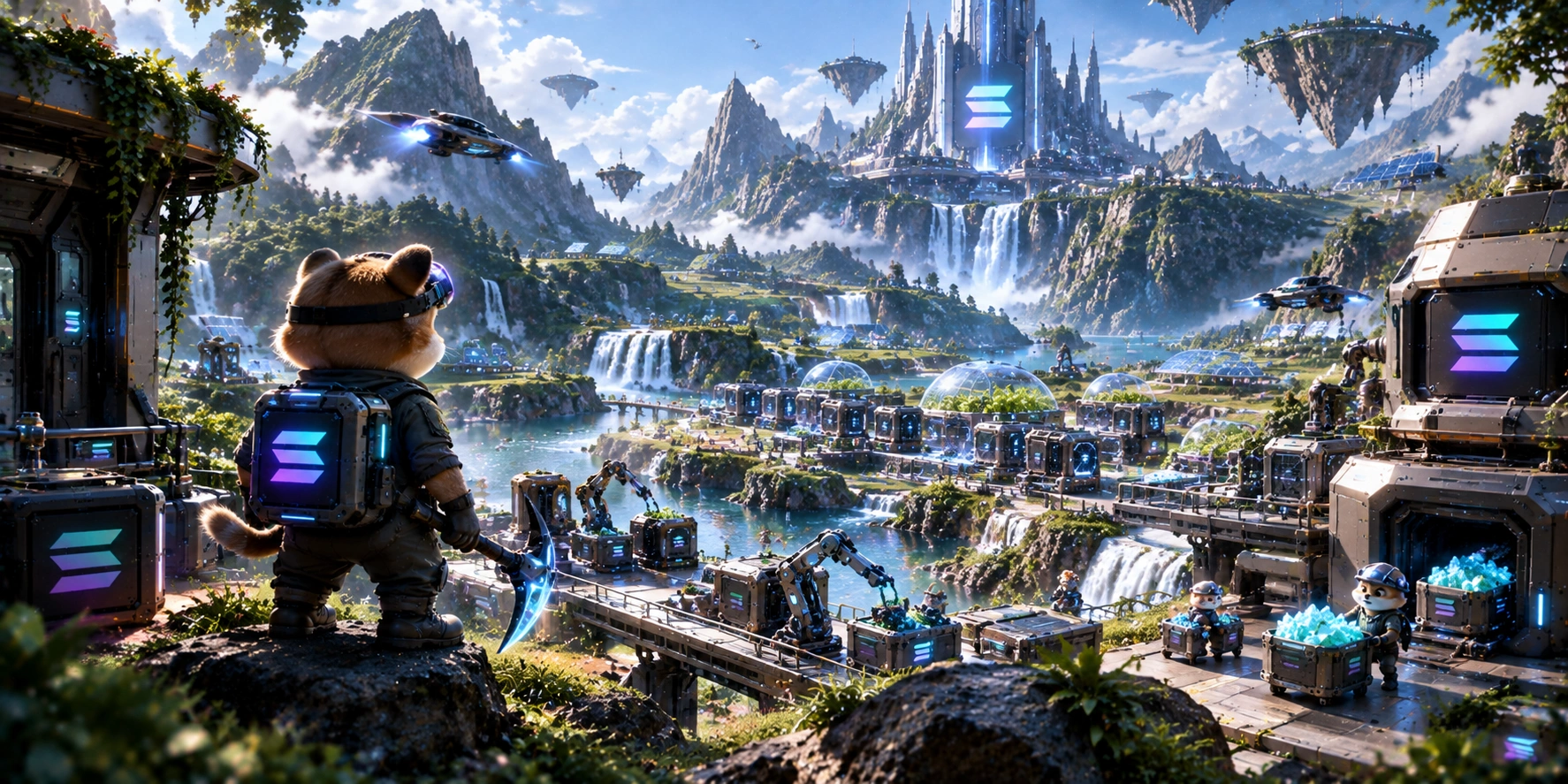
Another gameplay area is The Camp. Users obtain Farmers, send them on Expeditions, and collect equipment with different rarity levels. Items can be used for character progression and the Forge, while progression can unlock additional miners without directly purchasing them from the store. The Camp therefore adds RPG elements to the original idle mining model.
The Daily Arcade features short mini-games, including variations of Snake, Runner, and other arcade mechanics. Players receive a limited number of attempts each day, while top scores may qualify for prize distributions. Lucky Boxes provide another form of randomized reward, with a free daily option and additional chest tiers offering in-game bonuses and stated SOL rewards.
The Player Marketplace creates a separate economic layer. Players can list miners and items at their own prices, but after the introduction of SSOL, trading on internal markets is separated from withdrawable SOL. Selling a rare item is therefore not equivalent to selling a liquid crypto asset on an external DEX or NFT marketplace.
5. Real SOL Rewards and SolFarmer Risks
The main feature distinguishing SolFarmer from a conventional idle simulator is the stated ability to withdraw earned SOL to an external Solana wallet after meeting the project's requirements. In September 2026, CryptoFaucet.watch classified the game as Paying based on its own test withdrawals, while noting that this status does not guarantee future payments or platform security.
The project still has a relatively short independent track record: its domain was registered in October 2025, while active public development accelerated in 2026. This makes the long-term sustainability of its economy difficult to assess, and a significant portion of information about its mechanics and metrics comes directly from the developers.
Potential earnings shown on miner pages and in the SolFarmer calculator are based on the project's internal model and should not be treated as guaranteed returns. The size and sustainability of rewards depend on the reward pool, user activity, funds entering the game economy, and future changes to its rules.
Additional risks are associated with SSOL and in-game purchases. Once funds are converted into an internal balance, their utility differs from directly holding SOL. Users should also consider fees, withdrawal requirements, balance adjustments, and the possibility that the rules of the GameFi economy may change.
SolFarmer is therefore better described as a browser-based Solana-themed idle mining simulator with play-to-earn mechanics rather than a service for actual SOL mining. The game combines virtual rigs, merging, guilds, PvP, expeditions, and a marketplace, while some rewards are stated to be paid in real SOL. It is therefore important to distinguish virtual earnings and the SSOL balance from cryptocurrency that is actually available for withdrawal.