
SolFarmer — a browser-based blockchain game built on the Solana network that combines idle simulation, strategy, and the Play-to-Earn model. The project allows players to develop a virtual mining farm, upgrade equipment, participate in cooperative activities, and earn rewards in the form of SOL cryptocurrency. Unlike many early Web3 games, the gameplay focuses on long-term account progression and economic mechanics rather than relying solely on a native token. As a result, SolFarmer represents a new generation of blockchain games where gameplay depth and a sustainable in-game economy take priority.
Contents
- What Is the SolFarmer Blockchain Game?
- How Gameplay and Mining Farm Progression Work
- Core Gameplay Mechanics of SolFarmer
- SolFarmer Compared with Traditional Play-to-Earn Games
- Future Development and SolFarmer's Role in Web3 Gaming
1. What Is the SolFarmer Blockchain Game?
SolFarmer is a multiplayer browser game operating within the Solana ecosystem. The primary objective is to build an underground virtual mining base, place mining equipment, and steadily increase the overall productivity of the farm. All mining activities exist entirely as gameplay mechanics rather than real cryptocurrency mining.
The project follows a Free-to-Play model, allowing players to begin without any initial investment. After registration, every user receives a starter miner that serves as the foundation for future progression. As players advance, they unlock more powerful equipment, additional gameplay features, and new ways to earn rewards.
The game's economy is based on payouts in SOL instead of a proprietary in-game token. This approach reduces the game's dependence on the value of an internal currency while making the reward system more transparent and familiar to participants in the Solana ecosystem.
Conceptually, SolFarmer combines elements of an economic strategy game, an idle simulator, and a social multiplayer experience, where account progression depends both on individual decisions and interactions with other members of the community.
2. How Gameplay and Mining Farm Progression Work
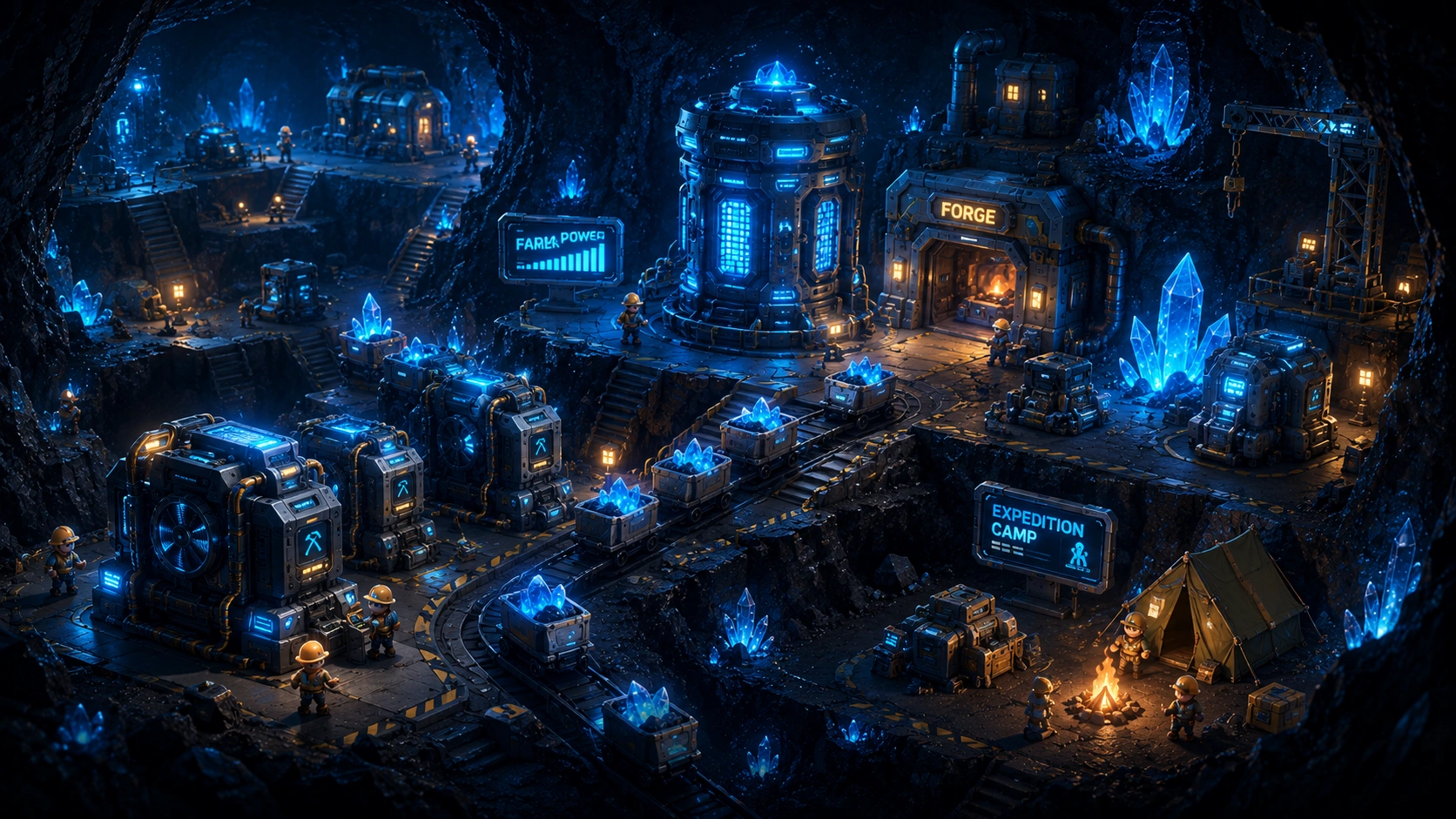
Gameplay begins inside a small underground cave where players install their first mining machine. As resources accumulate, additional miners can be purchased, existing ones can be merged, and the overall productivity of the virtual mining farm gradually increases.
One of SolFarmer's defining mechanics is the Merge system. Two identical miners can be combined into a stronger mining unit. This progression system resembles popular merge games while being fully integrated into the project's broader in-game economy.
Expanding the mining base requires managing several systems simultaneously. Players oversee equipment placement, energy consumption, facility upgrades, and technology research. These mechanics introduce strategic depth and make progression more engaging than traditional idle games.
An additional progression path is the Camp system, where Farmer characters are deployed on expeditions. They collect equipment of varying rarity, contribute to infrastructure development, and unlock new miners, expanding the capabilities of the player's account.
3. Core Gameplay Mechanics of SolFarmer
The in-game economy consists of several interconnected progression systems that continuously unlock new gameplay opportunities as the player's account level increases.
Throughout progression, players gain access to additional mechanics that expand the management of their virtual mining farm. These systems work together to influence account growth, resource generation, and access to new content. The result is a combination of strategic planning, collecting, and economic simulation that creates a more varied gameplay experience. Each feature has its own role while complementing the rest of the game's ecosystem.
- Building and upgrading miners to increase productivity.
- Merging identical mining equipment through the Merge system.
- Guilds and cooperative competitions between players.
- Farmer expeditions that reward equipment of various rarity levels.
- The Forge system for crafting higher-quality mining equipment.
- An in-game Marketplace for player-to-player trading.
- Daily missions, mini-games, and seasonal events.
- A Research Laboratory that provides permanent account upgrades.
The social aspect plays an important role throughout the game. Players join guilds, compete in collaborative events, compare the performance of their mining farms, and receive additional bonuses for participating in group activities.
The seasonal content system is regularly expanded with new events, missions, and leaderboards, ensuring that gameplay extends beyond simple resource accumulation.
4. SolFarmer Compared with Traditional Play-to-Earn Games
Many early blockchain games were centered around launching a native token whose market price largely determined the project's attractiveness. SolFarmer takes a different approach by emphasizing long-term gameplay progression while using SOL as the primary reward currency.
This model makes the in-game economy less dependent on the short-term price fluctuations of an internal token. For players, long-term farm development, participation in activities, equipment upgrades, and interaction with other community members become just as important as earning rewards.
The table below compares SolFarmer with the traditional Play-to-Earn model.
| Feature | SolFarmer | Traditional P2E Games |
|---|---|---|
| Getting Started | Free registration | NFT purchase often required |
| Primary Reward | SOL | Native game token |
| Progression | Idle strategy and base management | Token farming |
| Social Features | Guilds, wars, cooperative events | Often limited |
| Economy | Multiple interconnected gameplay systems | Highly dependent on token price |
| Trading | Player-to-player Marketplace | Not always available |
The comparison demonstrates that SolFarmer focuses not only on earning rewards but also on the gradual expansion of its gameplay systems. Upgrading miners, joining guilds, trading items, and completing recurring activities all contribute to long-term account development.
This approach reflects a broader trend within modern Web3 gaming, where gameplay value increasingly outweighs speculative incentives. Instead of prioritizing short-term profits, developers aim to retain players through deeper mechanics and continuous content updates.
5. Future Development and SolFarmer's Role in Web3 Gaming
SolFarmer illustrates the evolving direction of blockchain games built on Solana. Rather than focusing exclusively on token rewards, the project combines economic strategy, collecting, resource management, and social interaction into a single gameplay experience.
The browser-based format lowers the barrier to entry for new users, while Solana integration enables fast transactions and efficient reward distribution. At the same time, the game remains accessible even to players with little or no previous experience using Web3 applications.
Future development is expected to include additional game modes, expanded seasonal content, a more sophisticated in-game economy, improved expedition systems, and new social mechanics. These priorities align with current blockchain gaming trends, where long-term player retention has become a central objective.
SolFarmer demonstrates how projects within the Solana ecosystem are gradually moving beyond models driven solely by financial incentives. By combining strategic gameplay, steady progression, cooperative activities, and blockchain integration, the game represents a new generation of Web3 entertainment where distributed ledger technology serves as an integral part of the gaming infrastructure rather than its only defining feature.











