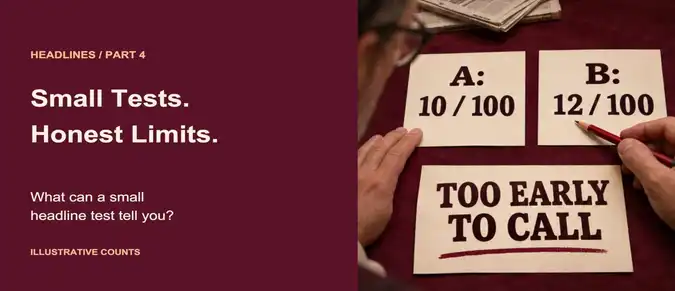

A small audience can help you spot a confusing headline. It may take much more traffic to establish that one clear headline earns more clicks than another. Decide which question your test can realistically answer before running it.
Separate understanding from click performance
Ask a few readers what they expect an article to explain after seeing its headline. Their answers can reveal ambiguity or an unsupported promise. This is a useful qualitative check, but it does not estimate a click-through improvement.
A causal comparison of click performance needs a design that makes the groups comparable. Ideally, randomly assign eligible readers to headline A or B while keeping the article, placement and other relevant conditions the same. Two organic posts on different days can differ in timing, audience and distribution as well as their headlines.

Define the decision before the test
Record the two variants, the eligible audience, the primary metric and the stopping rule. For a click-through rate, retain clicks and eligible exposures, not just a percentage. Decide what size of improvement would matter in practice.
The experimental-design guidance by List, Sadoff and Wagner explains why required sample size depends on the effect you want to detect, variation and the chosen error rates. For a binary outcome such as a click, the baseline rate matters too. There is no universal threshold of 100 impressions or seven days that makes every test reliable. Repeated exposures to one reader also cannot automatically be treated as independent participants.
Two extra clicks can be inconclusive
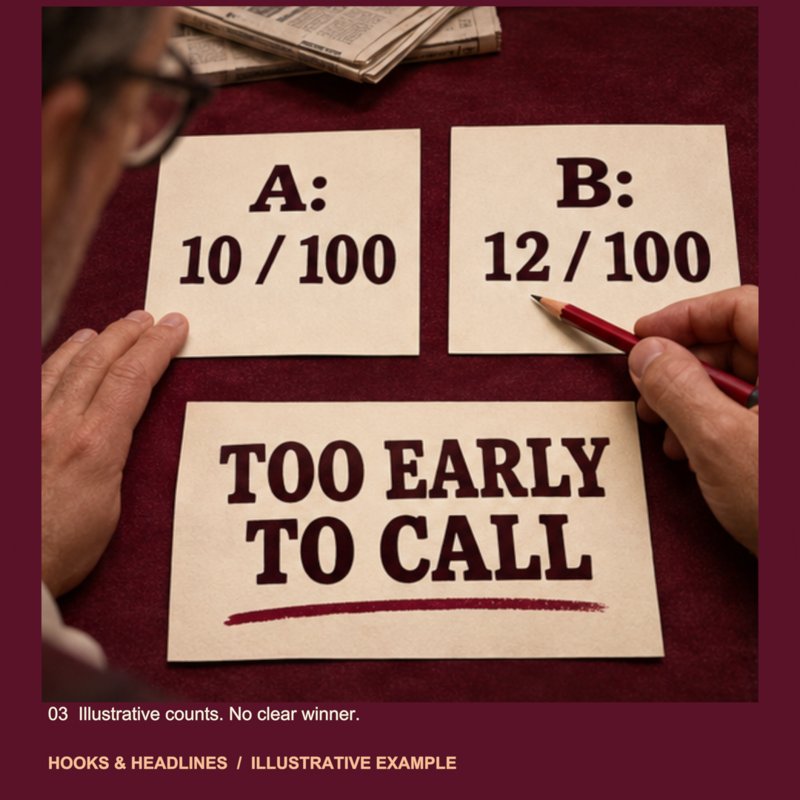
Imagine two randomly assigned groups of 100 independent eligible readers. Ten click headline A and twelve click headline B. These invented counts give rates of 10% and 12%, a difference of two percentage points. A rough normal approximation gives a standard error for the difference of about 4.4 percentage points. The observed gap is small relative to that uncertainty.
This is an illustrative calculation, not a real experiment or a universal sample-size recommendation. It does not establish a winner, and it does not prove the headlines perform equally. Small samples can leave a decision unresolved.
Keep the stopping rule honest
For a conventional fixed-sample analysis, do not end the test at the first favorable result. Johari, Pekelis and Walsh discuss why continuous monitoring needs appropriate statistical methods. A valid sequential design can support repeated looks, but those methods must be part of the analysis.
If traffic cannot resolve a worthwhile difference, choose using clarity, accuracy and the article's actual promise. Record the test as inconclusive. You can revisit the question with more appropriate data later.
A small test earns its value when the decision matches the evidence. Report the counts, the conditions and the uncertainty together.