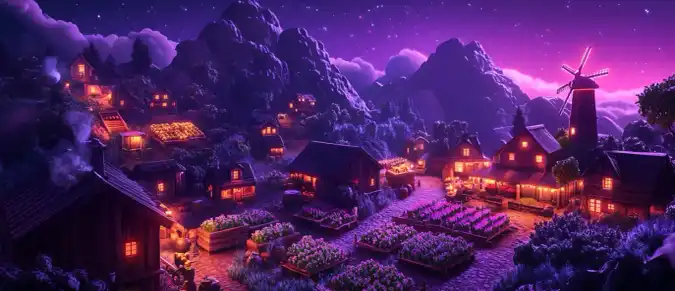

Wanaka Farm is a blockchain project in the farming simulation genre that combines GameFi mechanics, NFT assets, and an on-chain economy. The project creates a virtual agricultural world where players own land, resources, and items in the form of NFTs, manage production cycles, and participate in a decentralized marketplace. Unlike many Play-to-Earn games, Wanaka Farm focuses on long-term gameplay, a sustainable economy, and gradual development rather than aggressive token farming. This approach helps maintain player interest even during changing market conditions. The game targets both crypto enthusiasts and users familiar with classic farming simulators who have not previously interacted with Web3.
- Wanaka Farm and the Farming GameFi Ecosystem
- Gameplay Mechanics and Virtual Farm Logic
- Token and NFT Asset Economy of Wanaka
- Technical Architecture and Blockchain Infrastructure
- Project Development and Long-Term Outlook

Wanaka Farm and the Farming GameFi Ecosystem
Wanaka Farm builds a cohesive gaming ecosystem where farming is not merely a visual layer but the foundation of the entire economic model. Players receive digital land and resources represented as on-chain assets that can be freely owned and managed. The project combines familiar farming simulator mechanics with principles of a decentralized economy, where every action carries measurable value. The ecosystem revolves around sustainable production: crop cultivation, resource processing, and trading form a closed economic loop. This approach reduces dependence on external speculative factors and makes the in-game economy more predictable.
Additionally, the Wanaka Farm ecosystem is designed as a relatively closed economic environment with its own rules of supply and demand. The number of land plots and rare resources is limited, creating scarcity and supporting the value of NFT assets. This brings the game model closer to real-world economic systems, where growth is achieved through production expansion or process optimization. As a result, players are incentivized to invest time in farm development rather than short-term profit extraction strategies.
Gameplay Mechanics and Virtual Farm Logic
Wanaka Farm gameplay is based on the gradual development of a farming operation and the management of limited resources. Players make decisions regarding farm specialization, crop selection, and strategies for using NFT assets. Every action affects production efficiency and the future potential of the farm. Key gameplay elements include:
- ownership and development of land plots;
- cultivation of crops with different growth cycles;
- use of tools and upgrades;
- participation in seasonal events and quests;
- interaction with the in-game marketplace.
All mechanics are interconnected, forming an economy where mistakes in resource management directly impact results. An important feature is that farm efficiency depends on combinations of NFT assets rather than a single rare item. Even basic land plots can generate stable income when managed correctly. This lowers the entry barrier for new players and reduces the gap between large and small ecosystem participants.
Token and NFT Asset Economy of Wanaka
The economic model of Wanaka Farm is built on a combination of tokens and NFTs that separate gameplay and financial functions. The core of the ecosystem is the utility token WANA, while in-game rewards are distributed through the auxiliary token WAI. This structure helps reduce speculative pressure and maintain a balance between profitability and gameplay.
| Element | Purpose | Role in the Ecosystem |
|---|---|---|
| WANA | Main utility token | Purchasing NFTs, event participation, governance |
| WAI | In-game token | Rewards for player activity |
| Land (NFT) | Core asset | Resource production |
| Items (NFT) | Tools and upgrades | Efficiency improvement |
| Resources (NFT) | Farming output | Trading and processing |
The project economy also includes inflation control mechanisms, such as mandatory token spending on farm maintenance and development. A portion of tokens is regularly removed from circulation through gameplay actions. NFT assets function as long-term instruments rather than consumable items. This encourages asset retention within the ecosystem and supports a more stable market.
Technical Architecture and Blockchain Infrastructure
Wanaka Farm operates on Binance Smart Chain, providing low transaction fees and high transaction speeds. All key game assets are implemented through smart contracts, with ownership fully controlled by users. The project architecture follows a hybrid model, where part of the logic is handled off-chain to improve performance and usability.
This approach allows the game to scale without a sharp increase in transaction costs. At the same time, ownership data and key operations remain verifiable on the blockchain. The balance between on-chain and off-chain components makes the project resilient under load and accessible to a broad audience. This is particularly important for GameFi projects focused on long-term user engagement.
Project Development and Long-Term Outlook
Wanaka Farm is focused on the gradual expansion of the game world and the deepening of economic mechanics. The team emphasizes regular updates, the introduction of new asset types, and expanded interaction scenarios between players. The long-term strategy includes strengthening social features and cooperative elements.
The project’s growth potential is linked to the development of production chains and farm specializations. Integration with external NFT marketplaces and GameFi services can increase asset liquidity. The main challenge remains maintaining a balance between profitability and gameplay engagement. However, the chosen sustainable economic model provides a solid foundation for scaling even during periods of reduced interest in the Play-to-Earn segment.











