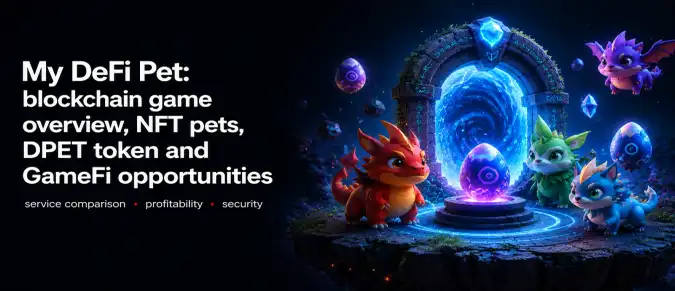

My DeFi Pet is a blockchain game focused on collecting and developing virtual creatures, combining RPG mechanics, NFTs, and a decentralized digital economy. Its gameplay loop revolves around obtaining pets, producing resources, upgrading attributes, breeding creatures, and participating in battles. The project launched in 2021 and has used the infrastructure of BNB Chain and KardiaChain, while many in-game operations are connected to the DPET token. Because much of the publicly available documentation relates to the project’s earlier development stages, users should independently verify current feature availability, server activity, and transaction conditions before playing.
Contents
- What Is My DeFi Pet and How Does the Blockchain Game Work?
- My DeFi Pet Gameplay: Pets, Progression, and Battles
- NFTs, the DPET Token, and the In-Game Economy
- My DeFi Pet Compared With Traditional and GameFi Titles
- Risks, Current Status, and the Future of My DeFi Pet
1. What Is My DeFi Pet and How Does the Blockchain Game Work?
My DeFi Pet is a browser-based virtual pet game developed with the involvement of Vietnamese studio TopeBox and a team connected to KardiaChain. The project’s name reflects three core ideas: creature personalization, integration of DeFi elements, and classic pet-raising mechanics. The game was designed as a more accessible way to introduce a broad audience to NFTs and blockchain transactions through a familiar gameplay format.
Each pet has its own attributes, visual traits, and classification by type or element. Players build collections of creatures, develop them, and select suitable combinations for different in-game activities. The NFT model can record the origin and characteristics of individual assets on-chain, although part of the gameplay and visual data still depends on the project’s server infrastructure.
The project has supported both BNB Chain and KardiaChain. Using two blockchains allowed users to choose an environment based on liquidity, wallet availability, and transaction costs, but assets and operations across different networks should not automatically be treated as interchangeable. Connecting to the game generally requires a compatible Web3 wallet and enough of the selected network’s native token to pay transaction fees.
My DeFi Pet belongs to the early generation of GameFi projects in which blockchain was closely linked to obtaining and upgrading in-game assets. As a result, the user experience depends not only on game balance but also on token conditions, liquidity, network fees, and smart contract availability.
2. My DeFi Pet Gameplay: Pets, Progression, and Battles
The main My DeFi Pet gameplay loop begins with obtaining a pet. Under the project’s early model, users could summon a random egg with DPET or take part in an auction. After incubation, the egg produced a creature with specific attributes that could be developed, used in gameplay activities, or added to a collection.
Account progression also involved constructing and upgrading buildings, producing resources, and managing the internal economy. Collected food was used to increase pet levels, while additional materials were needed to unlock new features and prepare creatures for more challenging activities.
Core My DeFi Pet mechanics include:
- obtaining and collecting virtual pets;
- incubating eggs and unlocking new creatures;
- feeding pets and increasing their levels;
- breeding creatures with inherited traits;
- constructing and upgrading in-game buildings;
- participating in PvE activities and boss battles;
- trading selected NFT assets when a marketplace is available.
Breeding allows two compatible pets to produce a new creature. The resulting pet may combine traits from its parents, adding elements of planning and collectible rarity. However, these operations consume in-game resources and tokens, so their economic value depends on current conditions within the project.
Earlier versions of the game also included large-scale boss battles in which pet owners joined forces and received in-game rewards. These modes expanded the basic creature-raising loop, although their availability could change with updates and seasonal events.
3. NFTs, the DPET Token, and the In-Game Economy
DPET is the utility token of the My DeFi Pet ecosystem. In the original model, it was used to summon pets, breed and evolve creatures, participate in selected events, and conduct transactions between users. Project documentation also mentioned governance mechanisms that could allow token holders to vote on certain ecosystem parameters.
NFTs are used to represent pets and selected in-game objects. Blockchain makes it possible to verify that an asset belongs to a particular wallet and may allow it to be transferred to another user. However, the practical utility of an NFT depends on continued server support, marketplace availability, and sustained demand from the community.
The project’s economy combines DPET spending with the generation of in-game resources. Unlike a conventional mobile game, the cost of certain actions can change with the token’s market price and network fees. This creates additional financial risk because an in-game asset may lose liquidity even if it remains visible in the user’s wallet.
The maximum DPET supply has been listed at 100 million tokens, although circulating supply, trading volume, and exchange availability change over time. For this reason, the token should not be evaluated only by its former role in a once-popular GameFi title. Current liquidity, developer activity, and practical use cases should be examined separately.
4. My DeFi Pet Compared With Traditional and GameFi Titles
My DeFi Pet combines familiar virtual pet mechanics with blockchain assets and tokenized actions. In a traditional game, characters and items exist only in the developer’s database, while in My DeFi Pet selected assets can be linked to a user-controlled wallet.
However, the presence of NFTs does not make the game fully independent from its development team. Graphics, balance, battle modes, interfaces, and access to most features still require active game servers. My DeFi Pet therefore occupies a middle ground between a conventional online game and a fully on-chain application.
| Parameter | My DeFi Pet | Traditional Pet Game | Typical GameFi Project |
|---|---|---|---|
| Main Genre | Creature collection and progression | Simulator or RPG | RPG, strategy, or card game |
| Asset Ownership | NFTs and server-based game data | Developer-controlled account | Depends on project architecture |
| In-Game Currency | DPET token and game resources | Closed in-game currency | One or more tokens |
| Breeding | Creation of new pets | Depends on the game | Often used to issue new NFTs |
| Network Costs | Blockchain transaction fees | None | Depend on the selected network |
| Market Risk | Linked to DPET and NFT liquidity | Usually limited to in-game purchases | Often a significant part of the model |
The main advantage of this structure is the ability to store and transfer selected assets through blockchain. Its main disadvantages are a more complex onboarding process, the need to use a wallet, and the dependence of gameplay costs on cryptocurrency market conditions.
My DeFi Pet should therefore be evaluated both as a game and as a digital economic system. Engaging gameplay does not guarantee returns, while NFT ownership does not guarantee permanent access to the functions associated with that asset.
5. Risks, Current Status, and the Future of My DeFi Pet
My DeFi Pet remains a notable example of the first wave of blockchain games combining virtual pets, NFTs, and a native token. The project demonstrated how familiar collection mechanics could introduce users to wallets, transactions, and digital ownership. During its early growth period, the game attracted users on BNB Chain and KardiaChain, but historical activity figures do not automatically reflect its current condition.
The main risks include DPET volatility, limited liquidity for selected NFTs, changing gameplay conditions, and dependence on centralized infrastructure. Users are also responsible for wallet security, choosing the correct blockchain network, and verifying smart contract addresses.
The project’s future depends on regular updates, the preservation of an active community, the availability of game modes, and the developers’ ability to separate gameplay value from speculative token dynamics. Blockchain functionality alone is not enough to restore lasting interest; stable servers, clear progression, new content, and transparent communication are also required.
My DeFi Pet can be viewed as a historically important GameFi experiment, but participation requires checking the product’s current state first. Prospective players should confirm that the required features are operational, assess fees and liquidity, and only then consider purchasing DPET or NFTs. This approach helps separate gaming interest from financial expectations and reduces the risks associated with early blockchain projects.











