

Likes alone do not explain reach on X. The “For You” feed is personalized: the same post can be valuable to one reader and irrelevant to another.
X’s published recommendation code shows how the Phoenix model predicts reader actions. Those predictions feed into ranking, alongside filters and other constraints.
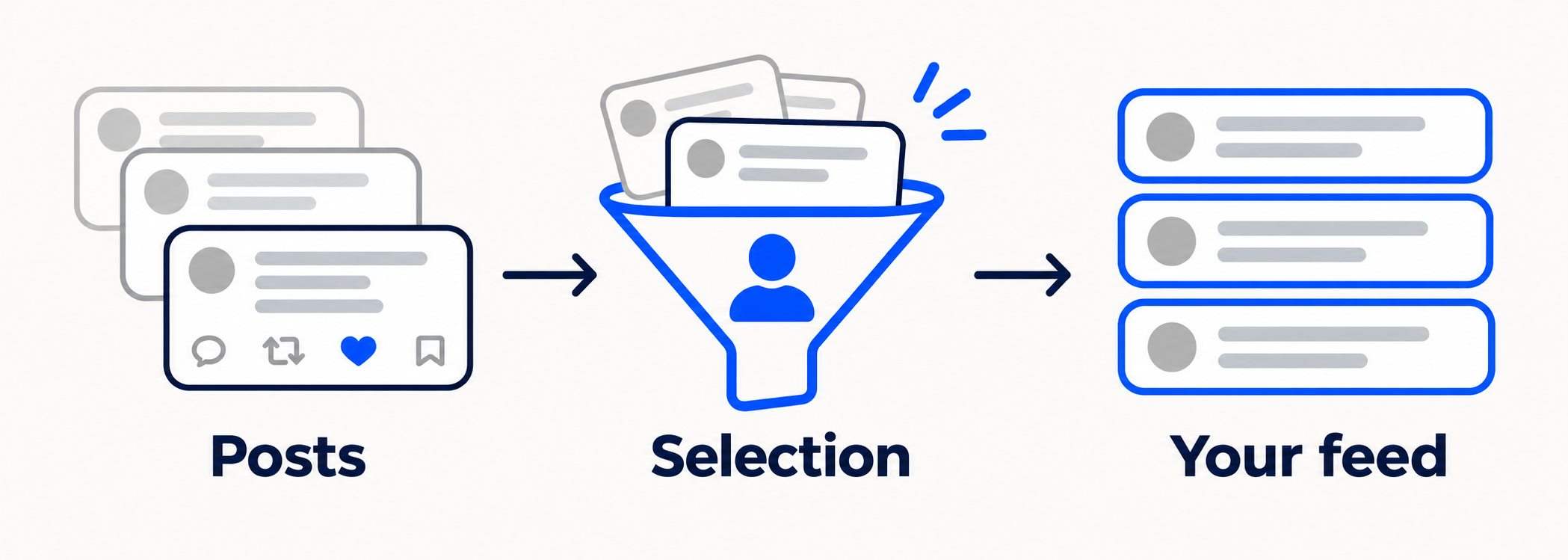
Simplified selection process, not the complete ranking pipeline.
The algorithm predicts your response
The model estimates the likelihood of likes, replies, reposts, follows and other actions, including negative responses. Published weights include: like +0.66; repost +1; follow +4; reply, quote or share through a direct message +5; copy link +20; “Not interested” −52.272; report −234.
These are weights on predictions, not points awarded for completed actions. Copying a link does not automatically add twenty points. The parameter file exposes settings that may vary across experiments and user groups.
Why one report does not “cancel out hundreds of likes”
Dividing report and like coefficients cannot tell us how many reactions promote or suppress a post. The formula uses probabilities: a like may be relatively likely while a report is extremely unlikely. The negative weight applies to that prediction, not directly to a report count.
The repository’s authors warn against this interpretation. Replies and shares likewise cannot be converted into guaranteed reach.
A high score does not guarantee a place in the feed
Author diversity matters. When several candidates come from one author, additional posts may be downweighted. This operates within a feed result; it does not establish a universal posting schedule.
A separate ranking service includes a 0.75 multiplier for out-of-network posts; under some conditions, it also applies to replies and reposts from followed accounts. It adjusts a score, not reach. It cannot promise 25% fewer impressions.
Why some posts are filtered out before scoring
Filters can exclude duplicates, posts already shown, blocked authors and muted words. The examined pipeline also filters out posts older than 48 hours. That limit applies to this route for building “For You”; it does not delete a post or prevent access through profiles, direct links or other parts of X.
Further visibility checks apply after selection. Predicted engagement does not override access restrictions or platform rules.
A separate mechanism can help smaller creators
The code provides for extra exposure for some posts with little attention. Published conditions include an original post no more than two hours old, fewer than 200 Home impressions and an author with no more than 50,000 followers.
Meeting these conditions does not guarantee promotion: further selection applies. Nor is this an automatic bonus for every newly registered account.
What creators can take from this
Look beyond likes. Ask why someone would finish a post, discuss it or save its link. Clear explanations, checkable calculations, identified risks and primary sources give readers reasons to engage. This is editorial advice, not a growth formula proved by the code.
The public repository reveals mechanisms, but not every production setting, trained model weight or private rule. “This exists in the code” does not establish why a particular post received a thousand views.
Based on the code snapshot reviewed for our original research on November 3, 2026. This article examines the “For You” feed; its conclusions do not automatically apply to search, notifications or other parts of X.











