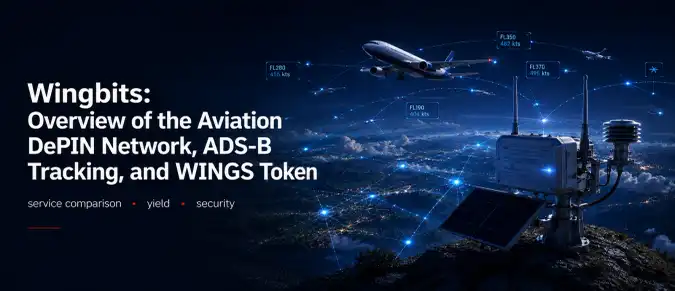

Wingbits — is an aviation DePIN network designed to collect and distribute real-time air traffic data. Participants install ADS-B receivers that capture signals from airplanes and other aircraft and transmit positional data to the shared infrastructure. Unlike the traditional voluntary flight-tracking model, Wingbits uses the WINGS token to reward station operators based on the usefulness of their contributions. The project operates on Solana, and following the mainnet launch and TGE in April 2026, WINGS became an economic component of the live network.
Contents:
- What Is Wingbits and How Does the Aviation DePIN Network Work?
- ADS-B Stations, Flight Tracking, and Aviation Data Verification
- WINGS Token, Rewards, and the Wingbits Economy
- The Project vs. Traditional Flight-Tracking Services
- Wingbits Use Cases, Development, and Key Risks

1. What Is Wingbits and How Does the Aviation DePIN Network Work?
Wingbits was founded in Stockholm in 2023 by Robin Wingårdh and Alex Lungu, who met through the Antler program. The project is building a global aviation data reception network in which the physical infrastructure is owned by a distributed community. Instead of deploying thousands of antennas itself, the company incentivizes users to install hardware and contribute the collected data to the network.
The primary source of information is ADS-B — a technology through which aircraft transmit their identifiers, coordinates, altitude, speed, and other parameters. A ground station receives these radio signals and sends useful positional messages to Wingbits. The better the antenna placement and the more stable its operation, the more data the network can potentially receive.
The project went through a public beta phase that began in November 2023 and subsequently expanded its geographic coverage rapidly. By the mainnet launch, Wingbits infrastructure included thousands of receivers across more than 120 countries. According to the project, during the testnet phase the network processed billions of data points daily and could track up to 200,000 flights per day, with a significant share of the information transmitted with a latency of less than a few seconds.
Wingbits has raised external funding to develop its infrastructure. Following a $3.5 million round, the company announced another $5.6 million investment in January 2025, led by Borderless Capital and Bullish Capital, with participation from Spartan Group, Tribe Capital, Antler, SNZ, and Heartcore. This brought the project's total funding to approximately $9.2 million.
2. ADS-B Stations, Flight Tracking, and Aviation Data Verification
Operating a Wingbits station begins with an ADS-B receiver and an antenna. ADS-B radio signals generally travel within line of sight, meaning that installation height and the absence of obstacles have a significant impact on reception range. Trees, buildings, metal structures, and poor indoor placement can reduce the number of messages received.
Wingbits initially supported self-built stations and later began developing specialized hardware with cryptographic verification mechanisms. The purpose of this approach is to associate a data stream with a specific physical receiver and make the transmission of fabricated information more difficult. Stations are registered within a specific geographic area, while their coordinates can be regularly verified by the system.
Key elements of the Wingbits infrastructure include:
- ADS-B Receiver — receives aircraft radio signals and extracts positional messages.
- Antenna — determines reception quality and the station's practical coverage range.
- Location Hex — an H3 cell used to register the installation location and limit excessive concentration of stations.
- Coverage Hex — a geographic area in which a station's contribution is considered when calculating network rewards.
- Cryptographic Verification — mechanisms designed to verify that data originates from registered hardware.
- PageRank — an algorithmic approach that evaluates the relative importance of stations and the areas they cover when distributing WINGS.
An additional verification layer emerged through cooperation with Spire Global. In 2025, a Spire satellite carrying an ADS-B payload associated with Wingbits was launched on the SpaceX Transporter-13 mission. Space-based observations are intended, among other purposes, to validate ground-based ADS-B data and complement coverage in regions where deploying terrestrial receivers is difficult, such as oceans and sparsely populated areas.
3. WINGS Token, Rewards, and the Wingbits Economy
WINGS is the SPL token of the Wingbits ecosystem on Solana. Its Token Generation Event took place on April 22, 2026, alongside the project's transition to mainnet. WINGS trading was launched on Kraken, while on-chain liquidity is developing through Solana DEXs. According to the published tokenomics, the maximum supply is 10 billion WINGS.
Under the published allocation model, 40% of the supply, or 4 billion WINGS, is reserved for station operator rewards. Another 11% is allocated to the ecosystem, including community development and partnerships. Capital partners and the team are each allocated 24.5%. As a result, more than half of the total supply is assigned to station rewards and the broader ecosystem.
Station rewards do not represent a fixed return on hardware. Base Network Rewards depend on the positional messages actually transmitted and the usefulness of the coverage provided. When an active coverage hex meets the minimum requirements, a specific daily WINGS pool is created and then distributed according to PageRank. If several operators serve an area that is already well covered, competition between them may reduce each operator's individual share of rewards.
Early Participant Rewards and additional incentive programs are also part of the model. For example, Low Altitude Rewards encourage the collection of information about aircraft flying at altitudes of up to 6,000 feet in designated areas around airports. For station operators, this means that rewards depend not only on the number of messages received but also on antenna location, stable uptime, signal quality, and the value of the data to overall network coverage.

4. The Project vs. Traditional Flight-Tracking Services
Global flight-tracking platforms have long relied on distributed networks of ADS-B receivers. In many cases, aviation enthusiasts install the equipment and provide collected information to a centralized operator free of charge. Wingbits retains the principle of distributed physical data collection but adds a blockchain layer to create economic incentives for participants.
The approach to hardware distribution also differs. Wingbits limits station registration within individual location hexes to avoid incentivizing excessive concentrations of receivers in the same area. Rewards are calculated according to coverage hexes and actual contributions to aviation data rather than simply for owning a device.
| Parameter | Wingbits | Traditional ADS-B Network | Personal ADS-B Station |
|---|---|---|---|
| Data Source | Distributed ADS-B stations | Proprietary and user-operated receivers | Local receiver |
| Model | DePIN | Centralized platform | Individual |
| Rewards | WINGS for useful contributions | Usually service benefits or no payment | None |
| Blockchain | Solana | Not required | Not required |
| Hardware Verification | Location registration and cryptographic mechanisms | Depends on the operator | Local control |
| Target Data Users | Aviation, analytics, and B2B | Consumers and enterprise clients | Station owner |
Blockchain itself does not make an ADS-B message more accurate. Data quality still depends on the receiver, antenna, radio visibility, correct location, and infrastructure reliability. The role of DePIN is different: it creates measurable incentives for expanding coverage and provides a mechanism for distributing part of the economic value of aviation data among its contributors.
5. Wingbits Use Cases, Development, and Key Risks
ADS-B data is used by airlines, airports, analytics companies, and research organizations. It can help analyze routes, delays, airport traffic, and other air traffic parameters. Wingbits builds its business model around the commercial use of data collected by its distributed network. The tokenomics model provides for a portion of Wingbits Foundation revenue to be used for WINGS buyback and burn operations, creating a connection between demand for aviation data and the token economy. The actual impact of this mechanism depends on the project's real revenue.
Station returns are not guaranteed and depend on location, coverage, uptime, competition, and the PageRank algorithm. Additional risks include WINGS price volatility, token unlocks for the team and investors, hardware performance, Solana infrastructure, and potential changes to the reward model. Wingbits also competes with major flight-tracking platforms that already operate extensive receiver networks.
The project's value therefore depends not only on the number of stations but also on geographic coverage, speed, reliability, and the quality of ADS-B data. Following the mainnet launch and TGE in 2026, Wingbits transitioned to an active token-based model. Its future development will depend on expanding useful coverage, maintaining data quality, attracting B2B customers, and connecting commercial demand with a sustainable WINGS economy.











