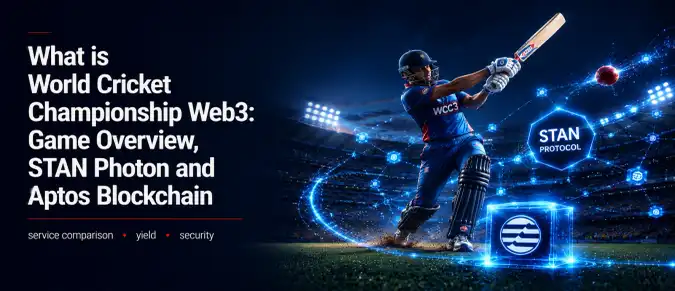

World Cricket Championship Web3 is an expansion of the World Cricket Championship mobile game series built around the integration of STAN Photon infrastructure for on-chain rewards and user activity verification. WCC itself remains a traditional sports gaming franchise developed by Nextwave Multimedia and operated within the Nazara Technologies ecosystem: its core gameplay, matches, career progression, and multiplayer systems are not moved to the blockchain. The Web3 layer is built around Photon, a STAN protocol on Aptos designed to verify selected user actions and enable programmable reward distribution. Therefore, the project is better viewed not as a standalone Play-to-Earn game, but as an example of blockchain-based engagement infrastructure integrated into a large mobile sports franchise.
Contents
- What Is World Cricket Championship Web3 and How Is It Connected to STAN?
- WCC Gameplay: Modes and Multiplayer
- STAN Photon: How On-Chain Rewards and Activity Verification Work
- Aptos, Privacy, and WCC Web3 Infrastructure
- World Cricket Championship Development and the Future of Its Web3 Model

1. What Is World Cricket Championship Web3 and How Is It Connected to STAN?
World Cricket Championship is a series of mobile cricket simulators developed by Indian studio Nextwave Multimedia, which is part of the Nazara Technologies ecosystem. The franchise has existed since 2011 and includes several games, such as WCC2, WCC3, Rivals, and Cricket Blitz. The series primarily targets Android and iOS users and focuses on different match formats, team management, competitions, and virtual player progression.
The Web3 direction appeared much later than the original franchise. In December 2025, STAN announced World Cricket Championship and Nazara Games as the first partners for its new Photon protocol. Its purpose is to transform verifiable user activity into programmable digital rewards while providing publishers with verifiable engagement data.
This is an important distinction from a conventional blockchain game. WCC has not been fully migrated to Aptos, and characters, the outcome of every delivery, or player movements are not recorded on a public ledger. Photon is connected as an additional technology layer to the existing game infrastructure and processes only the signals required to verify specific actions.
For this reason, World Cricket Championship Web3 describes a new model of audience engagement rather than a separate game client. Users continue playing the familiar cricket simulator, while STAN adds a mechanism through which selected activity, participation time, or in-game achievements can be considered when distributing digital rewards.
2. WCC Gameplay: Modes and Multiplayer
For several years, World Cricket Championship 3 has been one of the main products in the franchise. The game combines sports simulation with team management, single-player modes, and real-time multiplayer. Users can play 20-20, ODI, and Test cricket formats, as well as tournaments and seasonal competitions, while the AI system adjusts opponent behavior according to the player's skill level.
Career Mode allows users to gradually develop their own cricketer and progress through hundreds of matches, from domestic competitions to international tournaments. Players can select equipment, make match-related decisions, and improve character attributes. Motion-captured batting, bowling, and fielding animations, together with professional commentary in multiple languages, add another layer of realism.
| Component | Type | Role in the WCC Ecosystem |
|---|---|---|
| WCC3 | Cricket simulator | Matches, tournaments, Career Mode, and multiplayer |
| Career Mode | Progression | Player development through domestic and international competitions |
| Star Draft | Team-building mode | Use of licensed professional cricketers |
| Photon | Attention protocol | Activity verification and programmable reward distribution |
| Aptos | Layer 1 blockchain | On-chain settlement and verification of Photon data |
| STAN | Gaming community platform | Infrastructure for engagement, rewards, and player interaction |
One of the newer additions to WCC3 is Star Draft, which uses more than 500 licensed professional cricketers through infrastructure associated with Winners Alliance. This allows users to build teams featuring real athletes and expands the sports component without requiring every player to be linked to an NFT or another digital token.
The WCC franchise itself is considerably larger than a single title. Nextwave reports hundreds of millions of cumulative downloads across different WCC games, while WCC3 alone has surpassed 10 million installs on Google Play. In 2025–2026, the studio also began preparing the next generation of the franchise, WCC4, continuing its strategy of developing WCC as a large-scale mobile cricket IP.
3. STAN Photon: How On-Chain Rewards and Activity Verification Work
Photon was introduced by STAN as a universal attention protocol. Its concept extends beyond video games: the system is designed to verify user actions across applications, social services, communities, and creator platforms. In gaming scenarios, these actions can include time spent in a game, specific interactions, and other measurable forms of engagement.
The protocol's main objective is to create a verifiable mechanism between users and companies. A game publisher needs to determine whether activity is genuine rather than generated by bots or automated systems. Users, in turn, can receive rewards for actions that the system recognizes as verified.
Key Features of the WCC Web3 Integration:
- traditional mobile cricket gameplay remains unchanged;
- STAN Photon is integrated without moving the entire game on-chain;
- rewards can be linked to verifiable user activity;
- programmable on-chain settlement;
- Aptos serves as the blockchain layer for Photon;
- sensitive data is processed through Trusted Execution Environments;
- proofs are recorded instead of complete sets of user data;
- focus on fraud-resistant engagement;
- support for campaigns involving advertisers and game publishers;
- no requirement to tokenize every in-game object.
Photon therefore resembles a blockchain-based loyalty and attribution layer more than a traditional GameFi protocol. Rewards do not necessarily depend on winning a match or owning an NFT. Depending on the campaign, the system can account for different actions, while the publisher or advertiser defines the conditions for distributing incentives.
This model is particularly relevant to WCC because of the scale of its audience. Instead of creating a separate blockchain game, the developer can gradually test Web3 mechanics within an established franchise. This reduces technical complexity and does not require users to change the familiar way they manage teams or play cricket matches.
4. Aptos, Privacy, and WCC Web3 Infrastructure
Photon operates on Aptos, a Layer 1 blockchain designed for high-throughput applications and large user bases. Performance is particularly important for an attention protocol because consumer applications can generate large numbers of activity signals, while the infrastructure needs to verify them without excessive transaction costs or long confirmation times.
At the same time, STAN does not record a complete history of user behavior directly on a public blockchain. Trusted Execution Environments, or TEEs, are used to process data. They allow operations to be performed within a protected environment while exposing only the necessary verification results.
The on-chain layer records proof-based attestations that confirm specific events without publishing the complete underlying dataset. This approach reduces the risk of turning a blockchain reward system into a public record of user behavior. This is particularly relevant for consumer applications, where playtime, user behavior, and content interactions can involve sensitive information.
For WCC developers, this architecture makes it possible to separate the game server from blockchain settlement. Cricket physics, batting, bowling, matchmaking, and AI continue to operate through centralized gaming infrastructure. Aptos is used only for selected verifiable Web3 scenarios, meaning the quality of the core gameplay does not directly depend on block production speed or the state of the cryptocurrency network.
5. World Cricket Championship Development and the Future of Its Web3 Model
World Cricket Championship predates the modern Web3 market by many years. The first game in the series appeared in 2011, WCC2 followed in 2015, and WCC3 was released in 2020. Over time, Nextwave gradually introduced multiplayer, career modes, professional commentary, new tournaments, and expanded support for licensed players.
The STAN Photon integration represents a different type of upgrade. Instead of changing cricket gameplay, it introduces a new economic layer around user attention and activity. This brings Web3 closer to existing loyalty systems, advertising analytics, and live-service mechanics rather than to a model in which users must purchase NFTs before they can start playing.
The project also has broader significance for STAN. Photon was developed using the company's experience working with more than 150 partners across gaming, digital content, and brand ecosystems. WCC and Nazara were announced among the first major integrations capable of testing the protocol with a real consumer audience. Similar infrastructure could later be used in other applications that need to verify user attention and distribute rewards.
At its current stage, World Cricket Championship Web3 is best viewed as a hybrid of traditional mobile gaming and blockchain-based engagement infrastructure. The core game remains a centralized sports simulation, while Photon adds verifiable activity, on-chain settlement, and reward mechanisms on Aptos. The sustainability of this model will depend on whether rewards can improve player retention without encouraging artificial farming, how effectively Photon can prevent fraud, and whether STAN can scale its attention protocol beyond individual gaming and advertising campaigns.











