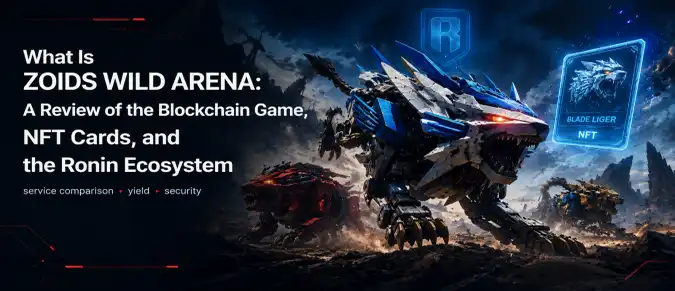

ZOIDS WILD ARENA is a blockchain-based trading card game developed by ACT Games using TOMY’s licensed ZOIDS franchise. The project combines turn-based PvP battles, card collecting, and card upgrades with digital ownership through NFTs. The Web3 version initially used Polygon, but in November 2023 the game infrastructure and NFT cards were migrated to the Ronin ecosystem, where the assets gained integration with Ronin Wallet and Mavis Market. This transition made ZOIDS WILD ARENA an example of an existing blockchain game moving to a specialized gaming network without changing its core TCG mechanics.
Contents
- What Is ZOIDS WILD ARENA and How Did the Web3 Game Evolve?
- How PvP Battles, Cards, and Deck Progression Work
- ZOIDS WILD ARENA Compared With Other Web3 Card Games
- NFT Cards, Ronin Wallet, and the Game Economy
- Migration to Ronin, Risks, and the Project’s Outlook
1. What Is ZOIDS WILD ARENA and How Did the Web3 Game Evolve?
ZOIDS WILD ARENA uses the ZOIDS intellectual property, a franchise of mechanical creatures that TOMY has developed since 1983 through toys, animation, and video games. The card game features characters and combat machines associated with titles including ZOIDS WILD and ZOIDS WILD ZERO. The project is developed by South Korean studio ACT Games.
The project was originally known as ZOIDS WILD NFT ARENA. In November 2022, the developers conducted a Frontier Test for PC and Android, testing card acquisition and upgrades, deck building, and PvP mechanics. The blockchain game officially launched in April 2023, giving users access to licensed NFT cards and trading features.
The first version of the Web3 infrastructure was connected to Polygon. This allowed the game to use Ethereum-compatible digital assets with lower fees than Ethereum mainnet. However, the game itself remained a traditional client application, with blockchain primarily used for NFT ownership and transfers rather than processing every action during a battle.
In November 2023, ACT Games and Sky Mavis migrated ZOIDS WILD ARENA to Ronin. Existing users were given a way to move their assets from Polygon, after which the NFT cards became available within the Ronin ecosystem. The gameplay mechanics did not change during the network migration, highlighting the separation between the core TCG logic and the Web3 ownership layer.
2. How PvP Battles, Cards, and Deck Progression Work
ZOIDS WILD ARENA is built around turn-based PvP battles between two Commanders. Each player builds a 30-card deck and uses it to deploy creatures on the battlefield and activate tactical effects. A match is won by reducing the opposing Commander’s HP to zero.
Cards are divided into Unit and Tactic categories. Unit Cards represent ZOIDS that participate directly in combat and have attack and health statistics. Tactic Cards serve a supporting role: they can alter the battlefield, interact with the deck, or trigger other tactical effects. As a result, some Tactic Cards do not have their own Attack or HP values.
The deck-building system creates an additional strategic layer. Players need to consider card costs, creature statistics, and interactions between tactical effects. Higher rarity does not eliminate the need for balance, because the combination of different card types determines which strategies are available during a particular match.
Collection progression is another important part of the game. Cards can be upgraded to improve their statistics and level. ACT Games materials describe the ability to develop cards up to six stars, making progression dependent on both strategic deck construction and the gradual strengthening of existing game assets.
3. ZOIDS WILD ARENA Compared With Other Web3 Card Games
Blockchain-based TCGs have become one of the more common formats in Web3 gaming. Card games naturally fit NFT mechanics because each card can be represented as a unique or limited digital asset that a user can hold in a wallet and, where supported, trade on an external marketplace.
ZOIDS WILD ARENA stands out because it uses an established gaming and media franchise. Rather than creating a collectible universe entirely around tokenized assets, the project brought existing ZOIDS into a TCG format and added Web3 ownership on top of traditional card game mechanics.
| Project | Genre | Web3 Infrastructure | Main Approach |
|---|---|---|---|
| ZOIDS WILD ARENA | Tactical TCG | Ronin | ZOIDS NFT cards, PvP, and deck progression |
| Axie Infinity: Origins | Card battles | Ronin | Creature battles and the Axie ecosystem |
| Gods Unchained | TCG | Immutable | Ownership and trading of game cards |
| Parallel | Sci-Fi TCG | Ethereum | NFT cards and a competitive economy |
| Skyweaver | Strategy TCG | Polygon | Digital cards and a Web3 marketplace |
An important difference from early Play-to-Earn projects is that the core gameplay model does not require constant blockchain transactions. Matches take place at the application level, while the network is used for NFT-related functions and digital ownership.
This approach reduces the dependence of battle speed on blockchain throughput. At the same time, the value of collectible assets remains linked to player activity, demand for specific cards, and liquidity in the secondary market.
4. NFT Cards, Ronin Wallet, and the Game Economy
After the November 2023 migration, Ronin became the blockchain layer for ZOIDS WILD ARENA. Users connected Ronin Wallet to access Web3 features, while NFT cards gained support on Mavis Market, the marketplace of the Sky Mavis ecosystem. Players moving from Polygon were able to transfer their assets into the new infrastructure.
An NFT represents ownership of the corresponding digital asset, while its gameplay parameters are defined by the rules of ZOIDS WILD ARENA. Cards have Attack and HP statistics, along with rarity and progression parameters. Tactic Cards may instead feature effects that influence the course of a match.
- 30-card decks built from Unit and Tactic Cards.
- Turn-based PvP battles between Commanders.
- NFT cards integrated with the Ronin network.
- Ronin Wallet for interacting with blockchain assets.
- Mavis Market for trading supported NFT cards.
- Different rarity levels and Birth Grade categories.
- Card upgrades and stat progression.
- Metal as an in-game resource for selected operations.
- Ranked competition and player rewards.
Birth Grade reflects a card’s original category and is connected to its rarity and characteristics. A higher grade may provide advantages, but effective deck building still requires a combination of different Unit and Tactic Cards. The value of a single NFT is therefore not the only factor determining player performance.
During the migration period, the developers also announced additional rewards for users moving wallets from Polygon to Ronin, including NFTs and a potential token airdrop. Ronin materials also mentioned plans by Mercury Labs to launch AGG on the network, although such early announcements should be separated from the game’s core economy and evaluated based on features that were actually implemented.
5. Migration to Ronin, Risks, and the Project’s Outlook
The move of ZOIDS WILD ARENA from Polygon to Ronin reflected a broader trend toward specialized blockchain infrastructure for gaming. Ronin was developed by Sky Mavis as a network for gaming applications and, by the time ZOIDS migrated, already supported the Axie Infinity ecosystem while expanding its catalog of third-party projects.
For ACT Games, the partnership provided access to established Web3 gaming infrastructure, a wallet, and an NFT marketplace. At the same time, network migration requires users to move assets and increases the game’s dependence on the selected ecosystem. If trading services or blockchain integrations change, the developer must preserve compatibility with user collections.
The main economic risks are similar to those of most NFT games. A card’s market price is not guaranteed by its rarity or statistics and depends on demand for the game itself. If the player base declines, collection liquidity may decrease even if the NFTs technically continue to exist on-chain.
Competitive balance is another important consideration. If rare NFTs provide a major advantage, the game risks creating a model in which collection size matters more than player skill. On the other hand, excessive balancing can reduce the practical value of rare assets. A card game therefore needs to maintain a balance between collecting, card progression, and strategy.
ZOIDS WILD ARENA demonstrates how a traditional licensed IP can be adapted to Web3 without moving the entire game logic on-chain. The migration from Polygon to Ronin preserved the core PvP battles while changing the infrastructure for NFT ownership and trading. The project’s long-term role depends primarily on continued game and license support, player activity, card balance, and demand for digital ownership rather than on the mere use of blockchain technology.











