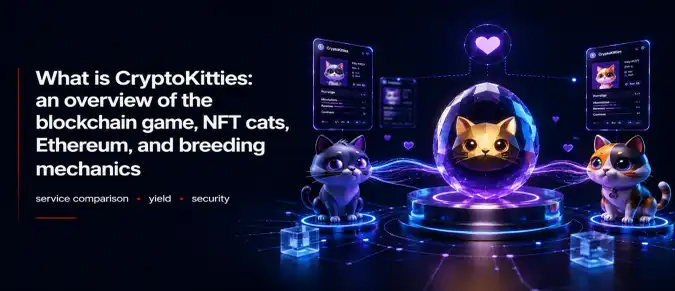

CryptoKitties is a blockchain game centered on collecting, breeding, and trading unique digital cats. Launched on Ethereum in 2017, the project became one of the earliest widely recognized examples of non-fungible tokens being used in an entertainment application. Each pet is represented as a separate digital asset with a unique identifier, genetic code, and set of inheritable traits. The popularity of CryptoKitties significantly influenced the development of the NFT market while also exposing the scalability limitations of the early Ethereum network.
Contents
- What Is CryptoKitties and How Does the Blockchain Game Work?
- Breeding, Genes, and CryptoKitties Gameplay Mechanics
- NFTs, Ethereum, and the Digital Cat Economy
- Key Features and Risks of CryptoKitties
- The Role of CryptoKitties in the NFT and Blockchain Gaming Markets
1. What Is CryptoKitties and How Does the Blockchain Game Work?
CryptoKitties was created by the Canadian studio Axiom Zen, while its later development became associated with Dapper Labs. The game emerged at a time when most blockchain applications focused on payments, tokens, and financial transactions. Its developers introduced a concept that was easier for mainstream users to understand: players could purchase a virtual pet, store it in a cryptocurrency wallet, breed new cats, and sell them to other participants.
Instead of relying only on a traditional game account, ownership of each CryptoKitty is recorded on the Ethereum blockchain. Every cat is linked to a separate token and cannot be completely identical to another asset because of its unique number and characteristics. The owner can transfer the token to another compatible address, list it for sale, or use it for breeding.
CryptoKitties does not feature battles, character levels, or a complex story campaign. Its core gameplay revolves around collecting, analyzing traits, selecting suitable parents, and producing offspring. The value of a particular cat is determined by the market and may depend on its generation, trait rarity, lineage, appearance, and collector demand.
To interact with the original version of the game, users need a compatible Ethereum wallet and ETH to pay for transactions. Purchases, transfers, sales, and breeding operations are processed through smart contracts, meaning the total cost depends not only on the price of a cat but also on network fees.
2. Breeding, Genes, and CryptoKitties Gameplay Mechanics
The main gameplay mechanic in CryptoKitties is breeding two compatible digital cats. One acts as the sire, while the other serves as the dame. After a blockchain transaction is completed, a new token is created with its own identifier and genetic code. The resulting pet becomes an independent asset and can later participate in further breeding.
A CryptoKitty genome consists of multiple blocks responsible for individual visual characteristics. Each block contains a dominant gene that determines the visible trait, as well as hidden genes that are not immediately displayed but may be passed on to offspring. As a result, two visually similar cats can produce kittens with different characteristics.
Mutations may also occur during inheritance. They can appear when certain combinations of parental genes interact, producing traits that are not visible in either parent. This system introduces an element of probability and makes breeding outcomes partially unpredictable, although users who study the collection's genetics can estimate likely combinations.
Each cat also has a generation number and a cooldown period after breeding. The offspring's generation is one level higher than that of the older parent. Early-generation cats generally begin with shorter cooldown periods, but the waiting time gradually increases after each breeding cycle. This limits how frequently individual pets can create new tokens.
3. NFTs, Ethereum, and the Digital Cat Economy
CryptoKitties was one of the projects that helped establish the early use of non-fungible tokens on Ethereum. The concept of unique digital cats was closely connected to the development of the ERC-721 standard, which introduced a common interface for tracking, transferring, and verifying ownership of unique tokens.
Unlike fungible cryptocurrencies, where one unit is equivalent to another, every CryptoKitty has its own identifier and characteristics. This allows the market to assign different prices to individual cats even when they belong to the same collection and use the same blockchain infrastructure.
| Component | Purpose |
|---|---|
| CryptoKitty | Unique digital cat and collectible NFT |
| Ethereum | Blockchain for recording ownership and processing transactions |
| ERC-721 | Non-fungible token standard |
| Genome | Set of visible and hidden inheritable traits |
| Smart Contracts | Management of ownership, breeding, and asset transfers |
The game's economy is shaped by its participants. Users purchase cats, create offspring, and offer assets to other collectors. Prices are not guaranteed or fixed by the developers; they depend on demand, trait rarity, sales history, generation, and overall NFT market activity.
Ethereum fees are an important factor when evaluating the CryptoKitties economy. Even an inexpensive cat may require additional spending for purchasing, transferring, or breeding. During periods of heavy network activity, transaction fees can make certain gameplay actions economically impractical.
4. Key Features and Risks of CryptoKitties
CryptoKitties combines game mechanics with direct ownership of digital assets. Users can manage their tokens through a blockchain wallet rather than relying only on the developer's internal database. However, owning an NFT does not guarantee liquidity, profitability, or continuous demand from other market participants.
Key game features include:
- collecting unique digital cats;
- breeding pets with inheritable genes;
- creating new NFTs through gameplay;
- buying, selling, and transferring tokens;
- verifying ownership and transaction history on the blockchain;
- searching for rare traits and genetic combinations;
- using external Ethereum wallets;
- interacting with smart contracts without centralized ownership records.
The main risks include price volatility, network fees, wallet management errors, and the absence of a guaranteed buyer. The value of rare cats is subjective, and previous sales do not reliably predict future prices. Losing access to private keys may also make it impossible to manage the associated assets.
In addition, part of the user experience depends on the website interface and external infrastructure. The blockchain confirms token ownership and key operations, but images, trait descriptions, and usability may still rely on centralized web services. For this reason, NFT ownership should not be treated as complete independence from every component of the application.
5. The Role of CryptoKitties in the NFT and Blockchain Gaming Markets
CryptoKitties played an important role in popularizing digital collectible assets. The project demonstrated that blockchain technology could be used not only for money transfers and fungible tokens but also for recording ownership of unique game items. This model later became the foundation for numerous NFT collections, marketplaces, and blockchain games.
The sharp increase in activity at the end of 2017 also served as a major stress test for Ethereum. CryptoKitties transactions accounted for a significant share of network activity, increased the backlog of unconfirmed transactions, and contributed to higher fees. This episode showed that mass-market blockchain applications require more scalable infrastructure and more convenient scaling solutions.
By modern standards, the gameplay of CryptoKitties is relatively simple, but the project's historical importance is not based on mechanical complexity. The game made the concept of unique digital ownership easier for a broad audience to understand and demonstrated that NFT characteristics could influence gameplay, inheritance, and market value.
Overall, CryptoKitties remains an important early example of blockchain gaming and practical NFT use. The project combines collecting, genetic mechanics, and Ethereum-based asset trading, but participation requires users to consider transaction fees, market risks, and the challenges of self-custody. Its primary legacy lies in advancing the idea of programmable digital items that users can own and manage through blockchain technology.











