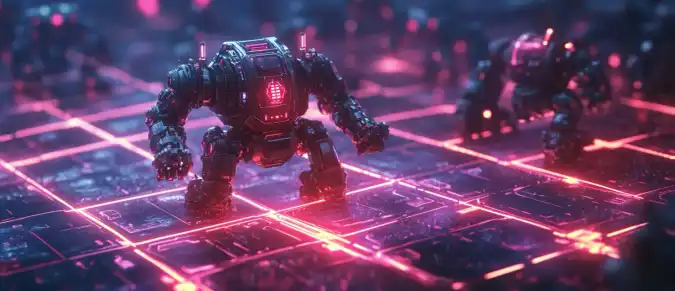

Data2073 is a Web3 gaming ecosystem in the strategic PvP TCG genre, built around a post-apocalyptic world of combat automatons, NFT assets, and a tokenized economy. The project combines competitive card-based gameplay, on-chain ownership of in-game assets, and DeFi mechanisms for revenue distribution among participants. Unlike many GameFi projects, Data2073 focuses not on “farming for the sake of farming,” but on a sustainable ecosystem where player skill, collecting, and social interaction are directly tied to the economic model and the long-term value of assets.
- Data2073: ecosystem concept and project architecture
- DATA 2073: game world, Architects, and PvP gameplay
- Data2073 economy: tokens, currencies, and use cases
- NFT infrastructure: asset types and their role in the game
- DATA2073 technology and scaling: networks, DeFi mechanics, and onboarding
Data2073: ecosystem concept and project architecture
Data2073 is designed from the outset not as a standalone game, but as a scalable gaming ecosystem that brings together multiple layers of interaction: gameplay, NFT ownership, economy, and governance. At its core lies the idea of interconnected products, where in-game assets retain value beyond a single mode or season. Cards, units, and land are used both in PvP battles and in social and economic mechanics, forming a unified value space.
The project’s architecture assumes gradual expansion of modes and services without resetting player progress. This distinguishes Data2073 from typical GameFi models, where the value of tokens and NFTs is often tightly bound to a single mechanic. Here, assets are embedded into the ecosystem as long-term elements: they can be upgraded, used in different scenarios, and participate in revenue distribution. This approach brings the project closer to a full-fledged gaming franchise rather than a short-lived Web3 experiment.
DATA 2073: game world, Architects, and PvP gameplay
The story of Data2073 unfolds in the distant future after a global catastrophe, where power has shifted to those capable of controlling technology and resources. The player takes on the role of an Architect—a strategic leader who creates, modifies, and commands an army of combat automatons. These machines are not merely visual NFTs, but fully functional game units with their own attributes, synergies, and battlefield roles.
Gameplay revolves around card-based tactical PvP battles, where match outcomes depend on deck composition, proper resource management, and the ability to adapt to opponents’ strategies. Progression comes through expanding the collection, upgrading cards, and participating in competitive modes. A strong social layer also plays a key role: guilds, shared land control, and tournaments create a meta-game in which value is driven not only by individual progress but also by cooperation between players.
Data2073 economy: tokens, currencies, and use cases
The economic model of Data2073 is built on a clear separation of functions between different types of tokens and in-game currencies. This helps reduce inflationary pressure and distinctly separate ecosystem governance from practical gameplay actions.
Key elements of the Data2073 economy:
-
$DAT — the ecosystem’s governance token, used for voting, participation in revenue distribution, and system-level operations
-
$MS (Mecha Shards) — a utility token for in-game transactions, upgrades, and crafting
-
In-game currencies — resources earned through matches and activities, spent on progression
-
NFT assets — units, land, and generators that form the foundation of the economy
-
Burn mechanisms — tools for supply control and reward balance
This separation allows players to choose different participation strategies: some focus on PvP and progression, while others concentrate on asset management and long-term token holding. The economy is directly tied to gameplay activity, reducing the risk of the project turning into a purely speculative market without real gameplay value.
NFT infrastructure: asset types and their role in the game
NFTs in Data2073 play a functional role and are tightly integrated into the project’s gameplay and economy. Each NFT type corresponds to a specific aspect of the game and provides practical utility.
| NFT Type | Purpose | Role in the ecosystem |
|---|---|---|
| Mechanoid Card | Combat unit | Core force in PvP battles |
| Drone Card | Support unit | Enhances strategy and tactics |
| Architect Action | Abilities | Expands tactical options |
| Generator Card | Card production | Source of new in-game assets |
| Land NFT | Territories | Social and guild mechanics |
| Mystery Box | Random rewards | Onboarding and collecting incentive |
This NFT structure forms a closed value loop: assets are created, used, upgraded, and redistributed among players through the marketplace and in-game mechanics. This reduces speculative imbalance and strengthens the link between NFT ownership and actual gameplay participation.
DATA2073 technology and scaling: networks, DeFi mechanics, and onboarding
From a technical perspective, Data2073 follows a multi-network strategy focused on scalability and user convenience. The project is deployed on Moonbeam and SKALE networks, which provide high throughput and low fees—critical for gaming scenarios. Integration with Arbitrum has also been announced, expanding liquidity and access to DeFi infrastructure.
The ecosystem’s DeFi layer includes Treasury, Nexus, and revenue distribution mechanisms, where part of the income is used to buy back $DAT from the market and redistribute it to holders. This creates a participation model in which returns depend on ecosystem activity rather than simple reward emission. Onboarding is simplified through an integrated wallet with email and social login, lowering the entry barrier for users without prior crypto experience and positioning Data2073 for a broader mainstream audience.











