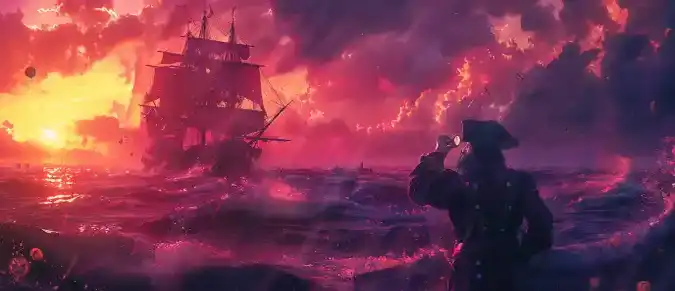

In the world of blockchain entertainment, an increasing number of projects are emerging that combine engaging gameplay with a real-world economy. The Seven Seas is one such prime example. It is a multiplayer pirate strategy built on Web3 technology, offering players not just a virtual adventure but a full-fledged ecosystem with its own digital assets. Players assume the role of captains, explore the seas, compete for resources, and influence the development of the game world. The project's uniqueness lies in the deep integration of ownership and earning mechanics, making every step meaningful and potentially profitable.
Contents:
- The World and Concept of The Seven Seas
- Gameplay and Key Mechanics
- In-Game Economy and Tokens: $BOOTY and $GOLD
- The Seven Seas Community and Social Aspects
- Technologies and Future Development of the Project
- Conclusion
The World and Concept of The Seven Seas
The universe of The Seven Seas immerses players in an era of maritime discovery and pirate freedom. The project presents a vast digital ocean where every location holds opportunities for gathering resources, exploration, or clashes with other captains. The key concept is providing absolute freedom of choice: one can become a peaceful merchant, a formidable corsair, or a discoverer of mysterious archipelagos.
The dynamic game world continuously changes under the influence of community actions, creating a living ecosystem with its own politics and economy. This approach blurs the line between traditional video games and the digital economy, offering an environment where virtual achievements gain real value. The concept emphasizes the player shaping their own unique story within the constantly evolving metaverse.
Gameplay and Key Mechanics
The gameplay of The Seven Seas is a multi-layered pirate strategy requiring both tactical thinking and the ability to act swiftly in an open world. Participants begin their journey by managing a basic ship, gradually expanding their influence through exploration, economics, and interaction with other captains. This process is built on several fundamental mechanics that ensure a diverse gaming experience.
The main components of the process include:
- Fleet Development and Customization: Players acquire new vessels, improve their characteristics, and equip them with specialized armaments for various tasks.
- Exploration and Cartography: Mastering new territories, searching for valuable resources, and discovering secret routes for a strategic advantage.
- Economy and Resource Management: Organizing the collection, production, and trade of materials necessary for fleet maintenance and infrastructure development.
- Diplomacy and PvP: Forming alliances for cooperative actions or engaging in competitive struggles for control over key points on the map.
These interconnected systems create a dynamic environment where every decision has consequences. Success depends on a balanced approach combining combat effectiveness, economic feasibility, and social activity. Thus, the project offers a deep and multifaceted experience, encouraging both individual achievements and cooperative play.
In-Game Economy and Tokens: $BOOTY and $GOLD
The economic system of The Seven Seas is one of the central mechanics of the project, based on two crypto tokens: $BOOTY and $GOLD. These assets facilitate not only the internal circulation of value but also create a stable link between in-game achievements and the real economy. Their functionalities are clearly delineated, allowing for a balanced and multi-tiered reward model for participants.
The key differences between the main in-game currencies are presented in the table:
| Token | Primary Function and Purpose | Typical Acquisition Methods |
|---|---|---|
| $BOOTY | The primary unit of account for daily operations: ship repairs, purchase of basic resources, payment for standard upgrades. | Completing daily quests, selling gathered materials, successful completion of regular contracts. |
| $GOLD | Premium currency for exclusive transactions: purchasing unique items, accelerating important processes, participating in special auctions. | Victory in major world events, achieving high positions in seasonal rankings, rare exploration finds. |
Both tokens are issued on the blockchain, guaranteeing transparency in their circulation and giving players full ownership rights over earned assets. This dual model stimulates both regular activity and the pursuit of outstanding results. Integration with decentralized technologies allows these digital assets to exist outside the game, creating real financial opportunities for captains based on their virtual successes.
The Seven Seas Community and Social Aspects
The Seven Seas is a social project where interaction between players determines the development of the entire world. As data from the site shows, an active community of around 25,000 participants has formed around the game on Discord and Twitter platforms. It is within guilds and alliances that captains coordinate their actions, plan joint raids, and forge political unions.
Social dynamics transform the gameplay into a collective experience: the decisions of individual groups influence the balance of power, economy, and politics across the entire game field. The developers maintain a dialogue with the audience, fostering a lively and responsive environment. Thus, the community acts not merely as spectators but as active co-authors and driving forces of the constantly changing pirate universe.
Technologies and Future Development of the Project
The Seven Seas project is based on modern blockchain technologies that ensure transparency, security, and true ownership of in-game valuables. The use of smart contracts automates economic processes, minimizing intermediary interference and ensuring fairness in all operations. This architecture not only supports current functionality but also creates a solid foundation for future large-scale updates.
Key technological directions and development plans include:
- Decentralized Governance (DAO): Implementing tools that allow the community to directly influence the development of the game world through proposals and voting.
- Expansion of the NFT Ecosystem: Releasing new types of unique collectible items, such as rare ships, land plots on islands, and artifacts, providing players with full ownership rights.
- Mobile Accessibility: Developing and launching a full-fledged version of the game for mobile devices, which will significantly expand the audience and increase engagement.
- Cross-Network Interoperability: Working on enabling the use of the project's key assets in partner games and metaverses, enhancing their utility and value.
These initiatives demonstrate the creators' ambition to build a sustainable and independent ecosystem around the game. The emphasis on decentralization and user rights is a key trend in the Web3 industry. Following this philosophy, The Seven Seas aims to secure a prominent place among projects shaping the future of digital entertainment and the virtual economy.
Conclusion
The Seven Seas confidently demonstrates how modern technologies can enrich the gaming experience, transforming it from simple entertainment into a meaningful digital endeavor. The project successfully integrates exciting pirate romance with a thoughtful economic model based on real value. This allows players not only to enjoy the process of exploration and conquest but also to see the material results of their strategic decisions and invested effort.
Thus, the game represents a holistic and promising ecosystem in the world of Web3. With an active community, transparent dual tokenomics, and ambitious plans for metaverse development, The Seven Seas offers captains a true digital proving ground for building their own legend. This project is a vivid example of a new generation of entertainment, where freedom of action, ownership rights, and real rewards become integral elements of gameplay.











