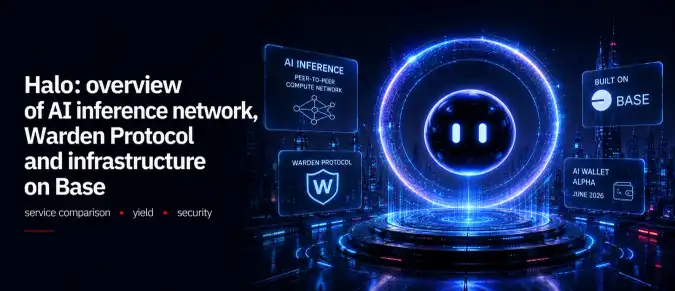

Halo is a blockchain-based infrastructure for distributed AI inference within the Warden Protocol ecosystem. Its public alpha launched on June 30, 2026, on Base mainnet. Despite Warden's connection to agentic wallets, Halo itself is more accurately described not as an AI wallet, but as a peer-to-peer compute marketplace where users and autonomous agents purchase access to AI models while operators provide inference. Payments within the network are centered around the USDC stablecoin, with Base serving as the initial blockchain for the payment infrastructure. The project is developing in stages: payments, privacy, SPEX verification, and other features are being introduced according to separate roadmap phases, so the capabilities of the alpha should be distinguished from the architecture of the full protocol.
Contents:
- What Is Halo and How Is It Connected to Warden Protocol
- How P2P AI Inference Works in Halo
- Base, USDC, x402, and the WARD Economy
- Differences Between P2P AI Inference and Centralized AI Services
- Privacy, SPEX, Roadmap, and Halo Risks
1. What Is Halo and How Is It Connected to Warden Protocol
Halo is being developed as a permissionless peer-to-peer network for AI inference. Its purpose is to connect users and AI agents that need access to models with operators capable of performing computations. An operator may provide local hardware, server infrastructure, or access to an external model. Instead of relying on a single centralized API, requests can be processed through a network of independent providers.
The project is being developed within the Warden Protocol ecosystem, which focuses on infrastructure for autonomous AI agents. However, Halo should be distinguished from Warden App. The latter was developed as a consumer-facing agentic wallet and platform for trading, AI agents, and Web3 operations. In May 2026, Warden announced that the application had been transferred to a separate BasedAI team, while Warden Foundation shifted its focus toward the protocol, WARD, and Halo.
Halo's public alpha opened on June 30, 2026, on Base mainnet. At this stage, users gained access to a portal for interacting with models, while operators could connect computing resources and process requests. In July, Warden reported that the network had processed more than 7 billion AI tokens across more than 160 models. However, these figures were reported by the project itself and may change with network activity.
Halo is designed not only for human users. An autonomous agent can use its own wallet and budget to pay for inference without requiring manual approval for every request. Compatibility with an OpenAI-style interface also simplifies the integration of existing AI applications and agent frameworks with the distributed infrastructure.
2. How P2P AI Inference Works in Halo
Halo's architecture divides participants into consumers, AI agents, and operators. A consumer submits a prompt and pays for the computation, after which the request is routed to an operator capable of serving the relevant model. The result is returned to the user, while the operator receives payment for performing the inference.
To get started in the alpha version, a consumer deposits USDC into the Halo vault on Base and needs a small amount of ETH for the initial transaction. Once the deposit is made, requests are paid from the available balance. The project uses gas sponsorship for most subsequent operations, reducing the need to approve a separate blockchain transaction for every prompt.
- Consumer — a user who selects a model and submits requests through Halo Portal.
- AI Agent — an autonomous application capable of purchasing inference within a predefined budget.
- Operator — a participant who provides access to an AI model and receives payment for processed requests.
- Halo Portal — a user interface for accessing distributed inference without using a CLI.
- Leaderboard — public statistics covering operators, models, uptime, request counts, and processed inference.
Operators do not necessarily need to own industrial-scale data centers. The architecture supports local models running on personal hardware, dedicated AI servers, and models accessed through external APIs. Warden has mentioned OpenClaw, ClaudeCode, Hermes, LangChain, CrewAI, Eliza, and Ollama among the supported integration scenarios.
This model creates a compute marketplace in which inference pricing and availability can depend on operator supply, supported models, and user demand. However, the quality of a distributed service also depends on node reliability, network latency, and the protocol's ability to verify that computational tasks have been performed correctly.
3. Base, USDC, x402, and the WARD Economy
Base became the first network used for Halo's payment infrastructure. Users do not need to pay for inference with the WARD token, as USDC serves as the primary settlement asset. This separates payments for AI computation from the economics of Warden Protocol's native token and reduces the direct impact of WARD volatility on the cost of individual inference requests.
The full architecture provides for two main payment routes. x402 is designed for automated payments for individual API requests and is particularly suitable for AI agents. Direct deposits are intended for users, DAOs, and applications that need to deposit USDC in advance and process a large number of requests. Automation of these mechanisms is being introduced gradually and should not automatically be attributed to the original June alpha.
Within the protocol's economic model, WARD is not the primary currency for inference. Instead, it is an asset associated with staking and value capture. According to the Halo litepaper, under the fully deployed model, a portion of fees is expected to accumulate in USDC and be used to purchase WARD on the open market. The purchased tokens would then be distributed between staking-related mechanisms and token burning.
The roadmap scheduled the launch of automated settlement and buyback infrastructure for August 2026. Before its full activation, the Foundation used manual buyback operations linked to network activity. When analyzing the tokenomics, it is therefore important to distinguish between components that are already operational and contract infrastructure that remains planned or is still being deployed.

4. Differences Between P2P AI Inference and Centralized AI Services
A conventional cloud AI API creates a direct relationship between a client and a specific model provider. Halo attempts to replace this structure with a marketplace of independent operators. Users interact with the network, while computations may be handled by different providers depending on the selected model and available infrastructure.
| Parameter | Halo | Centralized AI API | Typical DePIN AI Network |
|---|---|---|---|
| Architecture | P2P inference marketplace | Centralized provider | Distributed compute nodes |
| Primary Users | Humans and AI agents | Humans and applications | Developers and applications |
| Payments | USDC on Base | Fiat or bank card | Depends on the protocol |
| Payment per Request | x402 and deposit model | API billing | Tokens or stablecoins |
| Inference Providers | Independent operators | Single company | Network operators |
| Verification | SPEX included in the architecture | Trust in the provider | Depends on the network |
| Native Token | WARD is not required to pay for inference | None | Often used for settlement |
An important feature of Halo is its focus on the agentic economy. An AI agent needs not only access to a model but also the ability to pay for computation autonomously. The use of wallets, USDC, and x402 makes it possible to embed payments directly into machine-to-machine requests without creating a separate subscription or account for every agent.
However, decentralization alone does not guarantee lower costs, higher speed, or better quality. Centralized AI companies optimize their own data centers and maintain direct control over infrastructure. Halo, by contrast, must coordinate independent operators while addressing model availability, result verification, payments, and privacy.
5. Privacy, SPEX, Roadmap, and Halo Risks
One of the key challenges of P2P inference is protecting prompts and computation results. Halo's roadmap provides for a gradual development of its privacy stack, including request encryption, isolated operator keys, task fragmentation, and a later transition toward confidential inference using Trusted Execution Environments (TEEs).
To verify computations, Warden is developing Statistical Proof of Execution (SPEX). The mechanism uses statistical sampling and Bloom filter-based fingerprints to verify task execution without requiring every verifier to repeat the full computation. SPEX is designed to support non-deterministic AI inference workloads. According to the roadmap, the standard verification path is scheduled for September 2026 and was not part of the original June alpha.
Further development of Halo includes on-chain reputation for operators and agents, scaled verification, TEE-isolated execution, the Halo SDK, and expansion beyond Base. Since some of these capabilities remain on the roadmap, they should be distinguished from features that are already operational. The main risks are associated with Halo's early development stage, operator reliability, latency, inference quality, and smart contract security. When external APIs are used, the system also remains partially dependent on third-party model providers.
Additional factors include prompt privacy, key security, Base infrastructure, USDC, and the future economics of WARD. At this stage, Halo is more accurately viewed as an evolving P2P infrastructure for AI inference rather than a fully developed alternative to cloud-based AI services. Its longer-term assessment will depend on the implementation of SPEX and confidential computing, the resilience of the operator network, and actual demand from autonomous AI agents.











