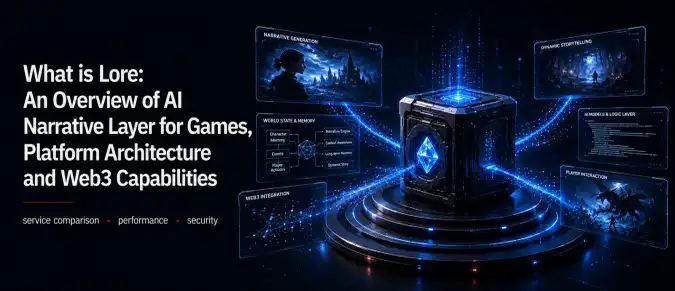

Lore is a project developing the concept of an AI narrative layer for game worlds, where generative artificial intelligence is used not only to create individual dialogues but also to maintain coherent storytelling, persistent character memory, and dynamic world evolution. This approach belongs to the emerging category of AI-native games, in which artificial intelligence becomes an integral part of gameplay rather than simply a development tool. By combining AI models, persistent world-state management, and Web3 infrastructure, developers can build more interactive and adaptive gaming ecosystems. The project's vision focuses on creating long-lived virtual worlds where stories continue to evolve alongside player actions.
- What Is Lore (AI Narrative Layer for Games)
- Platform Architecture and Core Principles
- Key Features of the Lore Platform
- Comparing Lore with Traditional Game Systems
- Lore Ecosystem, Use Cases, and Future Outlook

1. What Is Lore (AI Narrative Layer for Games)
The rapid advancement of generative artificial intelligence is transforming how modern games are designed. While storylines, dialogues, and NPC behavior were traditionally scripted in advance, today's large language models are capable of generating content dynamically during gameplay. However, simply integrating an LLM is not enough—without an additional orchestration layer, stories quickly lose consistency and characters may contradict previous events.
The AI narrative layer is designed to solve this challenge. It serves as an intermediary between the game engine and language models, managing world knowledge, narrative consistency, character memory, and synchronization of in-game events. This architecture helps maintain coherent storytelling even throughout extended gameplay sessions.
Lore is among the projects exploring this architectural approach. Instead of producing isolated AI responses, the platform leverages structured world data, historical player interactions, and persistent contextual information. As a result, narratives become significantly more coherent, while game scenarios can evolve according to player decisions.
2. Platform Architecture and Core Principles
The platform is built around separating narrative generation from the underlying game state. Artificial intelligence is responsible for producing dialogue, descriptions, and story content, while game logic is maintained independently in structured data. This architectural model reduces logical inconsistencies and improves the reliability of dynamic storytelling.
Modern AI-native gaming systems typically include several interconnected components, such as persistent memory management, contextual reasoning, world knowledge databases, event orchestration, and natural language generation. This modular architecture is gradually becoming a common design pattern for projects integrating large language models directly into gameplay.
Blockchain components can also be incorporated to manage digital assets, player identities, in-game ownership, and NFT verification. At the same time, story generation remains independent from blockchain infrastructure, while distributed ledgers primarily provide transparent ownership and interoperability within the ecosystem.
This separation allows developers to scale gaming services more efficiently, upgrade individual modules without rebuilding the entire platform, and integrate new AI models as they become available.
3. Key Features of the Lore Platform
Using a dedicated narrative layer enables developers to build gameplay experiences that go far beyond conventional dialogue trees. Instead of following predefined story branches, players experience dynamically generated narratives that continuously incorporate previous interactions and contextual information. This approach creates more natural interactions, allowing NPCs to remember past events and respond to changes within the game world. In addition, the platform's modular architecture simplifies the integration of new AI models without requiring major changes to the overall system.
- Real-time generation of dynamic storylines;
- Persistent long-term memory for NPCs;
- Recognition of previous player actions;
- Support for non-linear storytelling;
- Creation of unique AI-driven NPC personalities;
- Integration of digital assets with Web3 infrastructure;
- Scalable virtual worlds through modular architecture;
- Support for multiple large language models.
These capabilities can be implemented individually or combined to build more flexible gaming architectures. This allows developers to create large-scale virtual worlds featuring interconnected events, evolving characters, and personalized gameplay experiences.
As a result, the AI narrative layer can serve as a universal component for RPGs, MMORPGs, metaverse platforms, interactive storytelling applications, and other projects where narrative progression and player interaction play central roles. As generative AI technologies continue to evolve, similar architectures may become a standard foundation for next-generation gaming platforms focused on personalization and persistent virtual worlds.

4. Comparing Lore with Traditional Game Systems
The emergence of AI narrative layers reflects a broader shift in game development methodologies. Traditional game engines rely on predefined scripts and carefully designed dialogue trees, whereas AI-powered systems aim to deliver adaptive, continuously evolving narratives. Instead of rigid quests and fixed conversations, developers can build worlds that respond to player behavior almost instantly. This is particularly valuable in multiplayer environments, where manually scripting every possible interaction becomes impractical. The table below summarizes the key architectural differences.
| Feature | Lore (AI Narrative Layer) | Traditional Game Systems |
|---|---|---|
| Story Generation | AI-generated in real time | Pre-scripted storylines |
| NPC Memory | Persistent long-term memory | Limited or session-based |
| World Evolution | Driven by player actions | Mostly predefined |
| Dialogue Context | Automatically maintained | Fixed dialogue trees |
| Web3 Integration | Built into the architecture | Often unavailable |
The comparison demonstrates that an AI narrative layer primarily focuses on personalized gameplay and long-term world evolution. Rather than replacing traditional game engines, it extends them with an intelligent narrative layer responsible for storytelling, contextual reasoning, character memory, and adaptive player interactions.
It is important to recognize that these technologies are still at an early stage of development. Despite significant advances in generative AI, developers must continue addressing challenges related to content quality, computational efficiency, and reliable memory management. As language models and contextual reasoning systems improve, AI narrative layers could become a core component of future game development.
5. Lore Ecosystem, Use Cases, and Future Outlook
Interest in AI narrative layers continues to grow alongside the expansion of AI-native games, multiplayer metaverse platforms, and Web3 ecosystems. These technologies enable virtual worlds that continue evolving long after individual gaming sessions have ended, preserving player histories, character relationships, and the long-term consequences of in-game decisions.
Blockchain technology further extends these capabilities by enabling ownership of digital assets, characters, and unique story elements through NFTs. Smart contracts can manage decentralized ownership and interactions without relying on centralized intermediaries. Within this architecture, the AI narrative layer focuses on intelligent storytelling, while blockchain infrastructure provides transparent digital ownership and interoperability.
As large language models continue to mature, architectures like Lore could provide the foundation for a new generation of interactive games in which artificial intelligence governs not only conversations but also the long-term evolution of entire virtual worlds. For the Web3 gaming industry, this creates opportunities to build persistent, highly personalized ecosystems with continuously evolving narratives, while future adoption will depend on advances in AI quality, memory management, and blockchain infrastructure.











