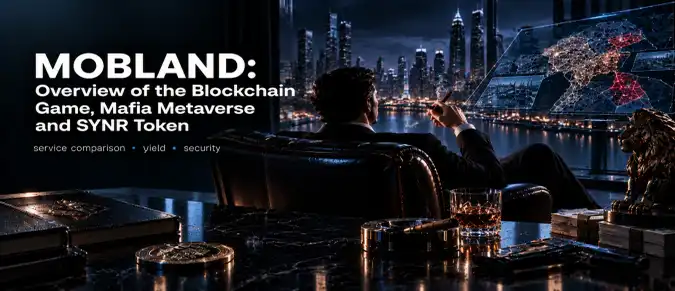

MOBLAND is a blockchain game and crime-themed virtual world originally launched under the name SYN CITY. The project was built around the Mafia Metaverse concept, where players form syndicates, develop characters, own digital assets, and participate in an economy powered by the SYNR token. MOBLAND combines elements of RPGs, GameFi, NFTs, and DeFi mechanics, while some of its gaming systems are connected to SEED and BUD resources. As of 2026, the project's official website remains operational and displays available gaming and economic components, although some elements of the original roadmap should be distinguished from features that have actually been implemented.
Contents
- What Is MOBLAND and How the Mafia Metaverse Evolved
- Gameplay, Syndicates, and the Crime-Themed Virtual World
- NFTs, Genesis Blueprints, TURF, and Shadow Market
- SYNR Token and the MOBLAND Economy
- MOBLAND Risks and Development Prospects

1. What Is MOBLAND and How the Mafia Metaverse Evolved
MOBLAND's history began in 2021 with the SYN CITY project. One of its co-founders was Roy Liu, who had previously held a senior business role at the TRON Foundation. The team also included specialists with experience at Disney, Ubisoft, Roblox, Electronic Arts, and Gameloft. The project adopted a crime-themed setting and a model in which players form mafia syndicates and compete for resources.
In November 2021, SYN CITY announced an $8 million funding round. The round was led by Twitch co-founder Justin Kan and Goat Capital, with Animoca Brands, Spartan Group, Hack VC, A&T Capital, and other investors also participating. In early 2022, the project was renamed MOBLAND while retaining its core Mafia Metaverse concept and the SYNR token.
The original concept focused on free-to-play and play-to-earn mechanics. Players were expected to participate in PvE, PvP, tournaments, and syndicate activities, while economic interactions were intended to move on-chain. One of the project's distinctive ideas was Mafia-as-a-DAO — a governance model in which in-game groups would participate in distributing influence across the metaverse.
MOBLAND was developed in stages, so its early whitepaper should not be treated as a description of a fully implemented product. The current official website focuses on HOOD, characters created from Genesis Blueprints, Shadow Market, TURF, and related resources. When analyzing the game, it is important to distinguish these available components from the broader mechanics described in the project's historical roadmap.
2. Gameplay, Syndicates, and the Crime-Themed Virtual World
MOBLAND's gameplay model revolves around building a criminal empire. Under the original concept, users were expected to start with a character, complete missions, participate in battles, collect resources, and gradually increase their influence. A broader social layer is formed by syndicates — groups of players designed for collective competition and management of gaming assets.
The official website provides access to the HOOD environment, where owners of eligible characters can explore the space, interact with other users through text and voice chat, and participate in gaming activities. Genesis Blueprints are used for characters and can be revealed to generate digital gangsters with different attributes.
Key elements of the MOBLAND ecosystem include:
- HOOD as the social and gaming environment of the Mafia Metaverse;
- Genesis Blueprint NFTs for gaming characters;
- syndicates and the Mafia-as-a-DAO model;
- SYNR as the primary token of the economy;
- synthetic and in-game economic assets;
- TURF as digital territory;
- SEED and BUD within the Shadow Market mechanics;
- PvE, PvP, and competitive mechanics included in the game's original concept.
Syndicates were designed to be more than conventional gaming guilds. SYNR holders could gain governance influence and delegate it to leaders, while participants with the strongest support could take on roles within the governance system. This model connected the game's social structure with its tokenomics.
However, the economic component does not replace gameplay. MOBLAND's long-term sustainability depends on whether its gaming mechanics can retain users without continuous reliance on token rewards. This remains a broader challenge for GameFi projects developed during the rapid expansion of the play-to-earn model in 2021–2022.
3. NFTs, Genesis Blueprints, TURF, and Shadow Market
NFTs are used in MOBLAND to represent specific gaming assets. Genesis Blueprints became one of the main categories. Blueprint holders can reveal characters through the dedicated Reveal App, after which the resulting gangsters can be used within the gaming environment. In this model, an NFT functions as a digital asset linked to a playable character rather than merely as a collectible image.
Another part of the economy is connected to TURF virtual land and Shadow Market. This system revolves around the production of gaming resources: territory owners use SEED to grow BUD. The concept involves competition for territory and protection of production assets, connecting NFT-based land with a resource-driven economy.
| Asset or Component | Function | Role in MOBLAND |
|---|---|---|
| Genesis Blueprint | Creation of a gaming character | Access to gangsters for use in the game |
| Gangster | Gaming character | Participation in Mafia Metaverse activities |
| TURF | Virtual territory | Foundation for Shadow Market resource mechanics |
| SEED | Gaming resource | Used in BUD production |
| BUD | Produced resource | Component of the in-game economy |
| SYNR | ERC-20 token | Governance, staking, and economic mechanics |
Shadow Market illustrates how MOBLAND attempted to move beyond a simple "play and earn a token" model toward an economy based on several interconnected resources. Players can use different types of assets depending on their chosen strategy, including territory ownership, resource production, and participation in other economic mechanics.
At the same time, NFTs and virtual land introduce additional risks. Their utility depends on game activity and user demand, while their market value can fluctuate significantly. Ownership of an NFT on the blockchain confirms ownership of the token, but does not by itself guarantee demand for the associated gaming item.

4. SYNR Token and the MOBLAND Economy
SYNR is the primary crypto asset of MOBLAND and was issued as an ERC-20 token on Ethereum. Its maximum supply is 10 billion SYNR. The original model primarily defined it as the governance token of the Mafia Metaverse while also connecting it to staking, gaming benefits, and other economic operations.
One of the project's mechanics involves creating synthetic assets through staking. Historical documentation describes sSYNR as an in-game synthetic version of SYNR intended for transactions within the ecosystem, including the acquisition of certain gaming assets. The project also introduced the concept of sPOWER, which was associated with voting and delegating influence to syndicate leaders.
The economy was later expanded with SEED and BUD resources. The official website describes a model in which users can use SYNR-related mechanics to obtain SEED and then deploy this resource within Shadow Market. As a result, the ecosystem contains several economic layers: the primary market token, synthetic assets, gaming resources, and NFTs.
This structure increases the complexity of the tokenomics. The value and utility of each component depend on activity in other parts of the system. If the number of players or demand for in-game actions declines, it may affect demand for resources, NFTs, and the primary token.
SYNR also remains a market-traded crypto asset, meaning that its price depends on more than gaming metrics. Liquidity, availability on trading platforms, broader cryptocurrency market conditions, and demand for GameFi tokens can all affect its value. Staking and in-game utility do not eliminate volatility or guarantee returns.
5. MOBLAND Risks and Development Prospects
MOBLAND emerged during the period when play-to-earn games and gaming metaverses were gaining popularity. The market has since changed, with users placing greater emphasis on gameplay quality. As a result, the project has to compete not only with other GameFi platforms but also with traditional online games.
Another risk is the difference between the project's original concept and its implemented features. Early materials described an extensive Mafia Metaverse with PvP, PvE, DAO governance, syndicates, and its own economy. In 2026, the official website displays HOOD, Shadow Market, Blueprint Reveal, NFTs, and token-related tools, but features described in the whitepaper or roadmap should not automatically be considered fully implemented.
The MOBLAND economy includes several interconnected assets: SYNR, SEED, BUD, TURF, synthetic tokens, and characters. Demand for these assets depends on player activity. Users also face smart contract, wallet, Ethereum transaction, NFT liquidity, and token volatility risks.
MOBLAND combines characters, virtual land, social mechanics, and a GameFi economy. However, the project's prospects depend primarily on maintaining an active audience, developing gaming content, and generating real demand for in-game assets. When evaluating MOBLAND, it is therefore important to distinguish the ecosystem's functioning features from the project's historical plans.