

Pheasant Network — an infrastructure-level cross-chain protocol focused on an intent-based approach and an optimistic transaction execution model. The project addresses one of the key challenges of the multi-chain ecosystem — the complexity and risk of moving liquidity between networks. Instead of forcing users to choose a bridge, manually calculate fees, and deal with technical details, Pheasant Network offers a model in which users define the desired outcome, while the protocol independently selects the optimal route and executor. This approach brings cross-chain operations closer to a familiar Web2-like experience while simultaneously laying the foundation for integrating AI agents and automated strategies into DeFi.
- Pheasant Network: purpose and core concept
- Pheasant Network architecture and the intent-based approach
- Optimistic security model and economic incentives
- Bridge and Swap within the Pheasant Network ecosystem
- Ecosystem, standards, and supported networks
- Risks, limitations, and future outlook
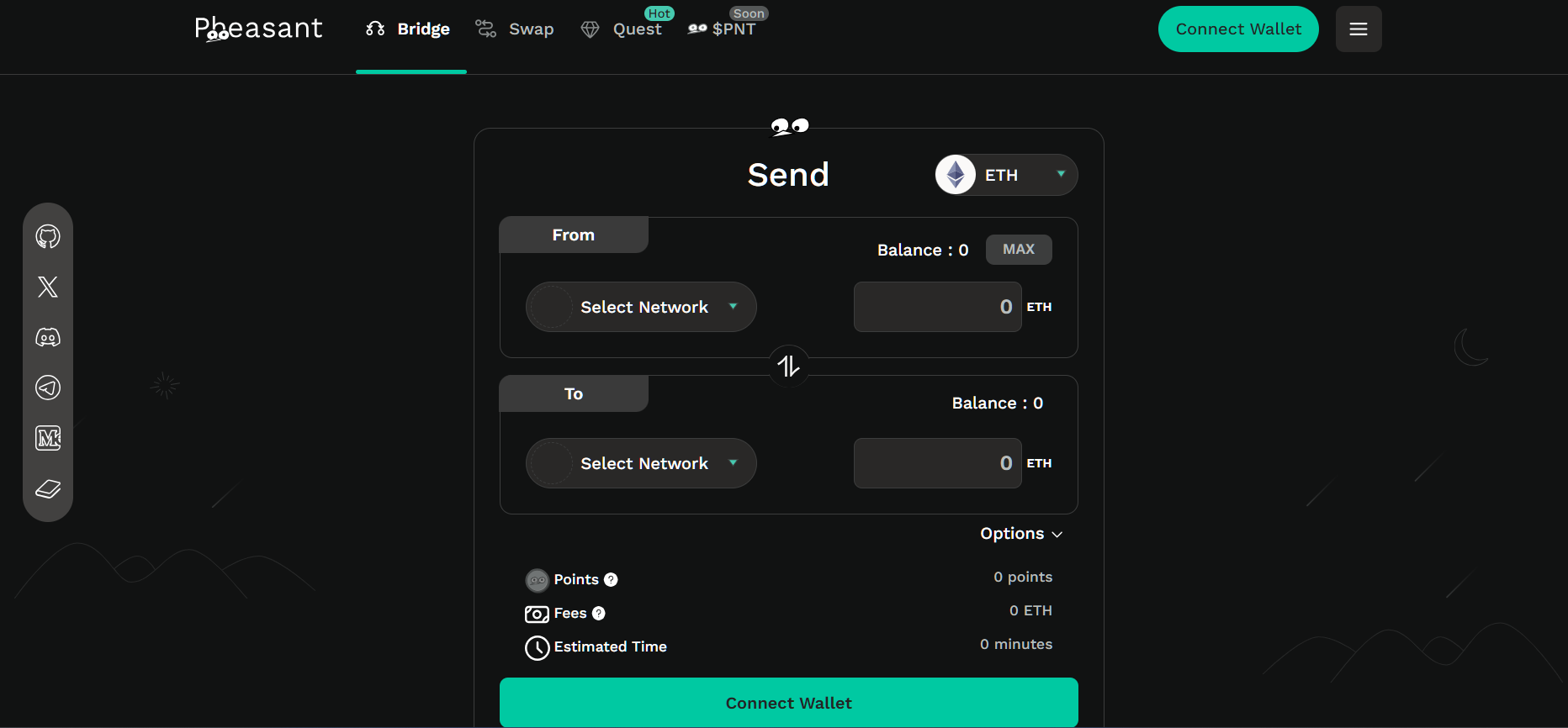
Pheasant Network: purpose and core concept
Pheasant Network is positioned as an interoperability layer for blockchain ecosystems where users increasingly interact with multiple networks simultaneously. With the growth of Layer 2 solutions, modular blockchains, and app-chain architectures, liquidity has become fragmented across dozens of execution environments. This has led to higher operational costs, transaction delays, and increased risks when relying on traditional bridges.
Pheasant Protocol offers an alternative model built around the intent-based approach. Users describe the final outcome, such as receiving a specific token on another network, without having to think about the sequence of technical steps. The protocol handles route coordination, executor selection, and transaction correctness verification. As a result, Pheasant Network functions not merely as a bridge but as an infrastructure layer for multi-chain DeFi and Web3 applications.
Pheasant Network architecture and the intent-based approach
The architecture of Pheasant Network is built around the rejection of a single shared liquidity pool and a strict separation of roles. Instead of centralized asset storage, the protocol relies on independent relayer liquidity pools, each providing its own capital and making autonomous economic decisions. This design reduces systemic risk and limits the impact of potential infrastructure attacks.
The intent-based approach plays a central role in the user experience. Users interact with the interface at the level of outcomes rather than individual transactions. The protocol’s internal logic coordinates off-chain and on-chain processes while ensuring compatibility with ERC-7683 and other intent standards. As a result, Pheasant Network can be easily embedded into wallets, aggregators, and dApp interfaces, abstracting away the technical complexity of cross-chain operations.
Optimistic security model and economic incentives
The security model of Pheasant Network is based on an optimistic assumption of correct execution. A relayer fulfills a user request and records the data on-chain, while the system assumes honest behavior unless a challenge is initiated. Monitoring is handled by the disputer role, which tracks potential violations and can trigger a dispute process within a predefined time window.
Economic discipline is enforced through a bonding mechanism. Relayers are required to lock collateral that can be partially or fully slashed in the event of confirmed misconduct. This approach reduces the cost of continuous validation while preserving strong incentives for honest execution. However, the protocol explicitly notes that slashing may be limited on certain networks, increasing the importance of relayer reputation and informed route selection by users.
Bridge and Swap within the Pheasant Network ecosystem
Within the Pheasant Network ecosystem, Bridge and Swap serve as the primary user-facing tools, complementing each other and operating as a unified cross-chain execution module.
- asset transfers between L1 and L2 to reduce transaction fees;
- liquidity migration across Layer 2 networks;
- cross-chain swaps that deliver the desired token directly on the destination network;
- integration of bridge and swap functionality into dApps and wallets.
Bridge is responsible for transferring value across networks, while Swap combines transfer and exchange into a single intent request. This reduces the number of steps, minimizes user error, and makes cross-chain interactions more accessible to a broader audience. Together, these tools form the foundational infrastructure for multi-chain DeFi.
Ecosystem, standards, and supported networks
Pheasant Network is developed as part of a broader multi-chain ecosystem and is designed to be compatible with intent standards. Support for ERC-7683 enables a unified format for cross-chain requests and simplifies interaction with external protocols and services. The project supports Ethereum and a wide range of Layer 2 networks, making it applicable to most current DeFi use cases.
| Component | Purpose |
|---|---|
| Pheasant Bridge | Cross-chain asset transfers |
| Pheasant Swap | Cross-chain token swaps |
| Relayer | Execution of intent requests |
| Disputer | Dispute and violation challenges |
| ERC-7683 | Intent standard |
| Pheasant Points | User engagement mechanism |
The Pheasant Points system is used to incentivize user activity and may serve as the foundation for future token utility within the project.
Risks, limitations, and future outlook
Despite its advanced architecture, Pheasant Network faces trade-offs typical of cross-chain solutions. Limitations of slashing mechanisms on certain networks, support restricted to standard ERC-20 tokens, and dependence on relayer quality remain key risk factors. Users are advised to carefully review execution conditions and start with smaller transaction sizes.
The project’s future is tied to further development of the intent-based model, the introduction of AI-assisted routing, and the expansion of supported networks. In the long term, Pheasant Network has the potential to become an infrastructure standard for cross-chain DeFi and Web3 applications, where multi-chain interaction becomes a native part of the user experience.











