

8 Ball Clash is PvP game in a virtual billiards format, built around a player-versus-player wagering model and integrated into the StakeClash blockchain ecosystem. The project uses the Solana network to lock in wagers and automatically pay out the winner, focusing not on tokenomics or NFT collecting, but on skill, reaction time, and a fair match outcome. This approach brings 8 Ball Clash closer to classic esports-style arcade games while adding on-chain economics and transparent settlements typical of Web3.
- On-chain PvP billiards
- Web3 8-ball pool arcade
- PvP billiards with wagers on Solana
- Skill-based wagering and fair play
- Arcade gameplay and project development
On-chain PvP billiards
8 Ball Clash occupies a niche in skill-based GameFi, where the financial outcome depends directly on player skill rather than time spent farming or the amount of capital invested. Unlike many Web3 games overloaded with NFT mechanics and complex economies, the project offers a clear and straightforward model: two players, equal conditions, a wager, and a transparent result.
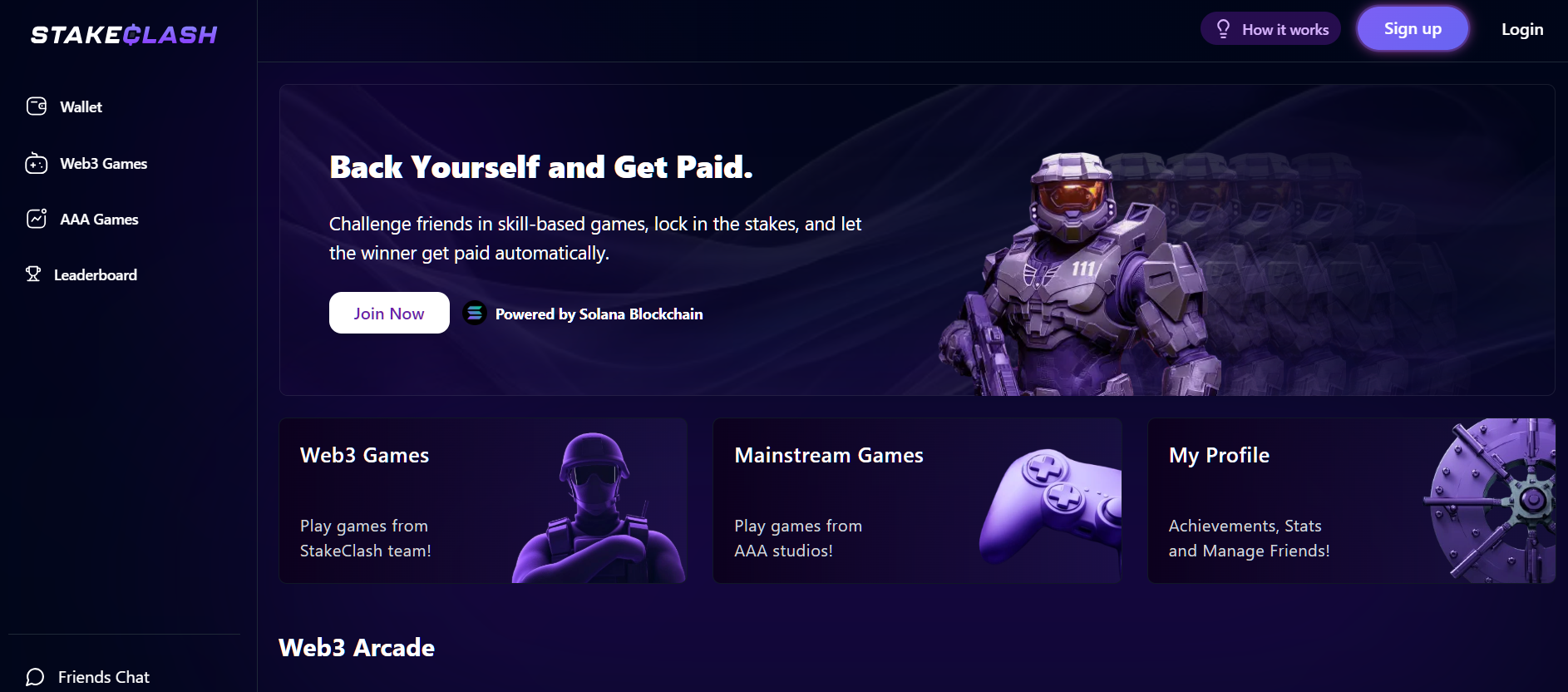
The connection with the StakeClash platform further reinforces this concept. StakeClash is developing an ecosystem of wager-based PvP games focused on familiar, mass-market genres. 8-ball billiards is a recognizable mechanic that requires minimal learning, lowering the entry barrier for a Web2 audience. In this context, 8 Ball Clash serves not as an experiment but as a demonstration of how classic arcade games can be adapted to Web3 without losing pace or enjoyment.
Web3 8-ball pool arcade
The game structure of 8 Ball Clash is designed to gradually guide players from learning the mechanics to full-fledged wager-based matches. The project features several modes that logically complement each other:
-
Solo Mode — a single-player mode without opponents or wagers, intended for practice, learning ball physics, and mastering controls.
-
Free Multiplayer — PvP matches without financial risk, where players compete for experience, ranking, and confidence.
-
Paid Multiplayer — the core mode of the project, where both participants lock in a wager in advance and the winner receives an on-chain payout.
This separation of modes reduces the psychological barrier to wagering and creates a natural player progression path from training to competition. An additional engagement element is the invite system, which allows players to create a match and invite a specific opponent via a link, strengthening the social aspect and making the game convenient for duels between friends.
PvP billiards with wagers on Solana
The financial logic of 8 Ball Clash is built around smart contracts on the Solana network, which handle wager locking and prize distribution. The blockchain is not used to simulate gameplay but rather as a settlement layer, allowing the game to maintain high match speed and avoid technical limitations.
Below is a summary table of the project’s core on-chain mechanics:
| Component | Description |
|---|---|
| Network | Solana |
| Wager asset | SOL |
| Wager lock timing | Before the match starts |
| Prize payout | Automatically after the match ends |
| Transparency | On-chain transaction confirmation |
| Fees | Minimal due to Solana |
Using Solana makes it possible to process a large number of matches at low cost, which is especially important for an arcade-style game. For players, this translates into fast results and no long delays between winning a match and receiving the payout.
Skill-based wagering and fair play
Because the project operates with wagers, fairness and player behavior control are critical. 8 Ball Clash implements a set of rules and technical limitations designed to protect both sides. Match openings are determined randomly, eliminating any consistent advantage from the first break.
Special attention is given to unstable connections. If a player disconnects, they are granted a limited time to reconnect. If they fail to return, the win is awarded to the opponent. This rule protects matches from intentional stalling and technical abuse.
Anti-cheat mechanisms analyze suspicious gameplay patterns. If anomalies are detected, payouts may be temporarily frozen until a review is completed. While this approach can cause delays, it is necessary to maintain trust in the wagering system and prevent abuse, especially in a competitive environment.
Arcade gameplay and project development
In addition to direct winnings, 8 Ball Clash uses a leaderboard system to build long-term motivation for active players. Rankings are updated on a regular basis and encourage repeated participation, turning individual matches into part of a broader competitive landscape.
From a development perspective, the project has several clear growth vectors: expanded tournament formats, deeper social features, seasonal rankings, and integration with other StakeClash games. At the same time, the core value of 8 Ball Clash is already established — a clear, fair, and fast PvP game where Web3 infrastructure enhances gameplay rather than replacing it. This approach makes the project potentially resilient in an increasingly saturated GameFi market.











