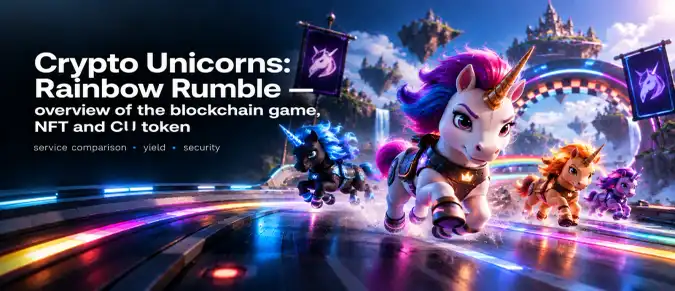

Crypto Unicorns: Rainbow Rumble is a competitive blockchain game developed by Laguna Games as part of the Crypto Unicorns ecosystem. Unlike the original farming game, Rainbow Rumble focuses on short PvP races in which players control unicorns, navigate obstacle courses, use power-ups, and interfere with opponents trying to reach the finish line. The first version appeared in late 2023, and following the migration of Crypto Unicorns from Polygon to the Xai ecosystem, the game launched on Xai in August 2024. The project demonstrates how NFT characters from one Web3 ecosystem can be used across a separate game with a different genre and gameplay model.
Contents
- History and Development of Rainbow Rumble
- Rainbow Rumble Gameplay, Modes, and Obstacle Courses
- NFT Unicorns, Power Ups, and In-Game Resources
- RBW and CU Tokens, Migration to Xai, and the Web3 Economy
- Risks and Prospects of Crypto Unicorns: Rainbow Rumble
1. History and Development of Rainbow Rumble
Rainbow Rumble was developed by Laguna Games, the studio behind Crypto Unicorns. The company was founded in 2019, while its main Web3 game evolved around NFT unicorns and virtual land. In 2021, Laguna Games raised $5 million in a seed round with participation from BITKRAFT Ventures, Delphi Digital, Transcend Fund, Headline Ventures, and Polygon Studios. In March 2022, Crypto Unicorns also completed a $26 million token sale involving several crypto-focused investors.
The original Crypto Unicorns launched on Polygon in 2022 as a collectible and farming-based NFT game. Players could raise and breed unicorns, manage land, produce resources, and use digital characters in additional gameplay loops. Over time, Laguna Games began experimenting with other genres within the same universe.
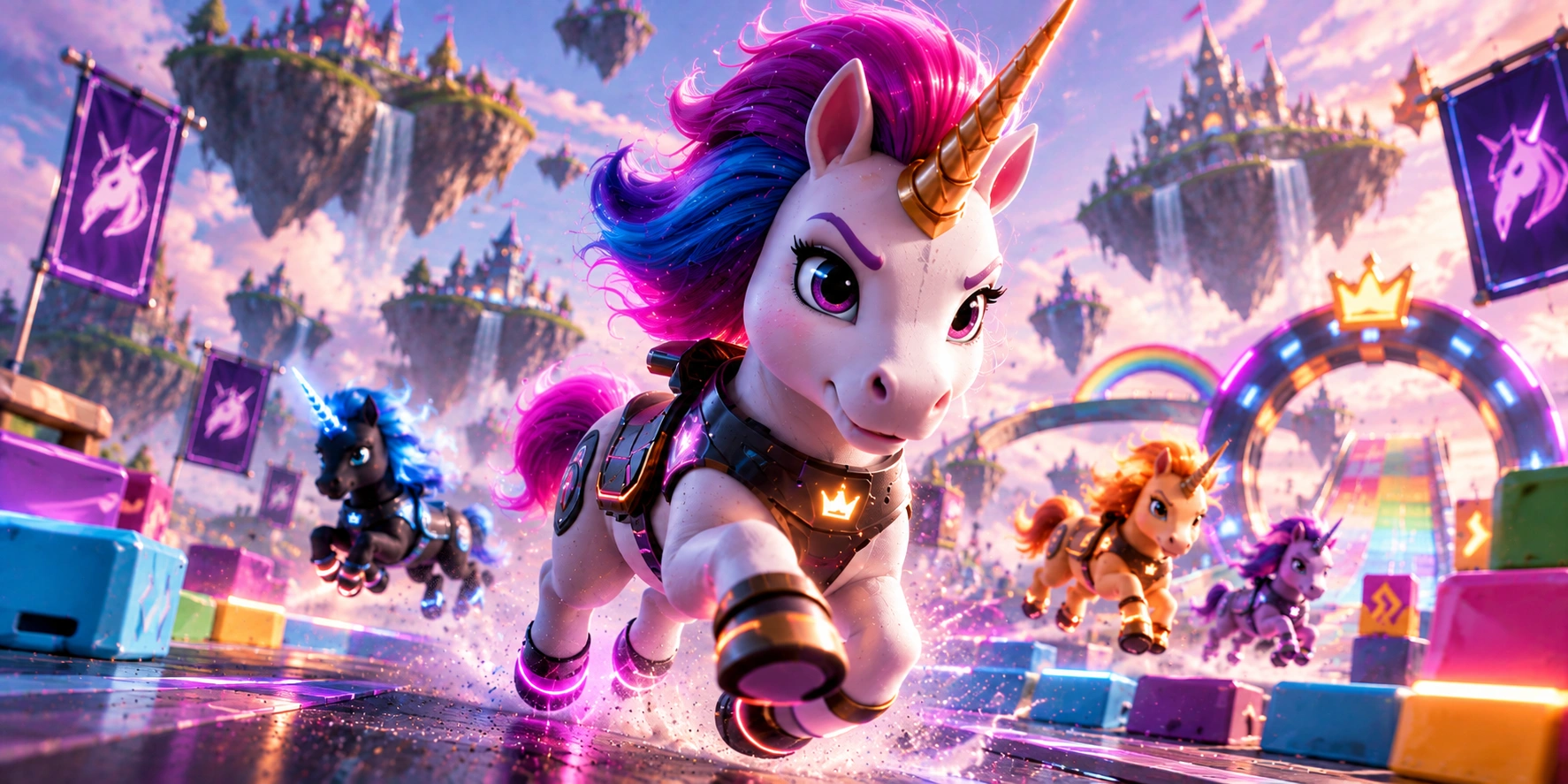
Rainbow Rumble was introduced in November 2023 as a skill-based game and officially launched on December 14. Instead of the slower farming cycle of the original game, the developers focused on short competitive matches built around obstacle courses. Structurally, it follows a battle royale format in which success depends on movement, route selection, special abilities, and interaction with opponents.
In 2024, the broader Crypto Unicorns ecosystem began migrating from Polygon to Xai, a gaming-focused network built using Arbitrum technology. Following the migration of the main game, Rainbow Rumble launched on Xai in August 2024. At the same time, the previous RBW token was replaced by the new CU token, changing the economic layer of the ecosystem as well.
2. Rainbow Rumble Gameplay, Modes, and Obstacle Courses
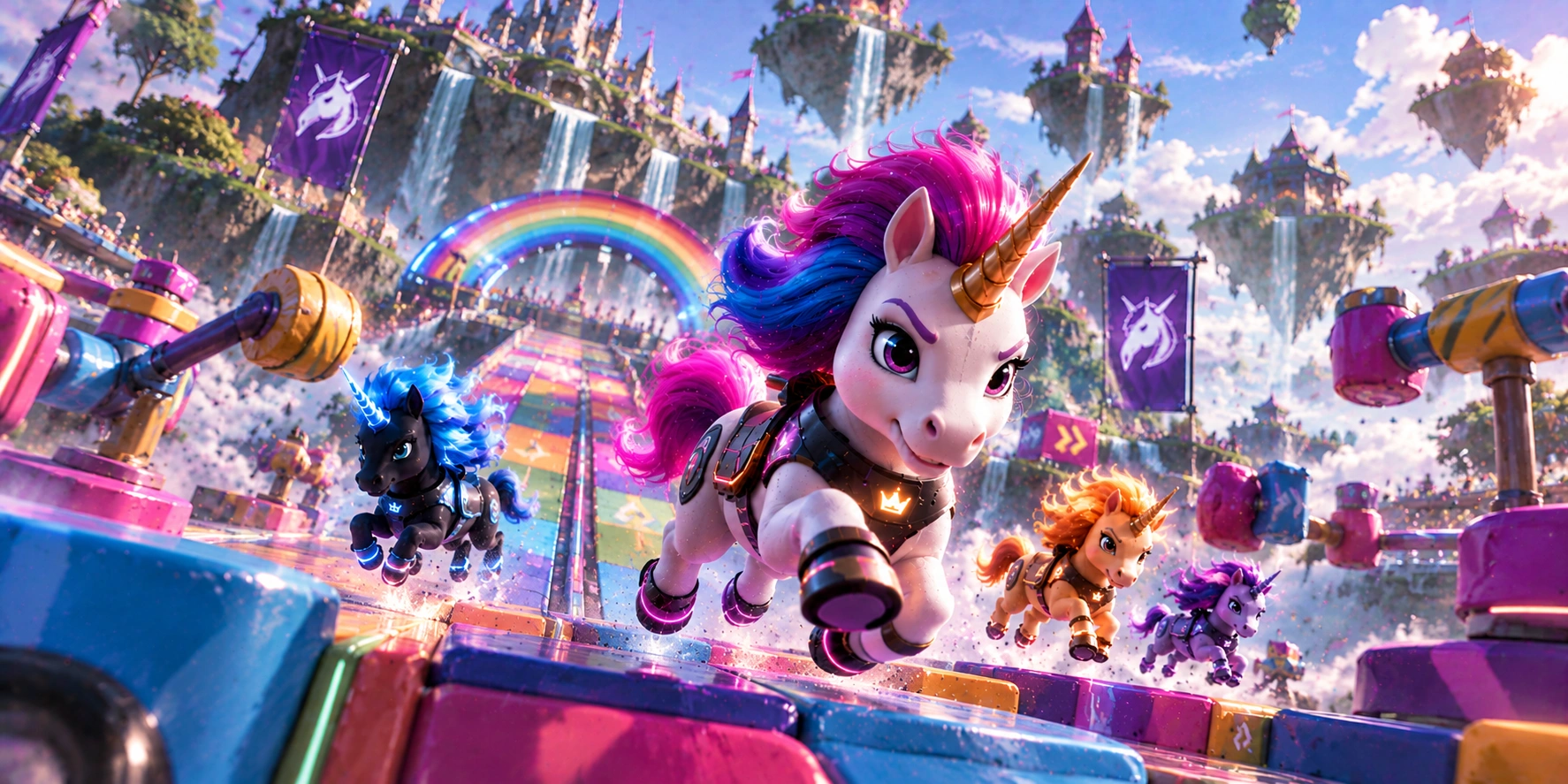
The main objective in Rainbow Rumble is to guide a unicorn through a course filled with moving platforms, traps, gaps, and other obstacles faster than competing players. The player controls the character directly, so the outcome depends not only on digital assets but also on reaction speed, route selection, and the ability to use gameplay mechanics effectively.
The original version featured two primary competition formats: Showdown and Rush. Showdown was a multi-stage competition in which participants completed several courses and were gradually eliminated. A match could begin with a group of up to 20 unicorns, with final positions in the last stage determined by the order in which players crossed the finish line. Rush used a shorter format with a single course and fewer participants.
Key Rainbow Rumble mechanics include:
- competitive PvP races across obstacle courses;
- collisions between unicorns and the ability to push opponents;
- checkpoints after falling from the course;
- multi-stage and shorter match formats;
- Power Ups that affect speed, defense, and character movement;
- leaderboards and competitive events;
- the use of NFT characters from the Crypto Unicorns ecosystem;
- token and in-game rewards in selected modes and events.
In the early Showdown format, players had to complete each stage within a set time limit to advance. Falling did not necessarily result in immediate elimination: the character returned to a checkpoint, although the lost time reduced the chance of qualifying. The ability to collide with other participants added a direct PvP element to the races.
Rainbow Rumble was initially designed as a browser-based game primarily for desktop computers using mouse and keyboard controls. This format made it possible to run a separate gameplay loop without installing a full game client while still connecting the experience to Crypto Unicorns NFTs and wallets.
3. NFT Unicorns, Power Ups, and In-Game Resources
Rainbow Rumble is connected to the main Crypto Unicorns ecosystem primarily through its characters. In the original version, participation in token-based modes required an adult Crypto Unicorn NFT. If a wallet contained several unicorns, the player could select one of them as the character for a race. Ownership of a land NFT was not required.
Power Ups introduced an additional strategic element. They provided temporary gameplay effects: Pegasus increased jump height and reduced falling speed, Shield protected the character from knockback, Dash increased movement speed, and Unicloak temporarily concealed the character from other participants. Unifart created a visual obstruction for opponents. Players could select a limited number of power-ups for each match.
| Component | Purpose | Role in Rainbow Rumble |
|---|---|---|
| Crypto Unicorn NFT | Digital game character | Used as the player's avatar in races |
| Rainbow Medal | Early-version game currency | Entry into selected competitive modes and rewards |
| Marble | In-game resource | Participation in Marble Showdown and purchases in UniMart |
| Power Ups | Temporary boosts | Modify movement, defense, or interaction with opponents |
| RBW | Former ecosystem token | Used in the original Rainbow Rumble economy |
| CU | Crypto Unicorns token after migration | Used in the updated ecosystem and gaming events |
The early version featured two internal currencies: Rainbow Medal and Marble. Rainbow Medals could be earned in matches and exchanged for RBW through an established 1:1 in-game mechanism. Marbles were not designed for external exchange; they were earned through gameplay and used for certain matches and purchases in the UniMart store.
This architecture separated the market-traded crypto asset from closed in-game resources. It allowed some mechanics to operate without requiring direct token interaction for every action. After the ecosystem migrated to Xai, the previous RBW-based system became outdated as RBW was replaced by the CU token.
4. RBW and CU Tokens, Migration to Xai, and the Web3 Economy
When Rainbow Rumble first launched, the Crypto Unicorns economy was connected to Rainbow Token, or RBW. The token was used in the main game, DAO governance, and selected competitions. In Rainbow Rumble's original paid modes, RBW could be converted into internal Rainbow Medals, which were then used as entry fees and distributed among participants depending on match results.
In 2024, Crypto Unicorns carried out a major infrastructure migration. The project moved away from Polygon and transferred its gaming assets to Xai, a gaming-focused network within the Arbitrum ecosystem. The main Crypto Unicorns game relaunched on Xai in June 2024, while the Xai version of Rainbow Rumble followed in August.
At the same time, RBW was replaced by Crypto Unicorns Token, or CU. The migration used a conversion ratio of 10 RBW to 1 CU. The new asset became the primary governance and utility token of the ecosystem. It is used across several Crypto Unicorns gaming systems, while its use in Rainbow Rumble was announced for tournaments, events, and rewards.
The migration to Xai was intended to reduce blockchain-related friction for players. The network is designed as gaming infrastructure using Arbitrum Orbit and focuses on fast operations and the ability to abstract transaction fees. This is particularly relevant for a game built around short matches, where requiring players to separately approve and pay for every blockchain action could disrupt the normal pace of PvP gameplay.
However, token-based competitions introduce additional economic risks. The value of CU depends on the cryptocurrency market, liquidity, and ecosystem activity, meaning that the value of gaming rewards can fluctuate. Participation involving a token entry fee is also fundamentally different from a standard free game mode and requires players to separately evaluate potential costs and outcomes.
5. Risks and Prospects of Crypto Unicorns: Rainbow Rumble
The history of Crypto Unicorns illustrates how quickly Web3 gaming infrastructure can change. The project started on Polygon, later migrated to Xai, replaced RBW with CU, and revised parts of its gaming strategy. In August 2024, Laguna Games also announced the closure of the original land-based core game and a transition toward a different fully on-chain experience. As a result, early materials about the ecosystem do not always reflect its later state.
For Rainbow Rumble, the main risks include the size of the active player base, match availability, token liquidity, and the developers' ability to support a standalone competitive game over the long term. An NFT unicorn can continue to exist on-chain independently of a specific game client, but its practical utility depends on which applications continue to support the asset.
There are also technical risks. Users interact with wallets, tokens, NFTs, and smart contracts, while the ecosystem itself depends on Xai infrastructure and related bridges or services. The migration between networks and the replacement of RBW with CU also demonstrate that the rules governing digital asset utility can change as a project evolves.
Rainbow Rumble is an example of extending a single NFT-based IP beyond its original genre. Instead of creating a new collection of characters, Laguna Games reused existing Crypto Unicorns in a separate PvP game, turning NFTs into transferable elements across multiple gameplay loops. This differs from models in which a digital item is tied to only one game mechanic.
At the same time, the future of Rainbow Rumble depends less on the use of blockchain itself and more on the quality and demand for its competitive gameplay. Migration to Xai reduces some infrastructure barriers, while CU connects the game to the broader Crypto Unicorns economy. However, the sustainability of this model depends on player activity, ongoing support, and real demand for tournaments and NFT characters. When evaluating the project, it is important to consider its evolving structure and distinguish the historical mechanics of the RBW version from the newer Xai-based ecosystem.