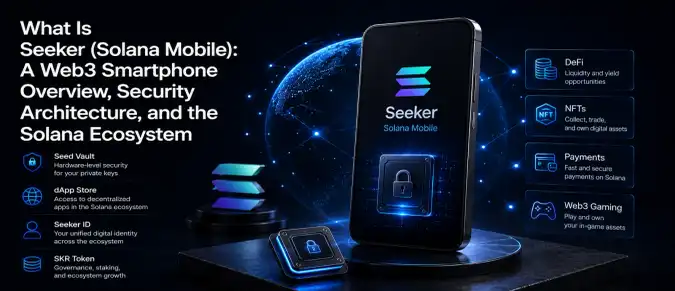

Seeker (Solana Mobile) is a Web3 platform that combines a dedicated mobile device, software infrastructure, and services built around the Solana ecosystem. The project advances the concept of a crypto-native smartphone, where tools for managing digital assets are integrated at both the hardware and software levels. As the successor to the original Saga device, Seeker is designed to simplify user interaction with DeFi, NFTs, payments, gaming services, and other applications running on the Solana blockchain. With its proprietary security architecture and specialized ecosystem, Seeker represents one of the most notable experiments in the emerging Web3 mobile industry.
- What Is Seeker (Solana Mobile)?
- Seeker Architecture and Core Technologies
- Solana Mobile Ecosystem and Platform Features
- Seeker vs. Traditional Smartphones
- Future Development of the Seeker Project
1. What Is Seeker (Solana Mobile)?
Seeker is the second-generation mobile platform developed by Solana Mobile, an initiative created by Solana Labs. Unlike conventional Android smartphones, Seeker is designed from the ground up as a secure gateway to Web3 services. Users gain built-in digital asset storage, access to a dedicated decentralized application marketplace, and a unified digital identity across the Solana ecosystem.
One of the project's primary objectives is to reduce developers' and users' reliance on traditional mobile app stores. Instead, Solana Mobile introduces its own dApp Store, designed specifically for Web3 applications without the high commission structure and strict centralized moderation commonly found in mainstream app marketplaces.
Following the launch of the Saga smartphone, the development team refined the platform's concept. Seeker introduces upgraded hardware, deeper integration with the Solana ecosystem, and broader support for blockchain-based services. Alongside the device, Solana Mobile continues to develop its identity infrastructure, Genesis Token mechanism, and a new governance model for the platform.
2. Seeker Architecture and Core Technologies
One of Seeker's defining features is its hardware-based security architecture. The device uses Seed Vault, a dedicated secure hardware module that isolates cryptographic operations from the main operating system. As a result, private keys remain protected within the secure environment, even when users interact with third-party applications.
Another key component is TEEPIN (Trusted Execution Environment Platform Infrastructure Network). This architecture combines hardware security, software infrastructure, and device verification into a unified framework. Instead of relying solely on a centralized authority, TEEPIN uses cryptographic verification to authenticate devices, system integrity, and application security.
Every Seeker device also includes a Genesis Token, a non-transferable digital identifier confirming the smartphone's membership in the Solana Mobile ecosystem. It provides access to selected services, ecosystem rewards, and exclusive community programs.
Additionally, users receive a Seeker ID, a unified identity that enables personalized interaction across multiple Solana services without the need to create separate accounts for each application.
3. Solana Mobile Ecosystem and Platform Features
Seeker is more than a smartphone—it serves as a complete infrastructure for interacting with Web3 services. The platform focuses on combining modern mobile technologies with the Solana blockchain. It is designed for users who want direct access to crypto services without constantly switching between separate wallets, exchanges, and decentralized applications. In this sense, Seeker functions as a unified gateway to the Solana ecosystem, where security, identity management, and dApp interaction are integrated into the user experience.
Key platform features include:
- Seed Vault hardware wallet for secure digital asset storage;
- Solana dApp Store for Web3 applications;
- Native access to DeFi protocols directly from the smartphone;
- Support for NFTs, blockchain games, and digital collectibles;
- Payment and transfer tools within the Solana network;
- Unified Seeker ID digital identity;
- Genesis Token as a participation mechanism within the ecosystem;
- SKR token integration for ecosystem development and governance.
The ecosystem is further supported by the SKR token, which is designed to align incentives among users, developers, validators, and other network participants. The token is intended for ecosystem governance, staking mechanisms, device verification, dApp Store curation, and continued expansion of the Solana Mobile infrastructure.
This approach creates a dedicated mobile blockchain economy in which the device itself becomes an active component of the Web3 infrastructure rather than simply serving as a gateway to crypto applications.
4. Seeker vs. Traditional Smartphones
Although Seeker is built on Android, it differs significantly from conventional smartphones. The main distinction lies not in hardware specifications but in the deep integration of blockchain functionality throughout the entire platform.
Unlike traditional smartphones, where crypto services operate as third-party applications, Seeker was designed specifically for Web3 from the beginning. This includes secure key management, decentralized application support, digital identity, and seamless interaction with the Solana ecosystem. The table below highlights the primary differences between the two approaches.
| Feature | Seeker (Solana Mobile) | Traditional Android Smartphone |
|---|---|---|
| Private Key Storage | Built-in Seed Vault | Typically unavailable |
| Application Store | Solana dApp Store | Google Play |
| Web3 Integration | Built directly into the platform | Via third-party applications |
| User Identity | Seeker ID | Standard Google account |
| Ecosystem Governance | SKR token and community participants | Centralized platform operator |
| Access to Exclusive Services | Genesis Token | Not available |
At the same time, Seeker remains a fully functional Android smartphone capable of handling everyday mobile tasks. Its primary advantages become most apparent for users who regularly interact with digital assets, decentralized applications, and blockchain services built on Solana.
It is important to note that the long-term success of this model depends on continued ecosystem growth, developer adoption, and the availability of new decentralized applications within Solana Mobile.
5. Future Development of the Seeker Project
Seeker illustrates a potential direction for the evolution of mobile devices, where cryptographic security, digital identity, and blockchain functionality become integral parts of smartphone architecture. Instead of relying on standalone crypto wallets, users gain access to a fully integrated Web3 environment built directly into the device.
Future development of the platform is expected to focus on expanding the Solana Mobile ecosystem, increasing the number of applications available through the dApp Store, implementing the TEEPIN architecture, growing the Guardians network, and extending the role of the SKR token in governance and ecosystem incentives. Another important direction is collaboration with hardware manufacturers to bring the Solana Mobile software platform to additional devices.
At the same time, the project faces several challenges. These include scaling the user base, competing with established mobile ecosystems, adapting to evolving digital asset regulations, and maintaining a high level of hardware security. The long-term adoption of Web3 smartphones will also depend on broader consumer demand for decentralized applications.
Overall, Seeker can be viewed as one of the most comprehensive initiatives at the intersection of blockchain technology and mobile computing. By combining secure hardware, a specialized software platform, digital identity infrastructure, and seamless integration with the Solana ecosystem, the project demonstrates how future mobile devices could evolve to support Web3 applications and digital asset management.











