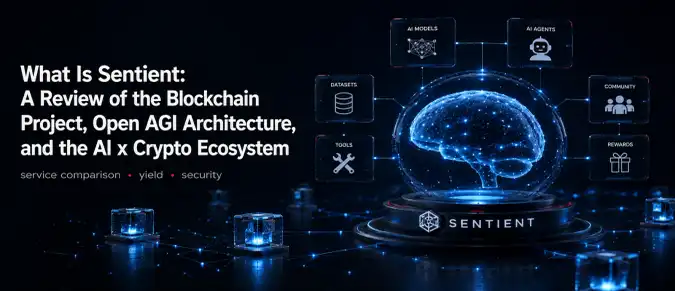

Sentient is a blockchain project that combines artificial intelligence, cryptography, and Web3 infrastructure. Its primary goal is to create an open environment for developing AGI, where models, agents, datasets, and tools can be shared by the community while contributors are recognized and rewarded through the protocol. Rather than treating blockchain as a purely financial layer, Sentient uses it as a mechanism for ownership, coordination, rights management, and AI provenance verification. This approach places Sentient within the growing AI x Crypto sector, where governance and ownership of AI are becoming just as important as model performance.
Contents
- What Is Sentient and What Problem Does It Solve?
- Sentient Architecture: The Grid, OML, and the Role of Blockchain
- Sentient Ecosystem and Network Participants
- Sentient vs. Other AI x Crypto Projects
- Sentient's Future, Risks, and Market Potential

1. What Is Sentient and What Problem Does It Solve?
Sentient positions itself as an open AGI protocol designed to support artificial intelligence that is not controlled by a single company or centralized organization. At its core is the concept of open-source AI with an important addition: developers should be able to monetize their work while keeping their models open and accessible.
A common limitation of open-source AI is the lack of economic protection for creators. Once a model is released, third parties can use it without transparent attribution, revenue sharing, or community oversight. Sentient aims to address this challenge by combining blockchain infrastructure, cryptographic techniques, and AI-native model identification technologies.
Unlike projects that simply add a token to an AI service, Sentient builds a coordination layer connecting models, agents, datasets, tools, and users into a unified ecosystem where every component can be verified, interoperable, and economically linked.
The project gained significant attention after announcing an $85 million seed funding round in 2024. Investors reportedly included Founders Fund, Pantera Capital, Framework Ventures, and several other venture firms, highlighting growing interest in decentralized AI infrastructure within the Web3 ecosystem.
2. Sentient Architecture: The Grid, OML, and the Role of Blockchain
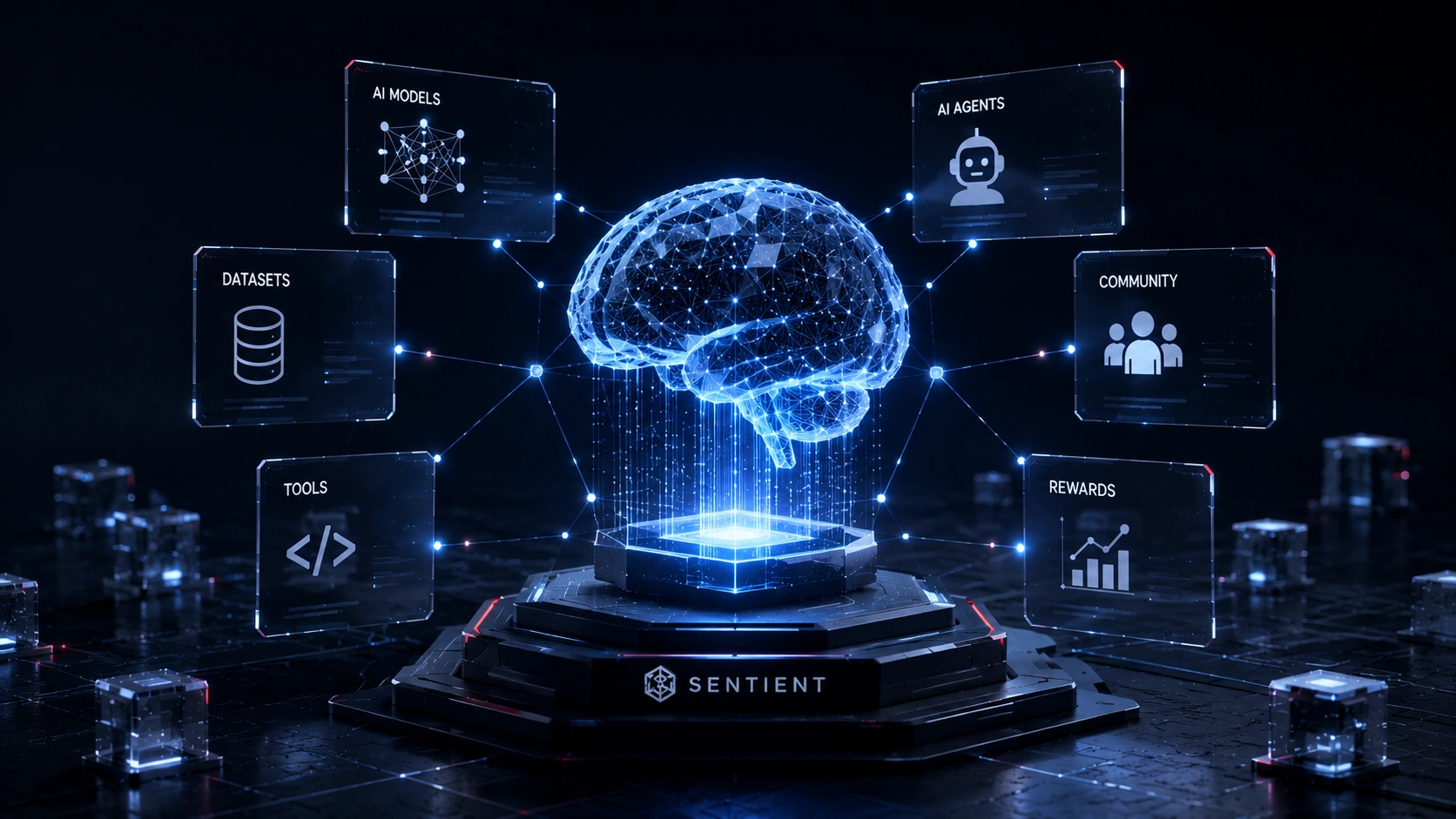
Sentient's architecture consists of several interconnected layers. The first is The Grid, a decentralized network designed to coordinate AI components. Instead of treating an AI model as a standalone product, the protocol organizes models, agents, datasets, tools, and services into reusable building blocks capable of solving complex tasks together.
Another key concept is OML (Open, Monetizable, Loyal AI). It describes an approach in which AI remains openly accessible while preserving ownership, attribution, and monetization mechanisms. A central technology within OML is fingerprinting, which embeds hidden identifiers into AI models to verify their origin and detect unauthorized use.
- The Grid coordinates interoperability between AI artifacts.
- OML enables open, monetizable, and verifiable AI development.
- Fingerprinting helps prove model ownership and detect misuse.
- Blockchain manages ownership records, incentives, staking, and governance.
- The SENT token is designed as a utility token for payments, governance, and protocol participation.
Within this architecture, blockchain serves as a coordination and economic layer rather than a storage solution for AI models. Since large AI models are impractical to store on-chain, blockchain is used to record ownership, distribute rewards, verify interactions, and align incentives across participants.
This design follows the logic of Web3 protocols, where developers build applications on top of a shared infrastructure. The difference is that Sentient coordinates not only digital assets but also AI models, datasets, reasoning processes, and intelligent agents.
3. Sentient Ecosystem and Network Participants
The Sentient ecosystem is designed for multiple participant groups. Developers can build models, agents, and AI tools. Researchers contribute new training techniques, verification methods, and alignment approaches. Users and applications interact with AI artifacts through the protocol, while the community participates in governance, curation, and quality assessment.
An important role is played by the Sentient Foundation, which acts as a neutral coordinator of the open AGI ecosystem. The foundation supports research, community growth, grant programs, and ecosystem development, positioning the project as more than a traditional blockchain startup.
The ecosystem also includes initiatives such as ROMA, OML, and ODS. ROMA focuses on reasoning and orchestration for multi-agent AI systems, while ODS (Open Deep Search) explores open search infrastructure and reasoning agents capable of interacting with external knowledge sources and tools.
For the blockchain industry, Sentient is notable because it combines AI infrastructure, cryptographic model protection, incentive mechanisms, and decentralized governance. Its long-term value, however, will depend on developer adoption and the sustainability of its economic model.
4. Sentient vs. Other AI x Crypto Projects
AI x Crypto includes decentralized compute networks, data marketplaces, AI agents, model-sharing protocols, and blockchain-based incentive systems. Sentient differentiates itself by focusing not only on AI accessibility but also on ownership and monetization of open AI models, making it a more specialized infrastructure project.
Projects within this sector can generally be distinguished by what they coordinate: computing power, datasets, AI agents, models, or ownership rights.
| Criteria | Sentient | Typical AI x Crypto Project |
|---|---|---|
| Main Focus | Open AGI, model ownership, AI monetization | Compute, datasets, AI services, or autonomous agents |
| Role of Blockchain | Ownership, incentives, staking, and governance | Payments, resource accounting, or token issuance |
| Technical Focus | OML, fingerprinting, AI artifact coordination | APIs, GPU networks, marketplaces, or agent frameworks |
| Participants | Developers, researchers, model owners, users, curators | Service providers, users, and token holders |
| Main Challenge | Technical complexity and ecosystem adoption | Token economics and market competition |
Sentient should not be viewed solely as an AI application or a blockchain network. It combines research infrastructure with an economic coordination layer, making successful implementation dependent on developer adoption, practical tools, and sustainable token utility.
Ultimately, the project's success will depend not only on its whitepaper and investors but also on whether The Grid, OML, and related technologies become widely adopted by developers building decentralized AI applications.
5. Sentient's Future, Risks, and Market Potential
Sentient's future is closely tied to the growing demand for open AI models and the broader debate over who controls AI infrastructure. While proprietary AI offers commercial advantages, it also increases dependence on large technology companies. Open AI promotes accessibility but faces challenges related to funding, attribution, and sustainable monetization.
One of Sentient's key strengths is its focus on practical solutions rather than decentralization alone. Technologies such as fingerprinting, OML, and The Grid aim to address ownership, monetization, and coordination of AI assets within a decentralized environment.
However, the project also faces significant challenges. Building reliable infrastructure for model verification, incentive distribution, and governance is technically demanding. In addition, Sentient must demonstrate that its protocol offers tangible advantages over existing open-source platforms, cloud APIs, and proprietary AI services.
Another important consideration is tokenomics. If the SENT token is used for payments, staking, and governance, its value should be supported by real network activity rather than speculation alone. Overall, Sentient represents an ambitious attempt to combine open-source AI, cryptography, and Web3 governance. Its long-term success will depend on whether the team can transform its research concepts into a practical protocol with active users and a sustainable ecosystem.











